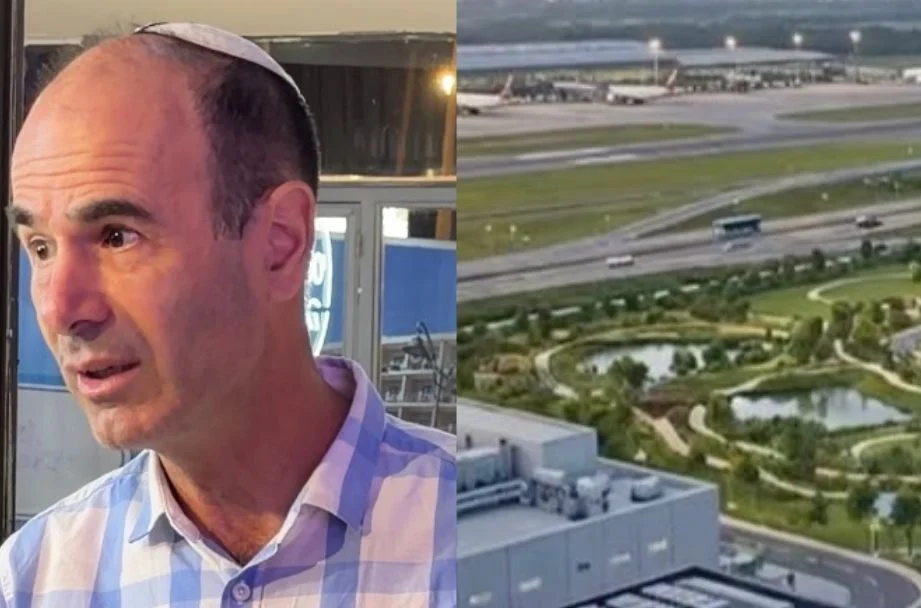


Jerusalem, Israel – The Philippines should seize the opportunities offered by artificial intelligence and the U.S.-led Pax Silica initiative but must carefully manage the enormous energy requirements, environmental impact and other risks that come with rapid technological development, a senior Israeli foreign ministry official said.
In an interview with visiting journalists, Former Israeli Ambassador to the Philippines Ilan Fluss, now policy coordinator for emerging and disruptive technologies at Israel’s Ministry of Foreign Affairs, said governments face a difficult balancing act as they pursue AI development.
“You have two options: Either you progress, move forward with technology, you do it in a smart way, in a planned way, but you want to be on the leading side,” Fluss told journalists in Israel.
“You don’t want to be left behind. If you don’t want to be left behind, be in front. Be the leader,” he added.
Israel is among the countries participating in Pax Silica together with United States, Australia, Japan, South Korea, Singapore, the United Kingdom, the Netherlands, the United Arab Emirates, Qatar, Canada and India.
The Philippines formally joined the initiative in April 2026, becoming its 13th participant.
The partnership covers areas including critical minerals, semiconductors, advanced manufacturing, computing and data infrastructure.
A centerpiece of the Philippine participation is a proposed 4,000-acre, or about 1,620-hectare, AI-focused industrial hub in New Clark City in Tarlac, envisioned to support critical minerals processing, semiconductors, advanced manufacturing and AI infrastructure.
But the scale and nature of the project have also fueled concerns over its electricity and water requirements, environmental footprint, possible displacement of communities and the extent of foreign influence over strategic Philippine resources.
Fluss said Israel is confronting some of the same problems as it expands its own AI capabilities.
“In Israel, we also have challenges of energy,” he said.
“There is a lot of demand for electricity. We know that AI, if you have data centers, etc., you need a lot of energy.”
The official warned that slowing technological development altogether carries its own risks.
“If you don’t go into the AI era, you’ll be left behind,” Fluss said. “So, do you want to stay behind, or do you want to move?”
“If you want to move, you need progress. Fine, but it has to be planned properly.”
Environmental, social concerns
Fluss acknowledged that rapid AI development carries environmental and social risks that governments cannot ignore.
He also pointed to the potential misuse of artificial intelligence and the risk that some sectors could be marginalized as technology transforms economies.
“There are kind of challenges to it, and for this we need to manage the process,” Fluss said.
“Yes, we need to be responsible for the environment. We are certainly aware of that.”
In the Philippines, those concerns have become part of a growing debate over Pax Silica.
Environmental group Kalikasan People’s Network for the Environment has raised concerns over the project’s potential demand for water and electricity, its environmental footprint and possible displacement of Aeta communities and farmers around the development area.
Scientists’ group AGHAM has also challenged government assurances surrounding the project and called for greater scrutiny of its environmental implications.
The Kilusang Magbubukid ng Pilipinas has opposed the project on land, environmental and sovereignty grounds, questioning whether the Philippines could end up primarily providing land and strategic resources for foreign industries instead of developing its own industrial capacity.
Fluss, meanwhile, offered an approach in which governments establish extensive regulation before allowing innovation to proceed.
“When you do the process of innovation, integrate into the process of innovation the issue of regulation,” he said.
Critical minerals in focus
Critical minerals form an important part of the initiative as countries seek more secure supplies of materials needed for batteries, semiconductors, electronics and other advanced technologies.
The Philippines has significant deposits of minerals including nickel, copper and cobalt, raising questions over whether the country will primarily export raw materials or capture more value through domestic processing and manufacturing.
Philippine and Israeli officials have discussed cooperation on critical minerals and AI under Pax Silica, including the possible use of Israeli technologies in mineral exploration, processing and water management.
“Critical minerals are critical. Why are they called critical? Because they are very important for other technologies,” Fluss said.
He cited electric vehicle batteries, radar systems and smartphones as examples of technologies dependent on those resources.
“There are global shortages, so we need to create the value chain of critical minerals accessible to make sure that the economy and the technology should continue to develop and to grow,” he said.
Fluss said artificial intelligence itself could be used in mineral exploration.
Israeli technology could also potentially be used in other stages of the value chain, including extraction, processing and water management, he added.
Palace promises safeguards
The Marcos administration has sought to allay concerns over Pax Silica, saying projects under the initiative would remain subject to Philippine laws and environmental requirements.
Malacañang has said concerns involving foreign influence, water resources, environmental damage and the possible displacement of communities would be addressed as plans move forward.
Palace Press Officer Claire Castro said President Ferdinand Marcos Jr. would ensure that development would not come at the expense of the environment or affected communities.
“Sinisigurado po ng pangulo na lahat po ng gagawin ay naaayon sa batas at hindi po maaaring makasira ito ng ating environment o maka-displace man ng ating mga kababayan nang walang anumang kapalit,” Castro said.
[Translation: “The president is ensuring that everything that will be done is in accordance with the law and that it cannot damage our environment or displace our fellow Filipinos without appropriate measures.”]