

Metro Manila, Philippines – The Philippines remains committed to constructive dialogue with China while standing firm on its positions and national interests as the two countries manage their maritime disputes, the Department of Foreign Affairs said.
Foreign Affairs Assistant Secretary for Asian and Pacific Affairs Marshall Louis Alferez said Manila would keep communication lines with Beijing open and pursue cooperation in areas where interests converge.
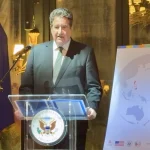
“The Philippines is committed to dialogue and constructive engagement with China, while remaining steadfast to our positions and our national interest,” Alferez said during a reception hosted by the Chinese embassy on Wednesday, Sept. 23, to celebrate the 77th anniversary of the founding of the People’s Republic of China.
He said the country’s approach to relations with China is clear despite differences.
“We must continue to speak candidly and respectfully, uphold our national interests, keep channels of communication open, manage differences responsibly, and pursue cooperation where our interests converge,” the official said.
Alferez cited diplomatic engagements, including meetings with his Chinese counterparts in February and the convening of the Foreign Ministry Consultations and Bilateral Consultation Mechanism on the South China Sea in March.
Foreign Affairs Secretary Theresa Lazaro also held talks with Chinese Foreign Minister Wang Yi in Manila in July.
Alferez said these were needed for “frank exchanges and constructive engagement.”
China’s chargé d’affaires ad interim Zhou Zhiyong similarly called for dialogue in addressing maritime disputes.
“China maintains that maritime issues are not the whole of our relationship,” Zhou said.
“The two countries have both the wisdom and the ability to properly manage our differences through friendly consultation, continuously deepen practical cooperation, and work together to steer bilateral relations back toward a healthy track,” he added.
Zhou described both sides as close neighbors that “cannot move apart” and partners separated by a narrow stretch of sea.
He said the two countries agreed during the July meeting between Lazaro and Wang to seek appropriate solutions to maritime issues through dialogue and work toward improving bilateral relations.
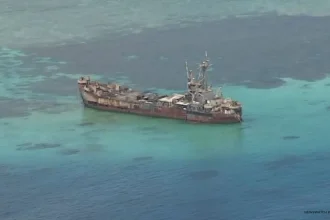
Tensions between Manila and Beijing have persisted because of their overlapping claims in the South China Sea, including areas within the Philippines’ exclusive economic zone.
The Philippines has repeatedly maintained that its maritime claims are anchored in international law and the 2016 arbitral ruling that rejected China’s sweeping claims over much of the South China Sea.
China does not recognize the ruling.
Despite the disputes, Alferez said economic and people-to-people relations remained strong.
He said bilateral trade reached nearly $48 billion in 2025, making China the country’s largest trading partner, the top source of imports, and fourth-largest export market.
Chinese tourist arrivals from January to August 2026 also increased by nearly 70 percent compared with the same period last year, said both officials.