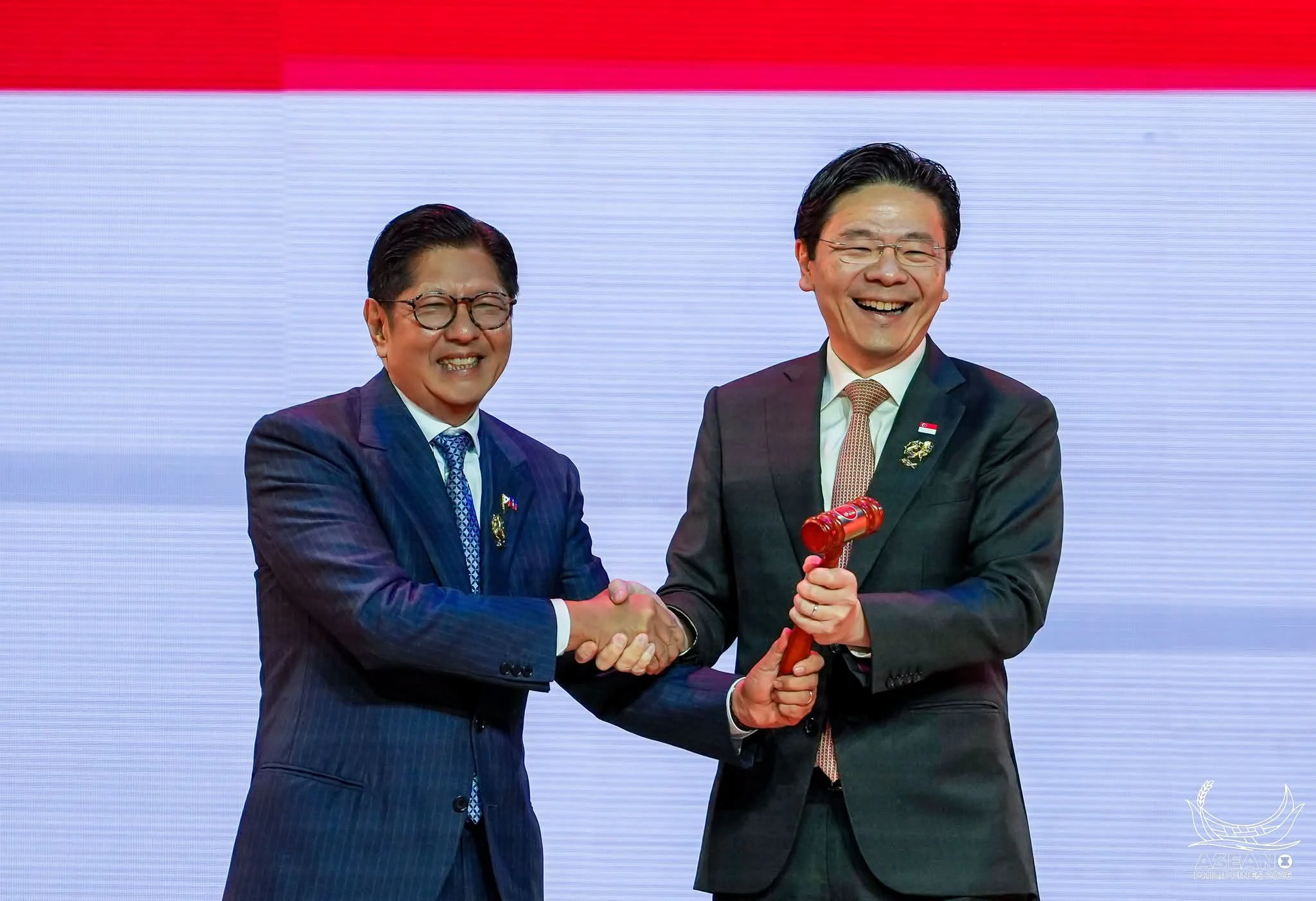


Metro Manila, Philippines – President Ferdinand Marcos Jr. on Tuesday, Nov. 17, concluded the Philippines chairmanship of the Association of Southeast Asian Nations (ASEAN), handing over leadership of the regional bloc to Singapore.
The year was marked by economic agreements, expanded diplomatic cooperation, and unfinished negotiations on a South China Sea Code of Conduct (COC).
Marcos formally turned over the rotating chairmanship to Singaporean Prime Minister Lawrence Wong at the closing ceremony of the 49th ASEAN Summit in Manila, capping three days of high-level meetings among Southeast Asian leaders and major world powers.
The Philippines ended its chairmanship with progress on regional economic integration, digital transformation, energy security and trade cooperation, but fell short of its goal of finalizing the long-awaited COC.
The summit also took place against the backdrop of the Middle East conflict, global trade uncertainty, tensions between major powers, and the political crisis in Myanmar.
Economic and diplomatic gains
ASEAN leaders approved or noted at least 150 documents, covering economic development, regional security, environmental protection and cooperation among its 11 members.
Major outcomes included the signing of the ASEAN Digital Economy Framework Agreement (DEFA), aimed at facilitating cross-border digital trade, electronic payments, data protection and cybersecurity cooperation.
The agreement is expected to help integrate the region’s growing digital economies and expand opportunities for businesses and consumers.
Marcos also highlighted the country’s 19 priority economic deliverables, covering digitalization, artificial intelligence, energy connectivity, resilient supply chains, sustainable development, small businesses and the creative economy.
ASEAN leaders adopted declarations on strategic trade management, critical minerals, cross-border movement of digital talent and cooperation in space science and technology.
The summit advanced plans to establish a Center for Creative Industries, reflecting efforts to expand regional cooperation in culture, innovation and the creative economy.
The Philippines also pursued stronger partnerships with dialogue partners, including the United States, China, Japan, Australia, India, South Korea, and the United Nations.
Energy security amid Middle East conflict
Energy security was a major concern as Southeast Asian economies continued to face the impact of instability in the Middle East.
Marcos called for stronger regional energy connectivity, diversification of energy sources and accelerated renewable energy development to make electricity more reliable and affordable.
ASEAN member states completed the signing of an enhanced memorandum of understanding on the ASEAN Power Grid, a regional initiative designed to expand cross-border electricity trade and strengthen energy infrastructure.
The agreement provides a framework for improving regional electricity connectivity, although implementation will require further investment and infrastructure development.
ASEAN also continued discussions on a proposed regional oil stockpile to prepare member states for potential supply disruptions and emergencies.
The proposal remains under study, with no finalized regional stockpiling arrangement announced during the summit.
Unfinished code
Despite progress on economic cooperation, ASEAN and China failed to finalize the South China Sea Code of Conduct, a major diplomatic push of the Philippines in its chairmanship.
Foreign Affairs Secretary Theresa Lazaro said negotiators reached provisional agreement on more than 80 percent of the paragraphs in the draft code, compared with around half earlier in the year.
However, disagreements remain over substantive issues, including the geographic scope of the agreement and whether its provisions should be legally binding.
Lazaro attributed the delay partly to lack of negotiating time and sensitivities among the parties.
She maintained that the progress achieved under the Philippine chairmanship should not be considered a failure.
The proposed code is intended to establish rules governing conduct in the disputed waters and reduce the risk of confrontations involving China and Southeast Asian claimants.
Negotiations have continued for more than two decades since ASEAN and China signed the Declaration on the Conduct of Parties in the South China Sea in 2002.
ASEAN and China agreed to continue talks, leaving the remaining issues for the incoming Singaporean chairmanship.
Myanmar and other regional challenges
The summit also addressed Myanmar’s political crisis, which has persisted since the military seized power in February 2021.
ASEAN leaders reviewed the implementation of the Five-Point Consensus, the regional peace framework calling for an end to violence, dialogue among parties, humanitarian assistance and diplomatic engagement.
The bloc maintained its emphasis on concrete progress toward implementing the peace plan, although violence and political instability continue to complicate diplomatic efforts.
Leaders also addressed transboundary haze pollution, strengthening cooperation to prevent forest fires and reduce their environmental and public health effects.
The Philippines chaired ASEAN in 2026 under the theme, “Navigating Our Future, Together,” with priorities focused on peace and security, economic prosperity and people empowerment.