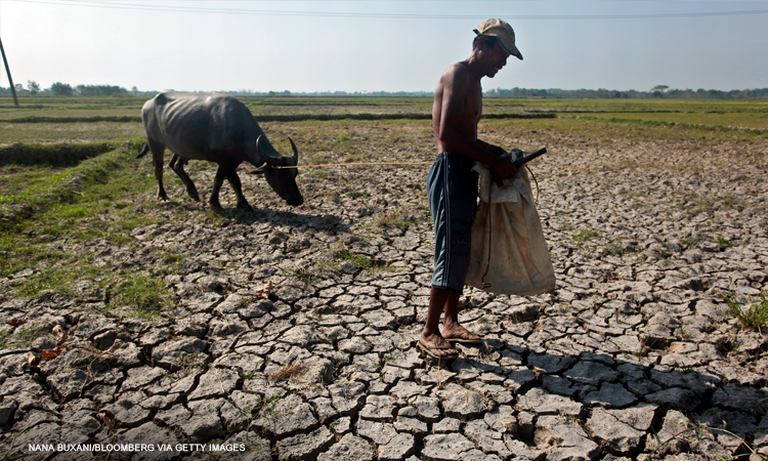


Metro Manila, Philippines – All provinces in the country may encounter drought by the end of March 2027 as a result of a strong El Niño, raising concerns over water supply, a Cabinet official said on Monday, Oct. 5.
Officials said the forecast does not mean a looming water crisis, noting that the severity will depend on available water reserves and conservation measures in the coming months.
Science and Technology Secretary Renato Solidum Jr. said seven provinces have exhibited drought as of September, and the number may rise as below-normal rainfall becomes extensive.
“Okay, by the end of March, lahat ng probinsya,” Solidum said when asked about the extent of the drought.
[Translation: Okay, by the end of March, all provinces]
Solidum said a strong El Niño has developed in the Pacific and will impact the country through the first half of 2027. Government forecasts show rainfall conditions worsening through March, with more areas receiving significantly less rain than normal.
The forecast refers to meteorological drought, which is based on rainfall deficiency. It does not necessarily mean reservoirs, groundwater sources or local water systems will immediately run dry.
The Philippine Atmospheric, Geophysical and Astronomical Services Administration (PAGASA) classifies an area as under drought when it registers three consecutive months of rainfall more than 60 percent below normal. Drought can also be declared after five consecutive months of below-normal rainfall.
“So talagang mas kakaunti ang tubig na babagsak,” Solidum said.
[Translation: “So there will really be significantly less rainfall.”]
Asked whether the nationwide drought forecast may result in a repeat of the 2019 water crisis, Solidum said the outcome would depend on how the country manages supply.
“How much we manage it, how much we conserve will be affecting whether we have a crisis or not,” Solidum said. “Balance iyan ng available at gastos natin.”
[Translation: “It is a balance between what is available and how much we consume.”]
Environment Secretary Juan Miguel Cuna pointed to Angat Dam, the source of about 90 percent of Metro Manila’s water supply.
Cuna said Angat fell to about 150 meters in July, lower than the 157-meter level recorded during the 2019 water crisis. Metro Manila did not experience water interruptions at the time, which he attributed to lower consumption.
Angat has since recovered to about 208 meters following successive typhoons.
Still, the Department of Environment and Natural Resources (DENR) is preparing additional conservation measures ahead of the expected drought.
Cuna said the government is considering directing agencies and government instrumentalities to implement stricter water conservation measures.
“Posibleng magbigay ng directive sa mga government agencies and its instrumentalities of government na to implement strict conservation measures,” Cuna said.
[Translation: “It is possible that a directive could be issued to government agencies and instrumentalities to implement strict conservation measures.”]
The DENR also plans to reiterate its directive for golf courses to use recycled water. Officials are looking at reducing other non-essential uses, including car washing, watering driveways and the use of water in swimming pools.
“Hindi puwedeng business as usual,” Cuna said. “Kailangan po every individual, lahat ng mamamayan, gawin natin ang part natin by conserving water.”
[Translation: “It cannot be business as usual. Every individual, every citizen, must do their part by conserving water.”]
The government has not discussed declaring a climate emergency despite the nationwide drought forecast.
“Hindi pa naman, wala namang napag-usapan na ganiyan kanina,” Cuna said. “But ang directive is paghandaan na po natin iyong worst-case scenario.”
[Translation: Not at this point. Nothing like that was discussed earlier. But the directive is for us to prepare for the worst-case scenario.]
President Ferdinand Marcos Jr. met officials from the Department of Agriculture, Department of Health, Department of Environment and Natural Resources, Department of Science and Technology, PAGASA, and Office of Civil Defense on Monday.
He directed agencies to step up preparations for the dry season through March 2027 and strengthen public information on measures to mitigate the effects of El Niño.