

Metro Manila, Philippines – President Ferdinand Marcos Jr. ruled out allowing the United States to launch attacks from Philippine territory in the event of a conflict over Taiwan, saying the country would focus on defending itself and maintaining regional stability.
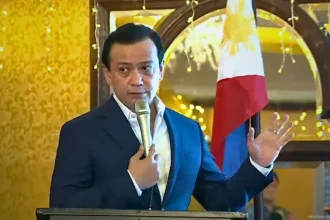
“No, there will be no attacks on anyone from the Philippines. The Philippines has no desire to be a belligerent nation in the region,” Marcos said during the Foreign Correspondents Association of the Philippines presidential luncheon on Friday, Aug. 14.
Marcos was asked whether he would allow the U.S. military to use bases and other facilities in the Philippines to launch offensive operations should China invade Taiwan.
“We have no interest in that. All we are concerned about is the defense of our territory and the maintenance of peace and stability in the region,” Marcos said.
“So, to allow an attack on anyone from the Philippines is contrary to that policy,” he added.
The Philippines and the U.S. are bound by the 1951 Mutual Defense Treaty and the Enhanced Defense Cooperation Agreement, or EDCA.
Under EDCA, the U.S. has access to nine agreed locations in the Philippines, including sites in Cagayan and Isabela in northern Luzon, relatively close to Taiwan. The agreement allows the rotational presence of U.S. forces and the prepositioning of equipment but does not establish permanent American bases.
Marcos said Manila’s defense partnerships should remain focused on protecting Philippine territory and sovereign rights.
When asked what more the U.S. and other partners could do to strengthen deterrence, Marcos said the Philippines would continue to avoid becoming a belligerent party.
“When it involves the Philippines, again, we hew back to that policy where we are not interested in being a belligerent force,” Marcos said.
“We are simply interested in the defense of the Republic, the continued exercise of our sovereign rights, and the recognition of our territorial imperatives,” he added.
Marcos’ position against allowing attacks from Philippine territory does not mean Manila expects to remain unaffected by a conflict across the Taiwan Strait.
The president has previously warned that the Philippines could not stay out of the consequences of such a conflict because of the country’s geographic proximity to Taiwan and the presence of Filipinos on the island.
The northernmost Philippine islands are roughly 150 kilometers from Taiwan, while more than 150,000 Filipinos live and work there, making their safety and possible evacuation a major concern for Manila in any contingency.
The Philippines also maintains a One China Policy, recognizing the People’s Republic of China as the sole government of China, while maintaining economic and unofficial relations with Taiwan.
“We continue to respect and to behave with that policy as the dominant principle in the treatment of both the People’s Republic and our more local engagements with Taiwan,” he said.