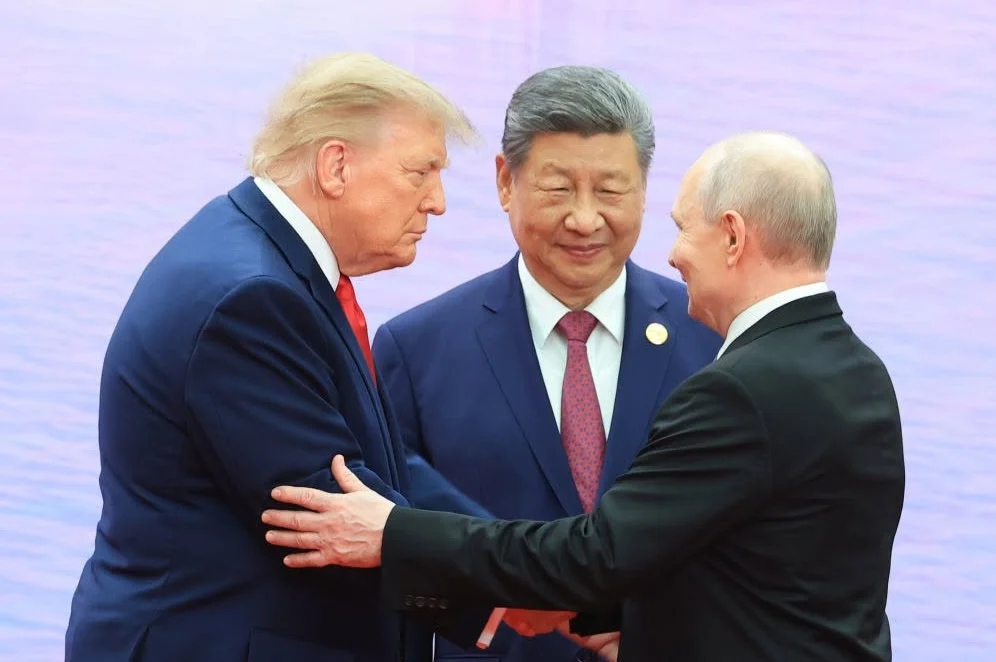


Shenzen, China (Viory News)– Chinese President Xi Jinping, U.S. President Donald Trump and RussianPresident Vladimir Putin held their first-ever trilateral meeting Thursday, Nov. 19, bringing together the leaders of three major nuclear powers for discussions on global security, nuclear arms control and international conflicts.
The unprecedented meeting took place on the sidelines of the Asia-Pacific Economic Cooperation (APEC) Economic Leaders’ Meeting in Shenzhen, where the three leaders emphasized their shared responsibility to maintain international peace and stability despite differences over major geopolitical issues.
Xi described the gathering as “groundbreaking,” saying cooperation among major powers was essential to preventing conflicts and maintaining global order.
“Today, more than sixty regional conflicts around the world continue to drag on. History has taught us that when major powers cooperate, the world is at peace; when they clash, the world falls into chaos,” Xi said.
The Chinese leader invoked the countries’ cooperation during World War II, arguing that their historical experience demonstrated the importance of working together to address international security challenges.
Putin echoed the historical reference, saying China, Russia and the United States share a responsibility to preserve the international system established after the war.
“Our three states are united not only by the status of victorious countries in the Second World War, but above all by a shared responsibility for maintaining international peace and security,” Putin said.
He noted that the three countries played important roles in establishing the United Nations and should work to uphold international law and the principles of the United Nations Charter.
The Russian president said discussions would cover global and regional economic relations, food security, energy security and international conflicts, including the war in Ukraine.
“Our countries have many common interests in terms of resolving regional conflicts, including, of course, the conflict in Ukraine,” Putin said.
The Ukraine conflict remains a major source of tension between Moscow and Western governments, with Russia’s full-scale invasion in 2022 triggering extensive international sanctions and continuing military assistance to Kyiv from the United States and European partners.
Trump, meanwhile, emphasized the importance of maintaining communication among the world’s major powers, particularly on issues affecting international security.
“Presidents of three of the world’s largest countries, we have a special responsibility to maintain open, respectful and productive dialogue on issues impacting not just our people, but the entire planet,” Trump said.
The U.S. president identified nuclear arms control as a major area for potential cooperation.
“The United States, Russia, and China are uniquely positioned to discuss how to reduce the number of nuclear weapons on Earth, and also to lessen the risk that those weapons will ever be used,” Trump said.
The three countries possess substantial nuclear capabilities, although the United States and Russia account for the overwhelming majority of the world’s nuclear weapons.
Efforts to establish new arms control arrangements have faced challenges amid deteriorating relations between Washington and Moscow and growing concerns over China’s expanding nuclear arsenal.
Trump did not announce a specific nuclear arms reduction agreement during the opening remarks.
Instead, he said the leaders had already discussed several issues and had more matters to address.
“There is a great deal to discuss, and we’ve already discussed a lot,” Trump said.
The trilateral talks were also expected to address trade, technology, Iran and other geopolitical challenges, although the opening statements did not establish whether the leaders had reached agreements on those issues.
The meeting comes amid intensifying competition among the three countries over economic influence, advanced technologies and international security.
China and the United States remain major economic competitors, while Russia’s war in Ukraine continues to strain Moscow’s relations with Washington and its allies.
Despite these differences, the three leaders presented dialogue as necessary to managing global risks.
The gathering also comes as China hosts the 33rd APEC Economic Leaders’ Meeting, which brings together representatives of 21 Asia-Pacific economies to discuss trade, investment and regional economic cooperation.
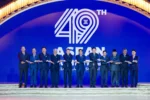
The Philippines is among the participating economies, with President Ferdinand Marcos Jr. attending the summit following Manila’s hosting of the 49th Association of Southeast Asian Nations (ASEAN) Summit.
For Southeast Asian countries, the meeting among the three powers comes amid continuing concerns over maritime security, economic competition and the impact of major-power rivalries on regional stability.
However, the leaders’ opening statements did not announce a specific agreement concerning the South China Sea or the broader Indo-Pacific security situation.
The trilateral meeting marks a diplomatic development, but its significance will ultimately depend on whether the discussions produce concrete agreements on nuclear arms, international conflicts and economic cooperation.