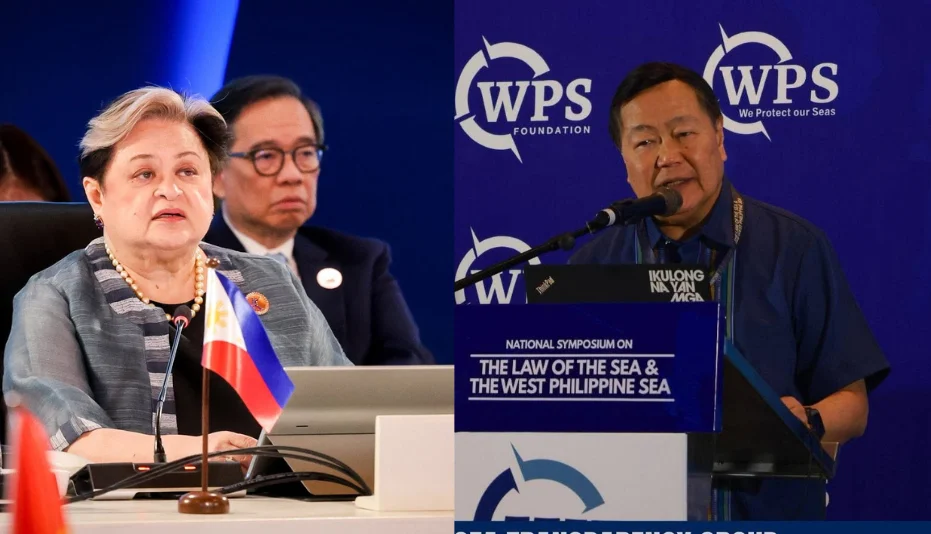


Metro Manila, Philippines – The Department of Foreign Affairs (DFA) rejected former Supreme Court Associate Justice Antonio Carpio’s accusation that the government committed “treason” by supporting a United Nations treaty on marine biodiversity, saying his criticism was based on a fundamental misunderstanding of the agreement and poses no threat to Philippine maritime rights.
In a four-page statement, the DFA took “strong exception” to Carpio’s remarks during a television interview on June 12, where he accused the department and the government of “dereliction of duty, treason, and sleeping on the job” over the Agreement on the Conservation and Sustainable Use of Marine Biological Diversity of Areas Beyond National Jurisdiction (BBNJ Agreement).
“Justice Carpio’s statements rest on a fundamental misreading of the BBNJ Agreement and a conflation of distinct maritime zones under UNCLOS, most critically, the confusion of the High Seas with the Exclusive Economic Zone,” the DFA said.
The department said the deal applies only to areas beyond national jurisdiction and does not affect the maritime zones of coastal states, including the Philippines’ exclusive economic zone (EEZ).
The DFA also disputed Carpio’s statement that the country risks losing portions of its EEZ if it fails to formally object to China’s declaration upon ratifying the treaty.
“Justice Carpio’s warning that the Philippines ‘stands to lose our own EEZ’ if it does not file a protest is without legal foundation,” the department said.
“The Philippines’ EEZ is defined and protected under UNCLOS — not by the BBNJ Agreement — and cannot be diminished, forfeited, or otherwise affected by the country’s implementation of the BBNJ Agreement.”
Carpio had also urged the government to formally challenge China’s declaration on the treaty, arguing it could affect Philippine interests in the South China Sea.
But the DFA said China’s declaration does not explicitly mention the South China Sea and that Carpio’s interpretation goes beyond the actual text.
“It bears noting that China’s declaration does not explicitly mention the South China Sea; this is Justice Carpio’s own interpretation,” the DFA said.
The department further argued that China’s sweeping maritime claims had already been settled under international law.
“There is no longer any unresolved maritime dispute with respect to China’s sweeping claims in the South China Sea: the 2016 Arbitral Award conclusively held that China’s nine-dash line is incompatible with UNCLOS and carries no legal force,” it said.
“Simply stated: the Philippines’ maritime zones are not at risk,” the DFA said.
The DFA also defended the government’s handling of the treaty negotiations, saying the Philippines consistently maintained that the agreement applies only to pockets of high seas beyond national jurisdiction and actively opposed provisions that could allow disputed maritime claims to block its implementation.
It added that the country’s position on the BBNJ Agreement was the result of consultations involving multiple government agencies, including the Department of Justice, Department of Environment and Natural Resources, Bureau of Fisheries and Aquatic Resources, non-government organizations and other stakeholders.
“The national interest has been and remains the primary consideration guiding all decisions,” the DFA said.
While acknowledging Carpio’s contributions to jurisprudence and legal scholarship, the DFA said greater care is needed when discussing issues of national importance.
“The Filipino public deserves accurate and well-grounded information,” the department said, adding that the government remains committed to protecting Philippine sovereignty, sovereign rights and jurisdiction in its maritime zones.
The BBNJ Agreement is a UN treaty aimed at conserving and sustainably using marine biodiversity in areas beyond national jurisdiction, commonly known as the high seas.