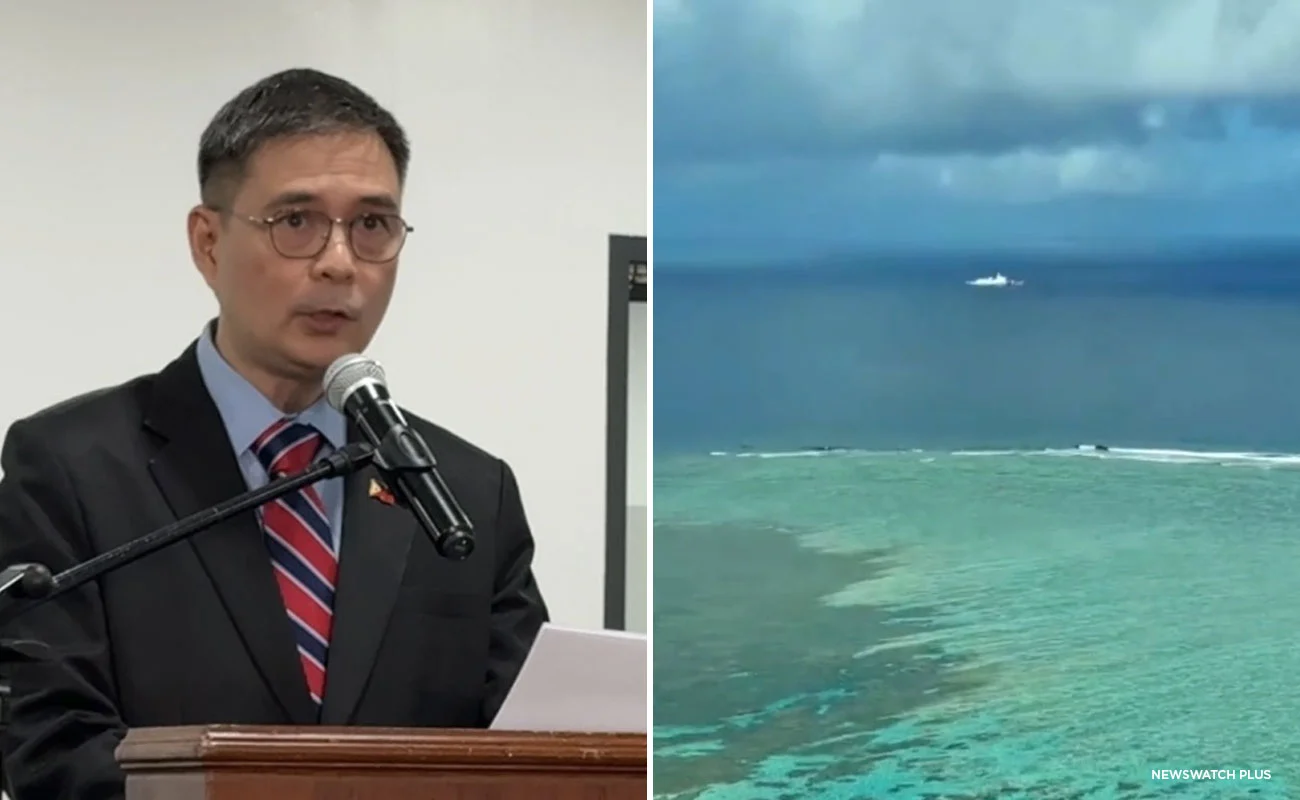


Tel Aviv, Israel – The Department of Foreign Affairs is leaving it to security agencies to determine the continuance of a provisional deal with China on resupply missions to a grounded vessel that serves as an outpost in the West Philippine Sea, in light of a renewed confrontation at Ayungin Shoal.
The DFA said the Armed Forces of the Philippines and the Philippine Coast Guard are in the best position to assess whether the Provisional Understanding on Rotation and Resupply, or RORE, for troops at the BRP Sierra Madre is still needed.
“The Department defers to the security sector on the Understanding’s continued implementation, should they deem this necessary,” the DFA said in a statement on Tuesday, Aug. 11.
The department also ruled out applying a similar arrangement to other areas in the West Philippine Sea.
“There is no intention to replicate the arrangement elsewhere in the Philippine maritime domain,” it said.
The statement comes amid renewed scrutiny of the confidential understanding reached by Manila and Beijing in July 2024 following a series of confrontations during Philippine missions to resupply troops stationed aboard the commissioned vessel.
The arrangement covers the rotation of personnel and delivery of essential supplies to the grounded Philippine Navy ship at Ayungin Shoal.
The DFA said 15 RORE missions have been completed without incident under the arrangement and noted that the AFP and PCG have been involved in its implementation.
It added that operational decisions, including “scheduling, routes, vessel deployment, and determination of supplies and personnel,” belong entirely to the security agencies and not the DFA.
Former Supreme Court Senior Associate Justice Antonio Carpio has urged the government to abandon the arrangement, arguing that the Philippines should not operate under conditions imposed by China when resupplying its own troops.
Carpio later reiterated his position after the DFA invited him to raise his proposed alternatives directly with the AFP and PCG.
He said the AFP can resupply through airdrops, drones and fast boats.
The DFA, however, described his criticism as “misplaced” and said the alternatives he proposed had already been considered.
“His proposed alternatives, such as airdrops, drones, fast boats, were studied and weighed before and throughout the Provisional Understanding’s implementation,” the department said.
“We welcome him to raise these directly with the Armed Forces of the Philippines and the Philippine Coast Guard, who are best placed to assess their operational feasibility.”
Questions over secret terms
Scrutiny of the arrangement intensified after journalist Marites Dañguilan Vitug raised questions in a Rappler opinion piece over what Manila and Beijing had actually agreed to and how the arrangement operates on the ground.
The terms of the provisional understanding have not been publicly released.
Vitug noted conflicting descriptions from Manila and Beijing over whether the Philippines provides prior notification of resupply missions and whether China is allowed to verify what Philippine vessels are carrying.
The DFA took issue with some of Vitug’s assertions, saying previous government statements had already addressed them.
“Commentary of this kind, offered in good faith, is a healthy and welcome part of journalistic scrutiny,” the DFA said.
“But there is a difference between scrutiny and the deliberate sowing of doubt and division to cast aspersion on the government’s work in the national interest.”
“The Provisional Understanding was crafted expressly without prejudice to the Arbitral Award,” it said.
The DFA also disclosed that the arrangement was formulated “with the knowledge of the highest levels of the Philippine Government.”