

Metro Manila, Philippines – Ten years after the Philippines secured a landmark legal victory at The Hague, the 2016 arbitral ruling under the United Nations Convention on the Law of the Sea (UNCLOS) remains one of the country’s most significant achievements in defending its sovereign rights in the West Philippine Sea.
To mark the 10th anniversary of the ruling, the docu-series The Unsinkable Spirit’s first episode, “The Thin Blue Line,” shows that the decision was more than a diplomatic triumph — it continues to shape the lives of millions of Filipinos whose food security, livelihoods, and future depend on the country’s maritime resources.
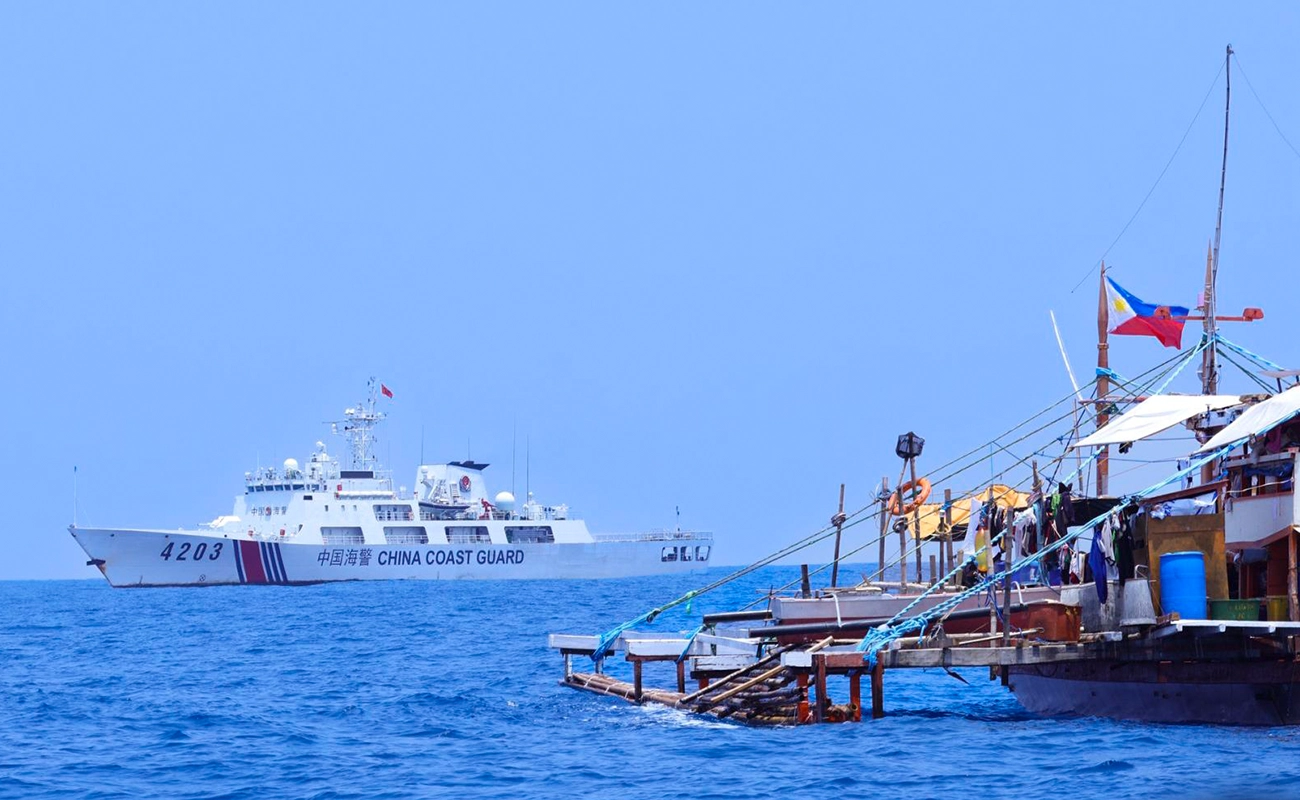
The path to that historic decision began in 2012 at Scarborough Shoal (Bajo de Masinloc), when Philippine and Chinese vessels became locked in a tense standoff after Philippine authorities attempted to apprehend Chinese fishermen engaged in illegal activities within Philippine waters. What could have escalated into armed conflict instead became a defining test of diplomacy, restraint, and international law.
Retired General Juancho Sabban, former commander of the Western Command (WESCOM), recalled the importance of avoiding military confrontation during the crisis.
“The first step should be the diplomatic approach, because if we go for gray-to-gray, it might trigger not only conflict between two countries — it might even provoke a regional conflict,” Sabban said.
For generations of Filipino fishermen, Scarborough Shoal was more than a disputed maritime feature. It was a source of livelihood and a place of refuge during storms.
Leonardo Cuaresma, a veteran fisherman from Zambales, remembered a time when fishermen freely sailed and worked in the area.
“We didn’t experience anyone bullying us, except when tensions with China began and eventually led to the standoff,” he said.
Retired Rear Admiral Rommel Jude Ong, who oversaw operations during the incident, described how Philippine forces carefully documented their actions while enforcing maritime laws. As tensions rose, authorities adopted a “white-on-white” approach, replacing naval vessels with Coast Guard ships to reduce the risk of escalation.
According to Philippine Coast Guard Commandant Admiral Ronnie Gil Gavan, that strategy reflected the country’s commitment to peaceful law enforcement.
“White-to-white means the chances of a shooting war are reduced,” Gavan explained. “Our strength lies in our moral high ground.”
Retired Admiral Alexander Pama, then Flag Officer-in-Command of the Philippine Navy, emphasized that the objective was never surrender but de-escalation.
“The objective was de-escalation without surrender,” Pama said, noting that the Navy continued to assert Philippine sovereignty even after the standoff. “We still have sovereign rights over those areas.”
As the maritime confrontation intensified, the Philippines chose a different battlefield: international law.
Senior Associate Justice Antonio Carpio, one of the country’s foremost advocates for maritime rights, proposed bringing China before an UNCLOS arbitral tribunal.
“I proposed that we should bring China to an UNCLOS tribunal to question the Nine-Dash Line,” Carpio recalled. “It was because of Scarborough that this was filed.”
On January 22, 2013, the Philippines formally initiated arbitration proceedings before the Permanent Court of Arbitration in The Hague. Three years later, on July 12, 2016, the tribunal ruled overwhelmingly in favor of the Philippines, invalidating China’s expansive Nine-Dash Line claim and affirming the country’s rights within its 200-nautical-mile Exclusive Economic Zone.
Carpio stressed the importance of the ruling for ordinary Filipinos.
“The Exclusive Economic Zone grants exclusive rights to fish, energy, and resources,” he explained.
“You can only claim based on UNCLOS — 12 nautical miles of territorial sea and a 200-nautical mile Exclusive Economic Zone.”
The significance of the ruling extends far beyond legal principles. The West Philippine Sea lies within the Philippines’ 2.2-million-square-kilometer Exclusive Economic Zone, an area rich in fisheries, biodiversity, and potential energy resources. It supports livelihoods, contributes to food security, and serves as a critical maritime corridor for global trade.
For many Filipinos, the West Philippine Sea is what advocates now call “MANA” — a living inheritance passed from one generation to the next. The episode tracing the Scarborough Shoal standoff portrays the maritime struggle not merely as a territorial dispute but as a fight for food,
livelihood, identity, and national survival. Through the testimonies of military leaders, fisherfolk, and policymakers, it shows how restraint, diplomacy, and the rule of law became the country’s strongest weapons.
Ten years after the arbitral victory, the challenges in the West Philippine Sea remain. Yet the ruling continues to provide the Philippines with a powerful legal foundation recognized by much of the international community.
As Carpio put it, the victory gave the country something more enduring than military might: “The Nine-Dash Line cannot prevail over our Exclusive Economic Zone.”
And for fishermen like Cuaresma — and countless others who depend on the sea — the message remains clear: the West Philippine Sea is not just a body of water. It is a national inheritance, one that future generations of Filipinos must continue to protect.
The Unsinkable Spirit’s first episode, “The Thin Blue Line,” explores the 2012 Scarborough Shoal standoff that pushed the Philippines into one of the most consequential legal battles in modern maritime history. The episode traces how a confrontation at sea between Philippine forces and Chinese vessels evolved into a global fight over sovereignty, international law, and the future of the West Philippine Sea.
It streams on Newswatch PH’s YouTube channel and Facebook page, premiering with Episode 1 on Sunday, June 28 at 6 p.m., followed by Episodes 2 and 3 on July 5 and July 12, respectively, both at 6 p.m.