

Metro Manila, Philippines – Leaders of the United States, Australia, India, and Japan strongly opposed the use of force and coercion to change the status quo in the Indo-Pacific, pledging closer maritime security cooperation amid continuing tensions in the South China Sea.
In a joint statement following the Quadrilateral Security Dialogue (Quad) Leaders’ Summit in Manila on Tuesday, Nov. 17, the four countries warned against destabilizing actions that could undermine regional peace and stability.
“We strongly oppose any destabilizing or unilateral actions that seek to change the status quo, including by force or coercion, which escalate tensions and undermine regional peace and stability,” the leaders said.
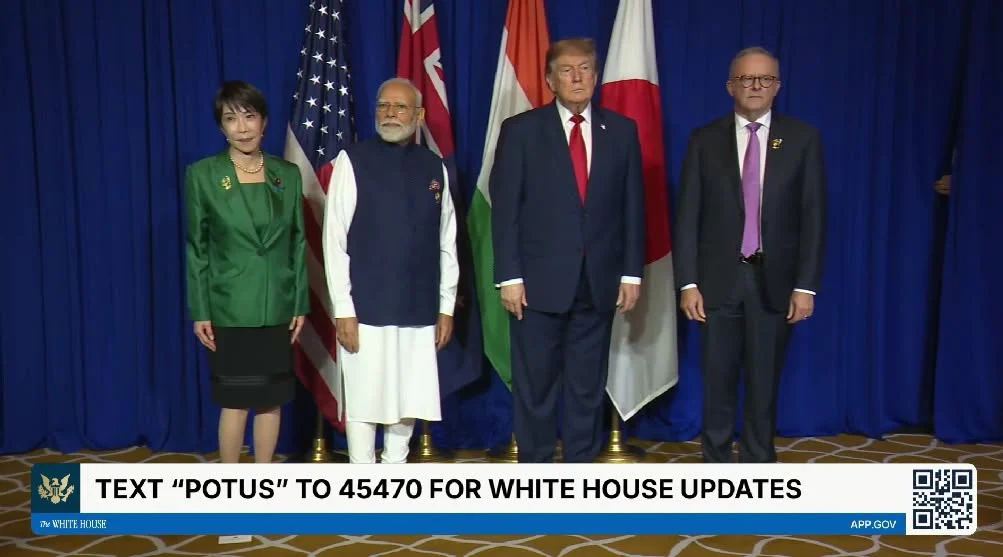
The statement was issued following a meeting between US President Donald Trump, Australian Prime Minister Anthony Albanese, Indian Prime Minister Narendra Modi, and Japanese Prime Minister Sanae Takaichi.
While the leaders did not explicitly name China, the declaration comes amid heightened security concerns in the South China Sea, where Beijing’s expansive maritime claims overlap with Southeast Asian countries, namely, the Philippines, Vietnam, Indonesia, Brunei, and Malaysia.
Manila and Beijing have repeatedly confronted each other in the West Philippine Sea, particularly near disputed maritime features where Chinese coast guard vessels have challenged Philippine patrols and resupply operations.
The Philippines maintains that its maritime rights are supported by the 2016 arbitral ruling, which invalidated the legal basis of China’s expansive claims to historic rights within its nine-dash line under the United Nations Convention on the Law of the Sea (UNCLOS).
Beijing has rejected the ruling and continues to assert its claims over much of the South China Sea.
Beyond opposing coercion, the Quad leaders pledged to strengthen maritime surveillance and protect international shipping routes across the Indo-Pacific.
“We commit to work together to ensure open, safe, and resilient maritime transit corridors in the Indo-Pacific,” the joint statement said.
The four countries announced the Indo-Pacific Maritime Surveillance Collaboration, a new initiative aimed at improving information sharing and maritime domain awareness.
Under the initiative, their respective P-8 and P-3C maritime patrol aircraft are scheduled to participate in a maritime exercise in 2027, marking the first such activity under the Quad framework.
The leaders also pledged to protect freedom of navigation and overflight, which are considered essential to international commerce and regional security.
The Quad also expressed concern over economic coercion, particularly arbitrary export restrictions that could disrupt critical supply chains.
“We express grave concerns about economic coercion, including through arbitrary export restrictions,” the leaders said.
The four countries committed to strengthening supply chain security, advancing trusted technologies and expanding cooperation on critical infrastructure.
The summit marked nearly a decade since the revival of the Quad and the 10th anniversary of the Free and Open Indo-Pacific vision first articulated by former Japanese Prime Minister Shinzo Abe in 2016.
The leaders described the grouping as a partnership committed to maintaining peace, stability and prosperity through practical cooperation.
The declaration also reaffirmed support for the central role of the Association of Southeast Asian Nations (ASEAN) in regional affairs.
“We reaffirm our unwavering support for ASEAN centrality and unity,” the leaders said.
The Quad meeting took place as the Philippines concluded its hosting of the 49th ASEAN Summit and Related Summits, during which Southeast Asian leaders and China failed to finalize the long-awaited South China Sea Code of Conduct (COC).