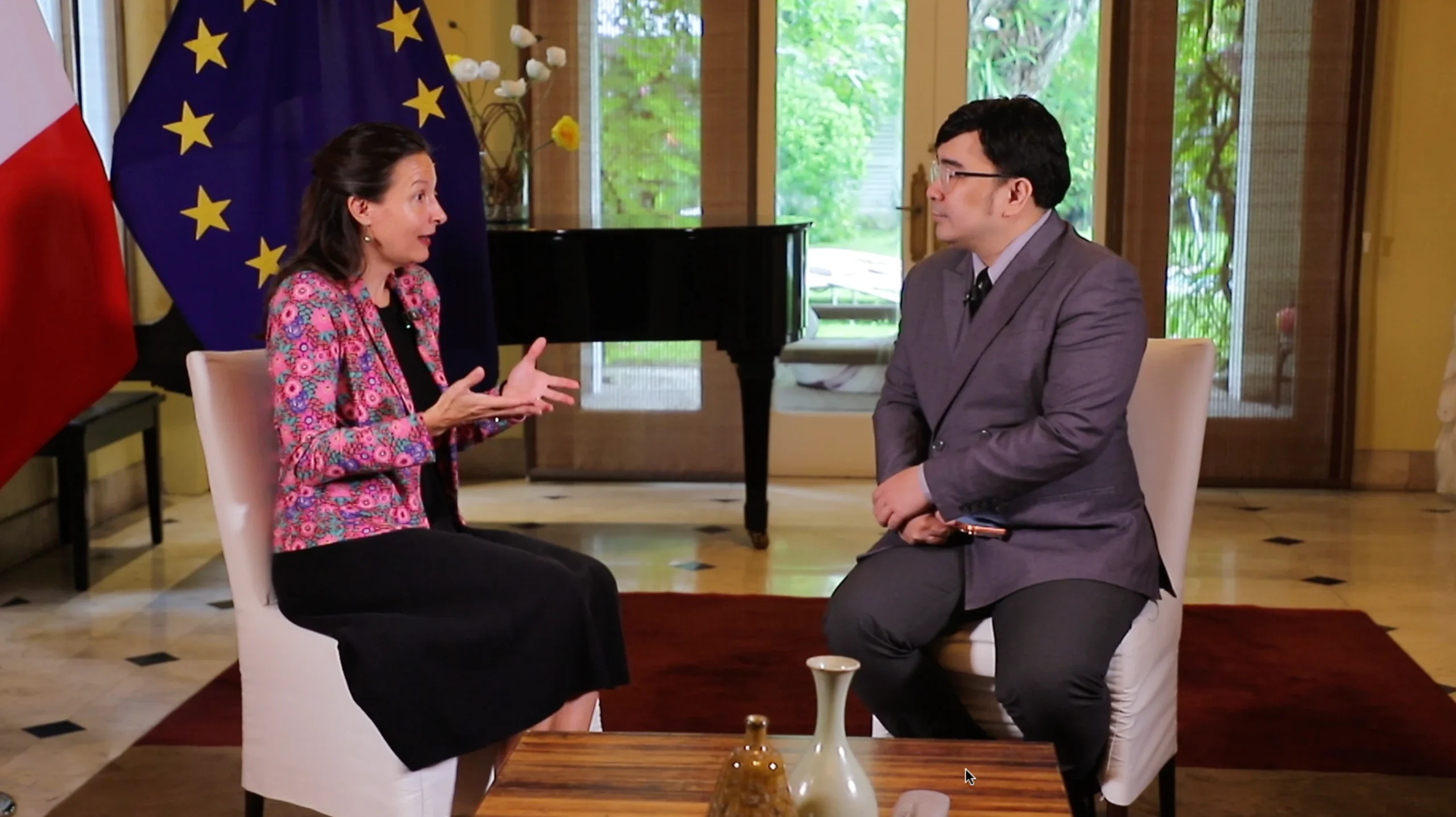


Metro Manila, Philippines – More French military personnel, ships and aircraft could be seen in the Philippines as Manila and Paris move to deepen defense cooperation following the signing of a visiting forces agreement, the outgoing French ambassador said.
In an interview with NewsWatch Plus, Ambassador Marie Fontanel said the agreement would allow both sides to significantly increase military-to-military activities, including reciprocal participation in exercises.
“Well, more interactions, basically. It will really foster the level and the number of interactions, the participation, the reciprocal participation in exercises,” Fontanel said.
“So you will probably in the future see more French armed forces calling to port or to come by plane to the Philippines,” she added.
The Philippines and France signed the Status of Visiting Forces Agreement (SOVFA) in Paris on March 26, 2026, providing a legal framework for military personnel from both countries to operate temporarily in each other’s territory for exercises, training and other agreed activities.
Defense Secretary Gilberto Teodoro Jr. and French Minister for the Armed Forces and Veterans Catherine Vautrin signed the agreement at the École Militaire in Paris, about a year after President Ferdinand Marcos Jr. authorized negotiations.
Teodoro said the agreement was concluded in “record time,” citing years of trust between the two countries. The defense chief also said Marcos had directed officials to expedite the negotiations because of the growing importance of Philippine-French and Philippine-European relations.
France became the first European country to enter into such an agreement with the Philippines.
Maritime security
Fontanel said France’s increased military engagement in the region is also tied to its interest in maintaining freedom of navigation in the Indo-Pacific.
“We need to ensure freedom of navigation and protection of our oceans,” she said, describing France and the Philippines as two maritime nations.
She also raised concern over repeated incidents in the South China Sea, warning that individual confrontations carry the risk of escalating into a wider situation.
“It’s a concern because any incident can provoke a risk of escalation,” Fontanel said.
“We’ve always been vocal, calling for international law to be the rule and not the force,” she added.