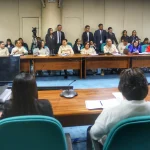


Metro Manila, Philippines – There is no deadlock between the Senate and the House of Representatives on the bill to institutionalize the social welfare program Assistance to Individuals in Crisis Situation (AICS) that failed to clear the special session, the head of a House panel said.
Davao Oriental 2nd district Rep. Cheeno Almario, chairperson of the House committee on social services, said this in response to a statement of Sen. Erwin Tulfo before the Senate adjourned on Wednesday.
“It’s part of the reconciliation in the formative process of legislation. I don’t think it makes sense to call it a deadlock,” Almario said in an interview on Thursday, June 18.
AICS is an ongoing program of the Department of Social Welfare and Development (DSWD), which aims to provide cash aid and other forms of assistance to Filipinos in crisis.
The bill institutionalizing the program wasn’t ratified at the special session of Congress on Wednesday, June 17, after Tulfo said the House of Representatives did not sign off on the version that includes an anti-epal provision, which bars government officials from distributing cash aid funded by the DSWD for personal gain.
Almario said while the House version excludes such provision, he and his colleagues support the proposed ban.
“I think it goes without saying na super 100 percent support kami sa anti-epal provisions [that we fully support the anti-epal provisions]. We want to discuss it to at least know the essence to further strengthen it,” Almario said.
He explained that the lower chamber did not include an anti-epal section as this was already existing in the 2026 General Appropriations Act, which he said may be “redundant.”
“Kasi if dagdagan sa GAA and then afterwards we have another kind of anti-epal provision that involves other things pa, but only specific to AICS, that becomes confusing na with everyone. So iyon lang naman talaga yung sa amin. That’s why we wanted to clarify this with the Senate,” said Almario.
[Translation: Because if it is added to the GAA, and then afterward we introduce another anti-epal provision that covers other matters but applies only to AICS, it could become confusing for everyone. That’s really our only concern. That’s why we wanted to clarify this with the Senate.]
The lawmaker also cited the need to review the penal clause.
“At least yung mga how do you punish those who use or politicize yung AICS. Once kasi we put that and ink that, there’s no turning back. Yung gusto namin kasi we have to make sure that since there is a penal clause, since there are also ramifications, kailangan dapat maayos ito,” he said.
[Translation: Specifically, it deals with how to punish those who misuse or politicize the AICS. Once we include that and formally adopt it, there’s no turning back. What we want is to make sure that, since there is a penal clause and there are corresponding consequences, everything is properly crafted and implemented.]
Almario said he will not sacrifice the bill’s potential even if it entails delay. The bill is a priority of President Ferdinand Marcos Jr.
Meanwhile, in a separate statement, he also rejected Tulfo’s statement suggesting that lawmakers may use AICS as a political tool.
“AICS and all other forms of government aid should never be used for the personal promotion, endorsement, or political advantage of any public official,” he said.
Almario said House members prefer a physical bicameral conference committee meeting to resolve the disagreements, adding that they are open to meet with the Senate even before the State of the Nation Address on July 27.