

Metro Manila (CNN Philippines, June 30) — Garbage collectors should be part of the circular economy that will be created as companies race to meet the year-end deadline set by the Extended Producers’ Responsibility Act (EPR), the Department of Environment and Natural Resources (DENR) said.
“We need to understand the circularity, the opportunity that we are faced with and the obsolescence of our linear economy. We can assign a fair value for all contributions to that industry. Here in particular, I wish to point out the situation of the informal waste sector of the country,” Environment Secretary Maria Antonia Yulo-Loyzaga said Friday.
“Unless we regard the waste management sector as a proper industry in the circular economy, we cannot fairly value the contribution of this sector to our work under the EPR law,\” she added.
The measure lapsed into law on August 13, 2022, while its implementing rules and regulations were released just last January.
The law requires that by end of December, manufacturers must be able to recycle at least 20% of their waste. Under the law, unregistered businesses will be fined at least ₱5 million, while those who comply can get tax incentives.
Citing data from the Organization for Economic Co-operation and Development (OECD) in 2022, the DENR said plastic waste produced worldwide more than doubled to 353 million metric tons (MT) in 2019 from 156 million MT in 2000. Packaging waste produced by manufacturers accounts for 50% of this.
The Philippines alone generates 61,000 MT of solid waste daily, 12% to 24% of which are plastic waste, the DENR-Environment Management Bureau said. Filipinos utilize over 163 million plastic sachet packets, 48 million shopping bags, and 45 million thin-film bags daily.
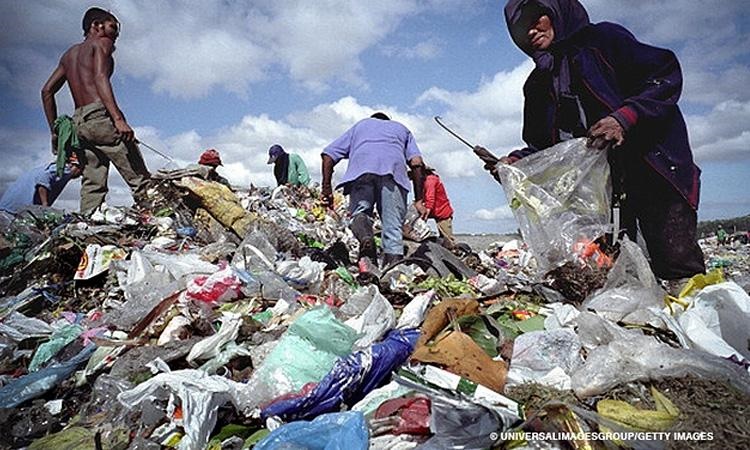
Since a third of plastic waste ends up in landfills, garbage collectors play a crucial role in the new law’s implementation. There are about 100,000 of them from the informal waste management sector, Yulo-Loyzaga said, but added that the number can be higher.