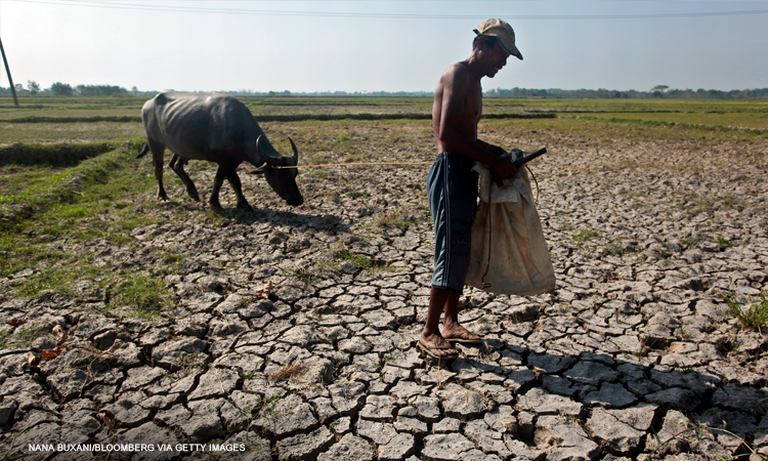


CNN Philippines (Metro Manila, June 26) — Some farmers are hesitant about planting rice this coming season, amid the state weather bureau’s warning that El Niño could begin as early as next week, which could lead to supply problems next year.
READ: PAGASA may declare start of El Niño next week
Camarines Norte and Southern Leyte could see a drought by the year’s end, while 36 other provinces could face a dry spell, the Philippine Atmospheric, Geophysical and Astronomical Services Administration said.
“Dito sa Tiaong [Quezon] yung ibang parte ng barangay na umaasa sa ulan ay di nagtanim,” Danilo Guevarra, president of the Farmers Association in Tiaong town, told CNN Philippines.
[Translation: Here in Tiaong, some parts of the barangay dependent on rain aren’t planting this season.]
“Sumibol man ang palay, mamulaklak man ito at nakaturo na ang uhay, ibig sabihin walang laman ang uhay nito,” Quezon province farmer Rene Cerilla said.
[Translate: Even if the rice grows and its flowers bloom, if the ear is pointed this means it’s empty.]Federation of Free Farmers Cooperatives national manager Raul Montemayor said that rice stock would be stable until December but warned that grain inventories would shrink.This could lead to major rice supply problems in the lean months of July to September next year, especially if farmers stop planting, he said.He added that rice import costs have gone up because top exporters will also be hit by dry spells.
“Vietnam and Thai [Thailand] prices have gone up by 5% compared to January, February this year. 5% translates to ₱2 per kilo landed in Manila with tariff. Yun ang increase sa [that’s the increase in] import prices,” Montemayor said.
Meanwhile, PAGASA Climate Monitoring and Prediction Section Chief Ana Solis explained that El Niño doesn’t always mean absence of rain.
“It just gives you the possibility na mas mataas ang potential na may reduction ng tubig-ulan na posibleng mauwi sa dry spell or drought. May ulan pa din po tayo,” she said.
[Translation: It just gives you the possibility of greater reduction in rainwater which could lead to a dry spell or drought. But there will still be rain.]Montemayor pointed out that a dry season that isn’t too intense might even be good for the crop.
“When you say less than normal rain because of the onset of El Niño, if it is not a very intense El Niño, it will actually be good for palay. Walang masyadong masisira sa sobrang ulan [There won’t be as much damage due to rain],” he said.