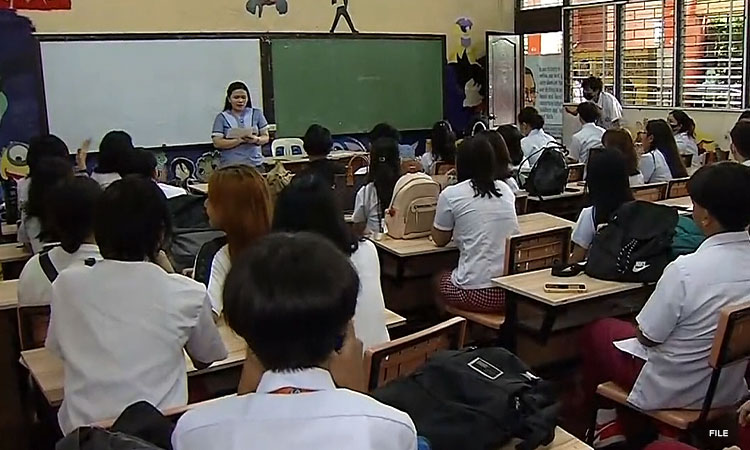

Metro Manila, Philippines – Senators are seeking more funds for the Department of Education (DepEd) program that provides extra tutoring in reading, mathematics, and science to struggling learners.
While Congress provided ₱8.9 billion for the Academic Recovery and Accessible Learning (ARAL) this year, the same item has zero budget in the proposed 2027 National Expenditure Program (NEP).
“Kung ano pa yung gumagana, yun pa yung nawala,” Senate President Win Gatchalian said during Friday’s, Oct. 16, budget hearing. He cited a DepEd report that more than three million learners had moved out of the struggling reader category.
[Translation: What was already working was removed.]
The House of Representatives allotted ₱350 million for ARAL and other learning recovery programs in the proposed budget. The DepEd has requested ₱15.9 billion.
The agency said the ₱350 million could fund only over 20,000 tutors. Program implementers identified around ₱8 billion as the minimum to sustain ARAL.
Education Secretary Sonny Angara said Congress funded ARAL in 2026 through additions spread across several budget items. These covered tutors, learning materials and teacher overload pay. Gatchalian proposed a separate budget line for ARAL funding.
The Second Congressional Commission on Education (EDCOM 2) estimates that 13.1 million basic education learners need remediation. ARAL would require 873,362 tutors based on one tutor for every 15 learners.
Education spending at 4% of GDP
Angara also asked senators to add ₱147.93 billion to the agency budget to support teacher hiring, classrooms, school security, feeding, and mental health programs.
The House-approved budget provides ₱969.79 billion for DepEd and its attached agencies, around ₱45 billion less than the current budget.
Sen. Bam Aquino, who chaired the hearing, said lawmakers want education spending to reach 4 percent of the gross domestic product (GDP), which measures economic output in a year..
“It’s our shared goal na mabalik natin ito to 4 percent. Of course, we know maraming competing interests po dito, but we will do our best,” Aquino said.
[Translation: It’s our shared goal to restore this to 4 percent. Of course, we know there are many competing interests, but we will do our best.]
Angara agreed, calling 4 percent a minimum benchmark. He also cited UNESCO’s recommendation to spend up to 6 percent of GDP on education.