

Metro Manila, Philippines – Anticipating and acting on risks before they become crises is how Science and Technology Secretary Renato Solidum Jr. described it as he advocates anticipatory governance to ensure better quality of life.
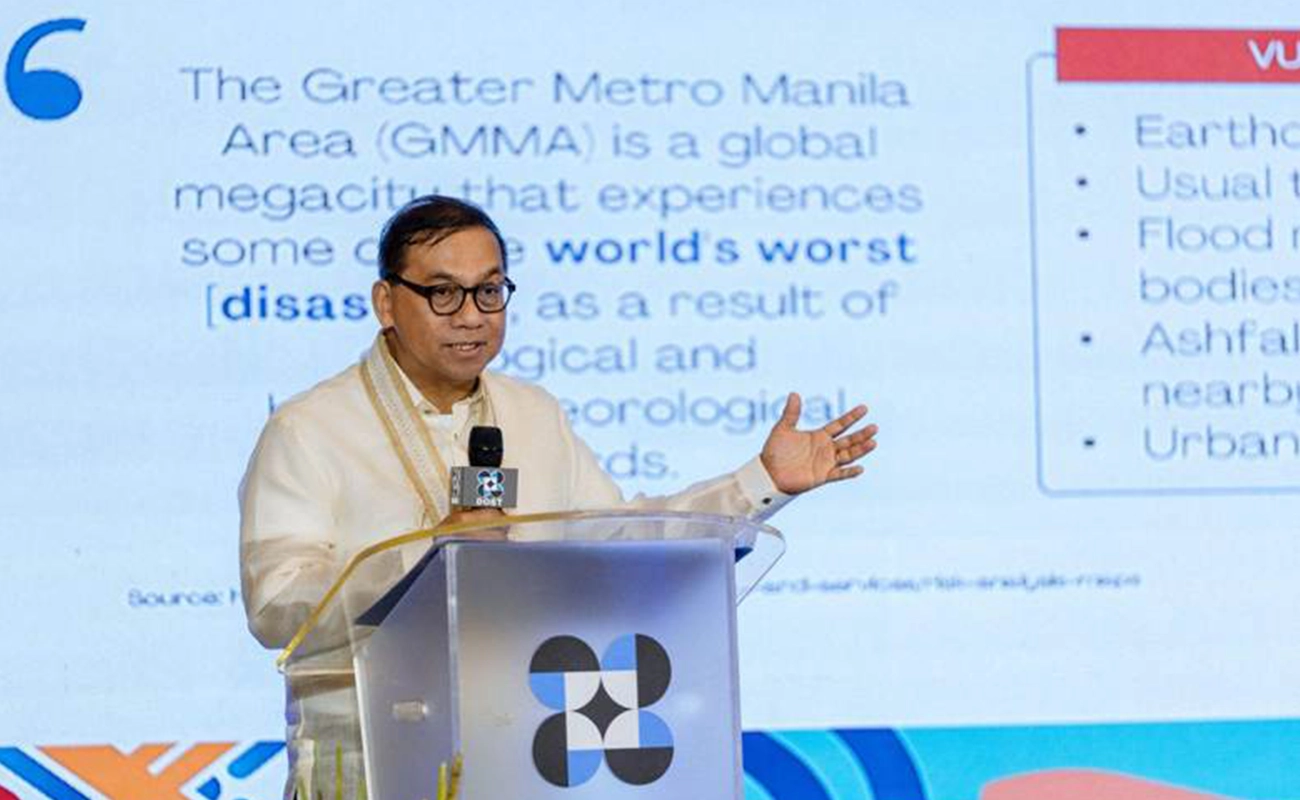
In his keynote at the opening of the 2026 Regional Science, Technology, and Innovation Week celebration, Solidum said the country should leverage science, technology, and digital innovation to transform uncertainty into preparedness, vulnerability into victories, and challenges into pathways for sustainable growth.
As daily living expenses in the capital region rise, he said ensuring access to basic necessities is not merely an economic concern; it is a matter of quality of life for millions.
He cited the 31.2% increase in the consumer price index in Metro Manila from 2018 to 2026, which means that a basket of goods worth ₱100 in 2018 is now ₱131.20.
“This places increasing pressure on households and underscores the need for science-based, technology-driven solutions that can strengthen food production, improve supply chain efficiency, and anticipate disruptions before they become crises,” Solidum said.
Additionally, he also mentioned that Metro Manila faces growing energy demands and persistent threats of disasters and climate change, with it being the country’s largest energy consumer due to rising demand from households, industries, and the move towards industrialization, and being prone to earthquakes, floods, ashfall drift, and urban heat challenges.
“We can only do this if we employ the use of converging emerging technologies to enable anticipatory governance,” he said, adding that no single technology can shape the future.
Food security
Anticipatory governance in food security means moving from crisis response to foresight-driven action.
“In terms of food security, we have to invest in precision agriculture, AI and predictive analytics, remote sensing and satellite technologies, smart logistics and supply-chain systems. And we continuously develop and support technologies aligned to this need, Solidum said.
He mentioned Project SARAI or Smarter Approaches to Reinvigorate Agriculture as an Industry, which uses remote sensing, satellite technologies and predictive analytics for smart agriculture; Agro-Digital PH, a digital agriculture value chain platform for production, logistics, marketing; Trace.AI, which uses AI for fish catch documentation and traceability for fisheries; and i-POND, which controls and monitors water management in aquaculture farms.
“All of these use different converging technologies to empower our agriculture and aquaculture sectors towards food security,” the secretary said.
Renewable energy
In terms of sustainable energy, anticipatory governance is the proactive use of science, technology, and data-driven foresight to forecast future demands and capacity gaps, identify vulnerabilities before failures occur, diversify energy sources, and plan energy investments, ultimately ensuring that energy is accessible and affordable for present and future generations.
While there are already technologies for e-mobility such as the converted electric tricycles, CHARM (charging in minutes) charging infrastructure, e-Tranvia for tourist transport, and the country’s first e-ferry, he also calls for more investment on renewable energy technologies, smart grids, expansive energy storage systems, and energy-efficient mobility infrastructure and buildings.
“Mahigit 20 na po ang ating partner LGUs sa renewable energy technologies, at marami pa po ang nasa pipeline. We are hoping for more partners here in Metro Manila,” he said.
Resilience
Anticipatory governance in national resilience means leveraging science, technology, and digital innovation to understand risks before they become disasters, proactively focusing on prevention and preparedness, utilizing forecasts and predictive analytics, assessing vulnerabilities through risk intelligence, and employing disaster imagination.
Solidum said the department has heavily invested on hazard monitoring, early warning systems, earthquake and flood modeling, digital twins for predictive risk assessment, and technologies for infrastructure integrity assessment.
“DOST (Department of Science and Technology) has launched the GeoriskPh Platforms for different purposes. We have also supported locally developed technologies such as the Infraspex, drone and AI-based road and bridge inspection for disaster resilience; Project Lungsod which uses digital twins for local governance and urban management; and AlertoPH for monitoring community safety from various hazards,” he said.
The Cabinet official also called on local government units to expand the capacities of their engineering departments beyond regulation and compliance to preventive engineering services and giving technical assistance to communities, saving significant government funds in the long run.
“In the end, our impact is not measured by the technologies we deploy, but by the people whose lives are made safer, better, and more secure because of them. That is our mission. Iyan ang diwa ng agham na ramdam,” he said.