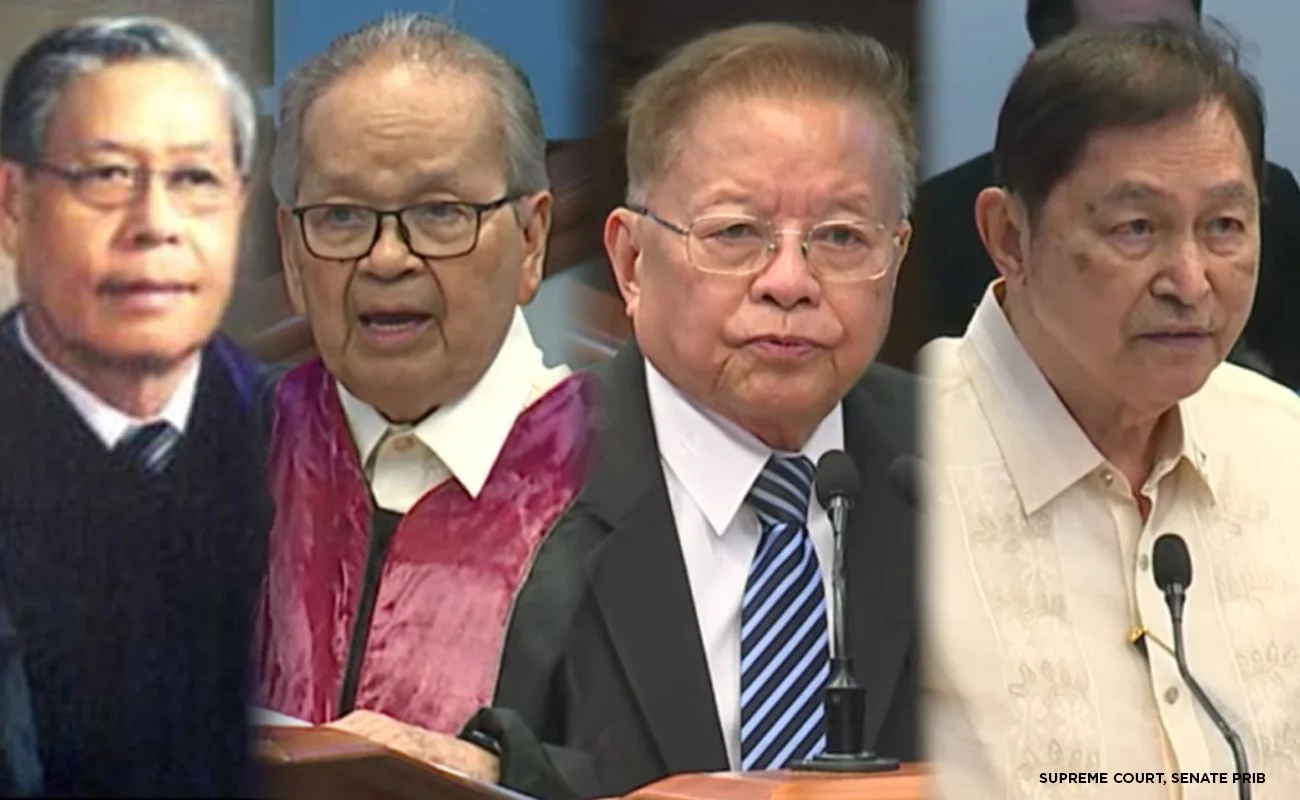

Metro Manila, Philippines – Three retired chief justices were of the opinion that the vote threshold to convict an impeachable official is a moving number, while one former associate justice was of the strict interpretation of an immovable 16.
Appearing as amici curiae or friends of the court on Wednesday, Sept. 16, the greater number of justices said the two-thirds provision in the Constitution required for the Senate, sitting as impeachment court, should be interpreted with other provisions of the charter and Supreme Court rulings, and not automatically based on all 24 members of the chamber.
Chief Justice Hilario Davide Jr., who submitted a legal memorandum read by Senate Secretary Renato Bantug as he is recovering from a medical procedure, said the denominator should be based on senators qualified to vote.
Davide said senators who are detained, abroad, suspended or whose whereabouts are unknown should be excluded from the phrase “all the Members of the Senate” when determining the voting threshold.
Chief Justice Artemio Panganiban held a similar view, questioning treating the 16-vote requirement as a fixed mathematical formula.
“Constitutional interpretation cannot always stop at abstract Mathematics,” Panganiban said.
He said the court should consider the intent and purpose of the constitutional provisions, the circumstances in which they operate, and the goals they seek to achieve.
Panganiban further said active participation and independent evaluation of evidence are essential to the senator-judges’ constitutional responsibility.
Chief Justice Reynato Puno pointed to the Constitution’s use of the phrase “two-thirds of all the members of the Senate.”
“Article XI, Section 3 (6) should have simply stated that the number of votes to convict is 16, period, but it did not say so,” Puno said.
“Instead, the language used a fraction,” he added.
Retired Associate Justice Adolfo Azcuna held a different opinion, saying the two-thirds threshold is absolute.
“As long as they are members of the Senate, they constitute the denominator in computing the threshold of two-thirds because all means all,” Azcuna said.
On whether a senator-judge who did not actively participate in the proceedings may still vote, he said he would allow the senator-judge to cast a vote based on conscience.
“In case of doubt, I would allow such a person to vote because this tribunal is a tribunal of record,” Azcuna said.
He noted that an absent senator-judge could review the transcripts of the proceedings and that much of the evidence presented before the impeachment court is documentary.
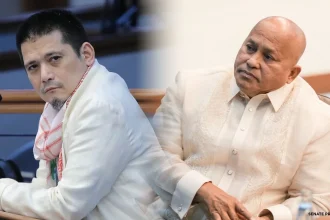
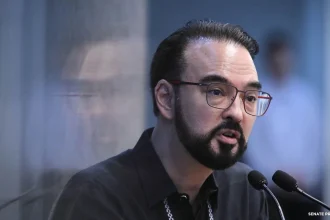
Presiding Officer Chiz Escudero had earlier ruled that 16 votes would be required to convict Duterte, based on two-thirds of the full 24-member Senate unless questioned in the Supreme Court, but the issue was raised again by Senator-Judge Erwin Tulfo last week.
Three of the four retired justices opined that the high court has no jurisdiction in interpreting the two-thirds threshold vote to convict an impeachable official.
Senators Jinggoy Estrada and Rodante Marcoleta are in detention for separate plunder charges, Sen. Bato dela Rosa is in hiding over an International Criminal Court arrest warrant, while Sen. Loren Legarda is on medical leave abroad.
The prosecution and defense are scheduled to present their arguments on the threshold issue on Sept. 23, after which the senator-judges are expected to decide whether Escudero’s 16-vote ruling should stand.