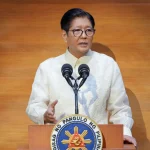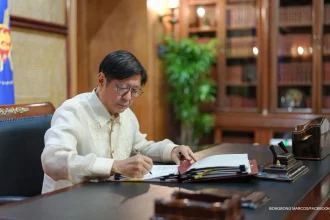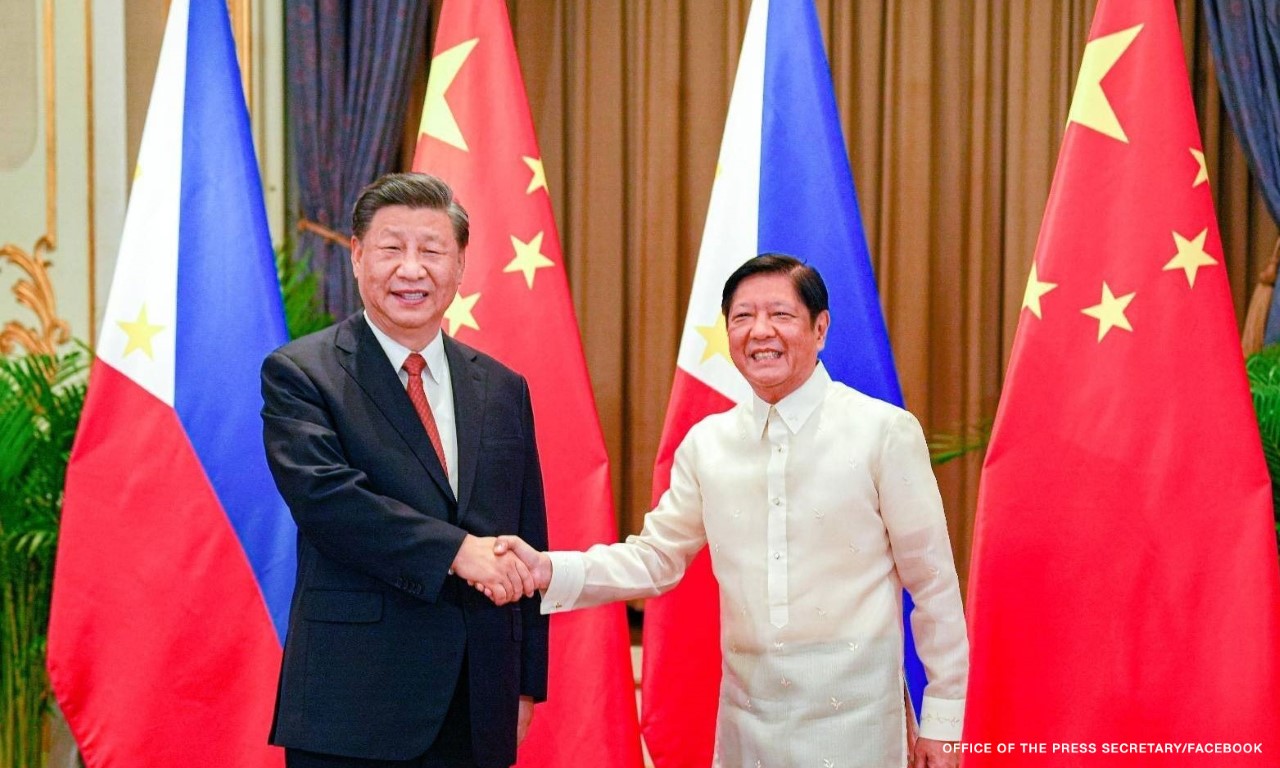


Metro Manila, Philippines — President Ferdinand Marcos Jr. on Friday, Aug. 14, defended the provisional understanding with China governing resupply missions to the BRP Sierra Madre in Ayungin Shoal, saying the arrangement is intended to prevent miscalculation and does not compromise sovereign rights or territorial claims in the West Philippine Sea.
Speaking at the Foreign Correspondents Association of the Philippines (FOCAP) presidential luncheon in Manila, Marcos said the understanding was designed to avoid incidents that could escalate into a wider confrontation, particularly as the Philippines continues to resupply troops stationed aboard the grounded navy vessel.
He said authorities issue a maritime notification before resupply missions to inform vessels operating in the West Philippine Sea of the planned movement.
“What we are trying to avoid, and that’s why we make these arrangements. It is especially important because we have to resupply our people who are still on the Sierra Madre,” Marcos said.
He explained that the Philippines informs other vessels of its planned route and schedule so its ships would not suddenly appear as unidentified vessels.
“What we actually do is we talk about a coalition agreement, but essentially what the Philippines does is that when we are going to conduct a resupply mission, we issue what is known as a nota, which is a notice to your maritime movements that our ship is going to go from here to there and they will stay here and stay there for two days or whatever it is and then come back,” he said.
Marcos stressed that the notification does not require the Philippines to seek permission from China or surrender any of its rights.
“It does not weaken our position in any way in terms of the arbitral award, in terms of the UNCLOS, in terms of our exercise of sovereign rights, in terms of our defense of our territory,” he said, referring to the United Nations Convention on the Law of the Sea.
There has been renewed scrutiny of the Provisional Understanding on Rotation and Resupply, or RORE, after the Department of Foreign Affairs said Tuesday that it was leaving it up to the security sector to determine whether the understanding should continue.
The DFA said the Armed Forces of the Philippines and the Philippine Coast Guard are in the best position to assess whether the deal remains necessary.
The department also said there was no intention to replicate the arrangement elsewhere in the Philippine maritime domain.
The RORE was reached by Manila and Beijing in July 2024 after a series of confrontations during Philippine resupply missions to Ayungin Shoal. The DFA said 15 missions had been completed without incident under the understanding.vesse
Asked whether the provisional understanding remains in effect, Marcos said he was reluctant to describe it as a special “arrangement.”
“I hesitate to use the word arrangement because we’re not going into any arrangement with everyone. We’re just conducting ourselves according to the standard practice of vessels sailing in the West Philippine Sea and, for that matter, in other seas,” Marcos said.
He said Philippine vessels would continue to sail, resupply troops, patrol and conduct other missions, with the maritime notification issued as part of the process.
“Our ships are going. Our vessels will sail. They will resupply, or they will patrol, or they will – any time that they do sail, that [notification] is issued. That’s the extent of it,” he said.
Defense Secretary Gilberto Teodoro Jr. publicly said he was not aware of an understanding governing Philippine resupply missions, raising questions about coordination within the government over the policy.
Former Supreme Court Senior Associate Justice Antonio Carpio has called for the government to abandon the provisional understanding, arguing that the Philippines should not operate under conditions imposed by China when resupplying its own troops.
Marcos said the country’s sovereign rights and claims were not weakened by the resupply protocol.
“It does not somehow make us more vulnerable or give up any of our sovereign rights, any of our territorial claims that are relevant in this territory, especially under UNCLOS at all,” he said.