

Cebu, Philippines – President Ferdinand Marcos Jr. pushed for the establishment of an Association of Southeast Asian Nations (ASEAN) Maritime Center in the country, as the situation in the South China Sea is becoming increasingly “unreadable”.
Speaking during a press conference at the 48th ASEAN Summit in Cebu, Marcos said regional leaders reached a broad consensus on the proposed maritime center, which aims to strengthen coordination on maritime security, navigation safety, and regional maritime policy.
“I suppose as the situation in the South China Sea becomes more, shall we say, unreadable, this becomes more important that there will be a central repository for maritime issues and maritime policy that will apply to ASEAN members,” Marcos said.
The proposal forms part of the newly adopted ASEAN Leaders’ Declaration on Maritime Cooperation, a key outcome document endorsed during the summit.
Marcos said the proposed center is not intended to target or confront any particular country in light of tensions between China and Southeast Asian claimants in the South China Sea.
“What we are looking for, or what is the ultimate reason for having this Maritime Centre is not to confront or not to somehow push back on any single force or any single country,” he said.
“It has to be seen from this perspective. What we are working for is the continued freedom of navigation and the peaceful navigation in the South China Sea,” he added.
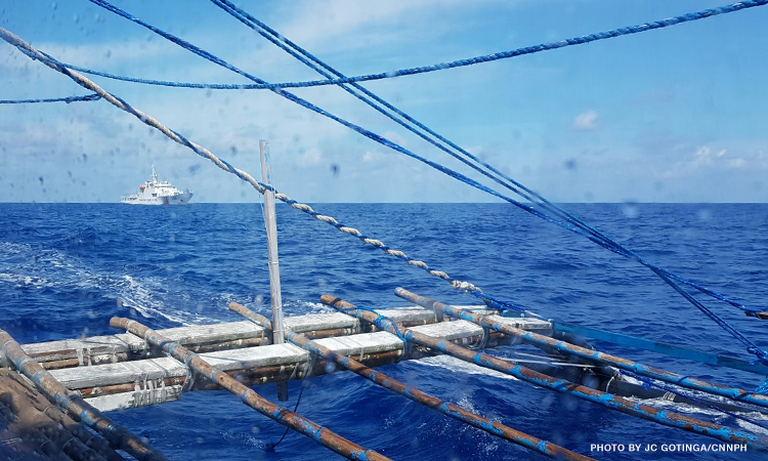
The South China Sea remains one of Asia’s most sensitive flashpoints, with overlapping territorial claims involving China, the Philippines, Vietnam, Malaysia, Brunei, and Taiwan.
Tensions between Manila and Beijing have escalated in recent years over confrontations involving Philippine and Chinese vessels in the West Philippine Sea.
Marcos said the maritime center would help improve coordination among ASEAN members on maritime monitoring, law enforcement, and safety operations.
“And then of course there are the attendant issues of assistance of making sure that our waters are safe, that our territories are well respected, and that UNCLOS is the single most important guide and principle that we adhere to,” the president said.
He said ASEAN leaders unanimously agreed in principle to establish the center, though operational details still need to be finalized.
“The concept of it, the principle of it has been fully agreed on. I did not hear any arguments against it,” Marcos said.
“So now the job before us is to put together the framework for what this maritime center is going to look like, who will be involved and what their involvement will be, who will fund it, where will it be, what is it supposed to do in the first place,” he added.
In particular, he said there would be coordination to improve maritime domain awareness and address common threats.
Meanwhile, Marcos warned of the potential global economic consequences should a major disruption occur in the South China Sea, citing the recent impact of tensions around the Strait of Hormuz.
“But if such a thing would happen in the South China Sea, the inevitable consequences would be alarming, just to even think about,” he said.
The Philippines formally offered to host the proposed ASEAN Maritime Center after presenting the initiative to fellow ASEAN leaders during the summit.
“Since we proposed the idea, we are offering the Philippines to be the home of that center,” Marcos said.