

Metro Manila (CNN Philippines, March 9) — Fresh conflicts in the South China Sea may arise as claimants – excluding the Philippines – push ahead with oil and gas projects in areas Beijing claims, according to a new report.
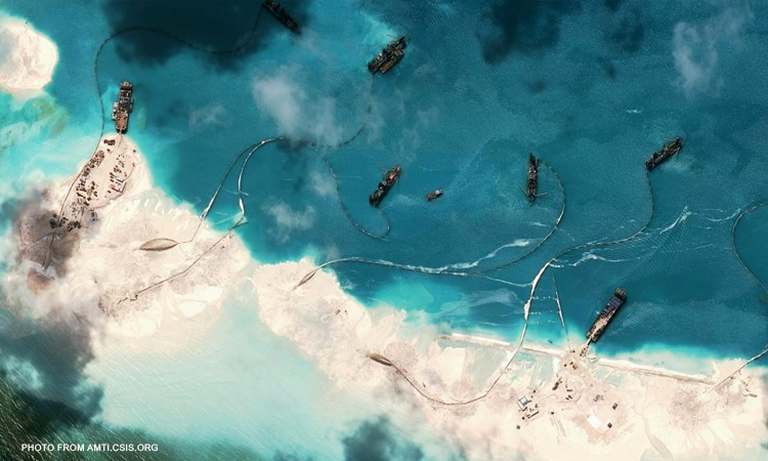
Data from US-based Asia Maritime Transparency Initiative (AMTI) detailed claimants’ new offshore projects, many of which lie inside China’s sweeping \”nine-dash\” line claim, including sites where confrontations previously took place.
The group warned that these could re-emerge as a “primary flashpoint” in the disputes.
It also noted that this comes after tensions over hydrocarbons relatively eased between China and Southeast Asian nations last year.
“With the China coast guard increasing the frequency of patrols across disputed waters, the prospect of confrontation between Chinese law enforcement and oil and gas operators at many of these locations is high,” the think tank said.
The Philippines, China, Brunei, Malaysia, Taiwan, and Vietnam have overlapping claims in the South China Sea, a strategic waterway where trillions of dollars of international trade pass through annually.
The AMTI said China, Vietnam, Malaysia, and Indonesia have moved forward with their energy exploration and development projects, while the Philippines continues to suspend all such ventures in contested waters — a policy it adopted in 2014.
According to the report, Manila is the only claimant not developing hydrocarbon resources on the portions of its continental shelf covered by China’s nine-dash line.
“Manila briefly permitted exploration at Reed Bank last spring, but quickly shut it down amid challenges from the China Coast Guard,” it said.
“Without access to more promising prospects, Philippine operators have turned to redeveloping the Cadlao oil field, an old concession that sits outside of China’s nine-dash line claim and that last produced oil in the early 1990s,” the AMTI added.
It noted Cadlao currently has an estimated five million barrels in reserves — much smaller than Reed Bank’s estimated five billion barrels of oil and 55 trillion cubic feet of gas.
The South China Sea holds about 190 trillion cubic feet of natural gas and 11 billion barrels of oil in proved and probable reserves, according to estimates from the US Energy Information Agency. In 2012, the US also said there could be another 160 trillion cubic feet of natural gas and 12 billion barrels of oil undiscovered in the waterway.
During his state visit to China in January, President Ferdinand Marcos Jr. told Chinese leader Xi Jinping that the Philippines wants to resume talks on joint oil and gas exploration in the area.
The talks were terminated by the Duterte administration, as it said the objective of developing oil and gas resources was “not achieved.\”
Since the meeting between Marcos and Xi, however, tensions between the two countries over the waters have heightened, with the Philippines’ top diplomat saying Beijing’s aggressive actions against Manila continue on a “daily” basis.