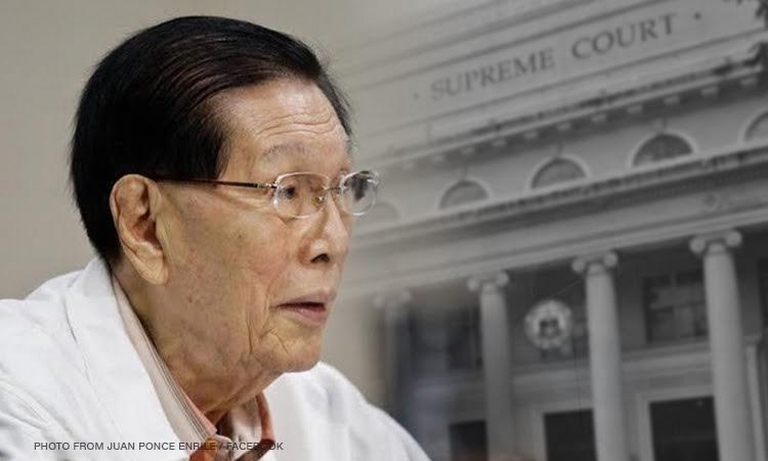


Metro Manila (CNN Philippines, February 9) — The Supreme Court has ordered the dismissal of the graft case against Presidential Legal Counsel Juan Ponce Enrile and others over their role in the supposed siphoning off P840 million from coco levy funds in 1983.
In a 53-page decision promulgated on Jan. 16 and released on Wednesday, the Supreme Court First Division ordered the Ombudsman to dismiss the complaint for violation of Republic Act No. 3019 filed against Enrile, Jose Concepcion, Rolando dela Cuesta, Narciso Pineda, and Danilo Ursua “due to the violation of the constitutional right to speedy disposition of cases.”
The court pointed to a “clear violation” of the respondents’ right when the government \”failed to provide sufficient justification for the delay in the termination of the preliminary investigation.\”
It also reversed and set aside the Ombudsman’s decision recommending the dismissal of the case on grounds of prescription, the period within a legal action can be taken against the reported offense.
The case stemmed from the complaint filed by the Office of the Solicitor General before the Presidential Commission on Good Government (PCGG) in February 1990.
The complaint alleged that the memorandum of agreement (MOA) between Eduardo Cojuangco Jr.’s Agricultural Investors, Inc. (AII) was unfavorable to the National Investment and Development Corporation (NIDC) as the NIDC was obligated to promptly pay AII with money from the Coconut Industry Development Fund (CIDF) but AII was only required to produce the target number of seednuts. The NIDC was also required to use the CIDF if it fails to do its obligations.
When the CIDF was depleted after many changes in its administration, the United Coconut Planters Bank (UCPB), as its administrator, terminated the MOA with AII.
Enrile, Concepcion, Dela Cuesta, Pineda and Ursua were board members of the UCPB.
Enrile and other respondents allegedly allowed a March 1983 decision of a board of arbitrators to lapse, supposedly resulting in the siphoning off of P840 million from the CIDF to the AII. This was the basis for the filing of the graft case against them.
The complaint said \”respondent Cojuangco, Jr. took advantage of his close relationship with then President Ferdinand E. Marcos for his own personal and business interests through the issuance of favorable decrees.”
The PCGG referred the complaint to the Office of the Ombudsman, which dismissed the charges in 1998, leading to the filing of the petition before the high court.
In 2001, the Supreme Court granted the OSG petition, which reversed and set aside the Ombudsman’s dismissal and ordered it to proceed with preliminary investigation on the graft complaints.
In 2004, the high court issued a resolution to set aside the 2001 decision, reasoning that “the case was not yet ripe for decision.\”
Respondents Cojuangco, Jose Eleazar Jr., Maria Clara Lobregat, and Augusto Orosa died before the release of the final decision on the case.
The high court explained that respondents’ deaths automatically remove criminal liability “without prejudice to the right of the State to recover unlawfully acquired properties or ill-gotten wealth.”
“With this case pending for over 30 years and possibly more without assurance of its resolution, the Court recognizes that the tactical disadvantages carried by the passage of time should be weighed against petitioner Republic and in favor of the respondents,” it explained.
The decision added that proceeding with the case would prolong the “already long delay” and said testimonies, documents and other exhibits could be lost and faded during the process.