


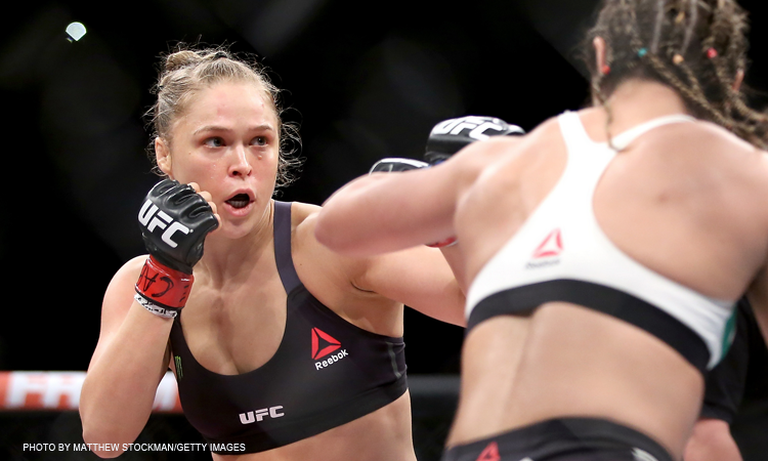


(CNN) — It’s the video you have to watch from this weekend: American mixed martial artist Ronda Rousey takes down Brazilian Bethe Correia on her own turf in just 34 seconds at the Ultimate Fighting Championship’s Women’s Bantamweight Title Fight.
With the swift knockout, the 28-year-old defending champion maintained her dominance as the only female bantamweight champion in the UFC with a 12-0 record.
Related: Rousey knocks out Correia in 34 seconds
Her last fight against Cat Zingano in February also ended swiftly, thanks to Rousey’s signature move, the armbar. Rousey brings her opponent to the ground and traps her arm between her legs, bending it back at the elbow. If her opponent doesn’t tap out to signal defeat, the move could snap the arm ligaments. Rousey deployed it to end the match in 14 seconds, making it the fastest submission in a UFC title fight.
Rousey’s groundbreaking career is full of firsts and superlatives. She’s been called a pioneer, a megastar, a badass, a beast. She’s also been called arrogant, brash and cocky. Few would dispute her claim that she’s “the best fighter in the whole world” — male or female. But her unabashed confidence also has made her a polarizing figure in the male-dominated world of sports.
Magazine profiles and TV interviews play up what they call contrasting qualities, as if none could mutually exist: an attractive woman excelling in a bloody sport; friendly and laid back in person while exhibiting brute force against opponents; masculine in physicality while relying on her sexuality to sell magazine covers.
She’s not afraid to call out — or blow off — critics, and she does not mince words in describing her perceived advantages over opponents — in and out of the ring. When asked if she would ever fight heavyweight boxing champ Floyd Mayweather, her response was “unless we ended up dating,” an apparent reference to domestic violence allegations against him.
In July, when she took home the Best Fighter ESPY award over Mayweather and others, she remarked, “I wonder how Floyd feels being beat by a woman for once.”
She appears to have accepted her provocateur role. As she told the New Yorker in 2014, “I’m the heel, I’m the antihero… And I like it that way.”
Even if you’re unfamiliar with Rousey’s record-breaking feats in the octagon, there are plenty more reasons to give her credit where credit is due. Here are a few:
She’s already made Olympic history
Before Rousey was a UFC champion, she was a top-ranked judoka in the United States.
In 2008, she was favored to become the first American woman to win an Olympic medal in judo, according to her first New York Times profile.
She began training after the death of her father by suicide when she was 8. Before then, swimming was her sport, something she did with her father. After his death, she took up her mothers sport, judo, and began traveling the country to train.
She was 17 when she went to the Athens Olympics but fell short of a medal.
She won a silver medal at the 2007 world championships. Her second visit to the Olympics in Beijing in 2008 went better. She took home a bronze medal and became the first American woman to earn an Olympic medal in Judo.
She considered training for 2012 until deciding that MMA fighting offered a better chance of a career. She began training in 2010 in Southern California’s Armenian-American fighting community, learning boxing and muay techniques before starting to fight on the amateur MMA circuit.
She’s inspired by her mother, who also made sports history
In 1984, Rousey’s mother, AnnMaria De Mars, became the first American — man or woman — to win gold at the World Judo Championships in Vienna. With few options for professional female judokas at the time, she turned her sights to pursuing a Ph.D and raising a family.
Complications from birth led to a speech defect that left Rousey unable to speak until she was five or six years old. Her father helped her with speech therapy and pushed her toward swimming.
After her father’s death in 1995, Rousey took up judo training under her mother.
In addition to judo technique and skills, Rousey says she also learned not to be “the kind of chick that just tries to be pretty and be taken care of by somebody else.” She has a term for it: “do-nothing b—h,” or a “DNB,” she said in a UFC YouTube vlog.
‘ ’41’: ‘assetautoplay’: false ‘assetcontrols’: true ‘assetloop’: false ‘assetmuted’: false ‘assetpreload’: ‘auto’ ’embed’: ‘