

(CNN Philippines) — Foreigners come and go, but some fall in love with the Philippines and eventually decide to call this Southeast Asian country their new home.
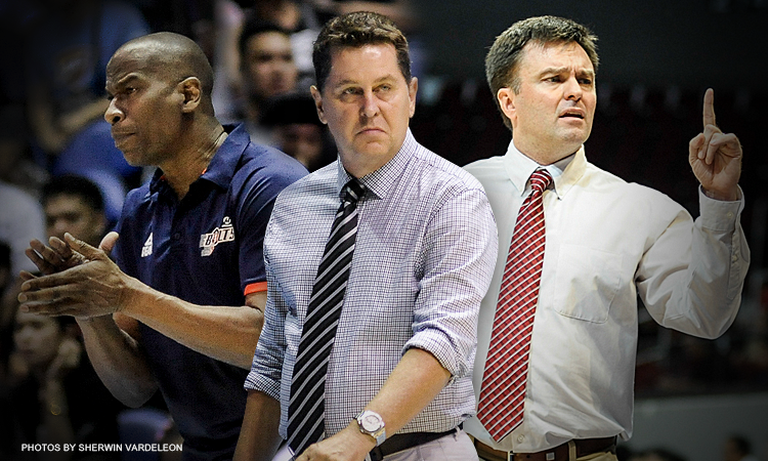
Such was the case for Tim Cone, Norman Black, and Alex Compton – all of whom are American coaches in the Philippine Basketball Association (PBA).
“It’s my home. My children are Filipinos. My wife is a Filipina. I don’t have a home in the U.S.,” said Cone, who has been here for 48 years now.
“To me, I’m a visitor when I go back to the U.S., I’m just a tourist when I go there.”
True Pinoys
Having lived here for a very long time now, Cone considers himself a Filipino. In fact, he has pledged his allegiance to the tricolor flag.
Proof?
“Of course I can sing Bayang Magiliw,” he quipped, referring to the Philippine national anthem Lupang Hinirang. “I spent every morning of my elementary school singing Bayang Magiliw in the public school. You have to sing it everyday.”
The Purefoods coach added in jocular fashion, “But I’m not gonna sing it for you.”
In an attempt to further prove his point, Cone’s face turned from spry to stoic and began explaining.
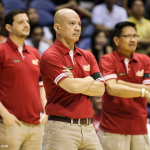
‘ ’18’: ‘image’: ‘jcr:04a97fef-462d-40d2-a2c3-eebe3e16e200’ ‘imageCaption’: ‘Tim Cone came to the Philippines when he was just nine years

“I grew up in the culture. All my friends are Pinoys,” said the 57-year-old coach, who went to the Philippines when he was just nine years old.
“I didn’t grow up as an American. Of course I have an American influence from my parents. But I can’t help but be a Filipino.”
Black shares almost the same sentiment. “Mr. 100%,” as he was dubbed, bared he is actually part Filipino in more ways than one.
“I’m a resident. I’m sure I have a Filipino heart,” said the Meralco coach, whose favorite food is sinigang na hipon.
“When I go back to the States even with my friends I have a tendency of talking in Taglish, which sometimes they don’t understand. In a lot of ways, I’ve become a Filipino over the years.”
Perhaps no other expat is as eloquent as Compton in terms of the speaking the local language.
The amiable Alaska mentor is very fluent in Tagalog. Remove the accent and no one will mistake him for a foreigner.
“Gusto mo bisaya pa, eh?”
But au contraire, unlike the other two accomplished PBA coaches, Compton still doesn’t believe he is among us. But he knows he belongs.
“I don’t consider myself a Filipino because that’s presumptuous and actually not true. I don’t want to dishonor the Filipino by saying that I am one,” bared Compton, who, incidentally, was born in Makati.
“So I don’t put my hand in my heart (during the national anthem) because I’m not a Filipino. I don’t wanna disrespect the country. I love my status right now. Everything’s great but I wanna honor the truth. There are some things that I just didn’t grow up here, kahit nagtatagalog na ako. Hindi ko talaga dinaanan lahat ng dinaanan ng Filipino.”
He loves the country and its people nonetheless.
“I married a Filipina. My children are Filipinos. The truth of the matter is that I’m not ashamed of being an American, I just love the Philippines,” he said.
“Sometimes when they play the national anthem and I put my hand on my chest it’s like, ‘Am I allowed to do this?’ And what’s most honorable thing to do for the nation that I love?”
Learning hoops from childhood friends
Cone is arguably the best coach in the PBA, and his accolades support that claim.
His illustrious career’s highlight is littered with 18 championships – the most in the first play-for-pay league in Asia – including two Grand Slams with two famed ballclubs – Alaska and San Mig Super Coffee Mixers, who reverted back to their glorified Purefoods name before the ongoing 40th season.
He is the lone PBA coach to have pulled off the rare feat.
‘ ’57’: ‘image’: ‘jcr:13a03779-4686-4eb3-8158-23227ab0701f’ ‘imageCaption’: ‘Tim Cone was the only American boy in Baler 47 years ago. But
But little did people know, before he held a drawing board and designed plays for the likes of Johnny Abarrientos and James Yap during crunch times of the most crucial games, the first thing Cone taught the Filipinos was how to play baseball.
When Cone and his family moved in here in 48 years ago, he was the only white guy in a small town in Baler. It didn’t completely come as a surprise for him. What did is the fact that basketball is a religion in this nation of 100 million people whose average height is 5-foot-5.
The provincial capital of Aurora where nine-feet waves in the beaches are a fixture, Baler is a haven for surfers. But, like every corner of this archipelago, it is also home to make-shift basketball courts.
And this was where the youthful Cone first learned how to play hoops.
“Dito lang ako natuto mag-basketball,” he recalled with a child’s gusto.
“Most people had never seen an American boy before. I went to the public school and had a lot of friends. That’s where I first played basketball. Dito lang. In the U.S., I was playing baseball and some American football pero walang basketball.”
It was post-colonial period, and basketball had already dethroned baseball in the sporting kingdom here. Still, in return, he taught his playmates America’s favorite pastime.
From import to coach
Unlike Cone, Black didn’t spend his childhood in the Philippines. But he would eventually live most of his life here.
“I’ve lived here longer than I have in the United States.”
Norman had achieved every cager’s ultimate dream: to play in the National Basketball Association (NBA). He was with the Detroit Pistons during the 1980-1981 season, but played only three games under scant minutes to average 2.7 points. He also suited up in the Continental Basketball Association, now the D-League.
With another NBA stint virtually within reach, why did he decide to take his talents overseas?
Sweat-drenched on his team’s bench, Black was approached by Filipino coach Jimmy Mariano after his last game in the D-League.
“Jimmy Mariano asked me if it was possible for me to come over and play for the Presto team, the Great Taste team at that time,” he said, trying to recall everything that transpired then.
He politely refused. But when then Pistons coach Scottie Robertson told him he wouldn’t be given a guaranteed contract the following season, he reconsidered Mariano’s offer.
‘ ’88’:
“I looked up the Philippines in the encyclopedia to know a little bit more about it and decided that if I was not going to get a guaranteed contract from Detroit, I would take the guaranteed money that Jimmy was offering me,” Norman recalled, adding he didn’t know anyone from the Philippines then but Mariano.
By that time Norman changed his mind, Mariano already tabbed Lew Massey as his team’s import.
A week after, though, he got a call from Tefilin Fiber Makers manager Frank Han. Hence, the beginning of his storied PBA career.
He made an outright impact. To cut the long story short, he became the all-time scoring and rebounding import leader with 11,314 points and 5,333 rebounds after playing 282 games from 1981 to 1990.
“Hopefully I’ve uplifted the brand of play in the Philippines when I was an import,” he said.
His greatness actually rubbed off on his players when he decided to become a full-time coach. Under his tutelage, the San Miguel Beermen won nine championships, including a season sweep in 1989.
As if that wasn’t enough, he also steered the Ateneo de Manila University to an unprecedented five-straight championship in the University Athletic Association of the Philippines (UAAP), before returning to the PBA in 2013 to call the shots for the Talk ‘N Text Tropang Texters, whom he led to the 2014 Commissioner’s Cup finals.
Returning home
Compton was born in the Philippines to parents who are Southeast Asian studies scholars, who stayed here briefly because their work required them to travel from one place to another. The next time he would hear about the country again was during his third year in college.
His coach at Cornell University played overseas and in one random conversation with Alex, the former mentioned that he served as import in the Southeast Asian nation.
“I was born in the Philippines, that’s crazy!” Compton told his coach.
The coach started narrating his experience, as if enticing the young Compton to come over. “Man, you’d be hanging out with actors and actresses there. the biggest name (Robert) Jaworski, he’s like a legend there.”
But what struck him most was this: “There’s a point guard there who is better than you, this guy Johnny Abarientos. He can play.”
Fast forward to 1997. He saw action in the now-defunct Metropolitan Basketball Association for four seasons. He made a good account of himself and became a fixture in the basketball scene.
‘ ‘103’:
Abarrientos was as good as advertised. During that one game in March, Abarrientos broke the hearts of the Dragons with a dagger of a three-pointer that proved to be the game-winner.
“It was right around my birthday. He was still a great player and hit the crucial three that led Ginebra to beat us,” he recalled. “It was my first time to play against him and it was near my birthday.”
As far as Compton can remember, that’s the only time they squared off because he wouldn’t be allowed to play again in the PBA. Under league rules, eligible to play are those who are of Filipino descent. Compton is born here, but is a thoroughbred American.
But he didn’t feel bad. He knew he could no longer suit up in any team in the PBA, but returning to the States had not been much of a consideration for Compton. He felt he was meant to be in the Philippines the same way moths cleave to light.
“The PBL (now-defunct Philippine Basketball League) let me played but the salary is getting less and less and it’s more like an amateur,” he explained. “But it wasn’t about making money or not making money. It was that I felt this is where I’m supposed to be.”
“I was telling my brothers that the Philippines had the most positive impact on me.”
Filipino home and family
The three American coaches, who are all married to a Filipina, feel there is nothing like a Filipino family.
“I guess the one Filipino tradition that I’m quite proud of is probably the love of the family,” Black, who has three kids with wife Carmen, said. “The one thing that I noticed over the years is the fact that they (Filipinos) are very family oriented – something that I have not grown into but I’ve learned to love.”
For Cone, this is the most vital aspect of being a Filipino.
“The Filipino culture of family is very important,” he said. “Every Sunday, we go to my in-laws and spend time with them. We’re very close to our cousins and in-laws. We always have a big reunion every Sunday at the house.”
“I don’t think it’s as important in the U.S.”
Compton said he didn’t feel like a castoff from Day one despite being a foreigner. Home is everywhere: inside the gym, inside the coliseum, in the streets, in a restaurant, to name a few. And everyone’s a family.
“I love the warmth of the Filipino hospitality,” Compton said. “I’m cool with (the concept of) barkada, whose members poke fun at each other. I don’t think I’m changing my personality because it fits my personality.”