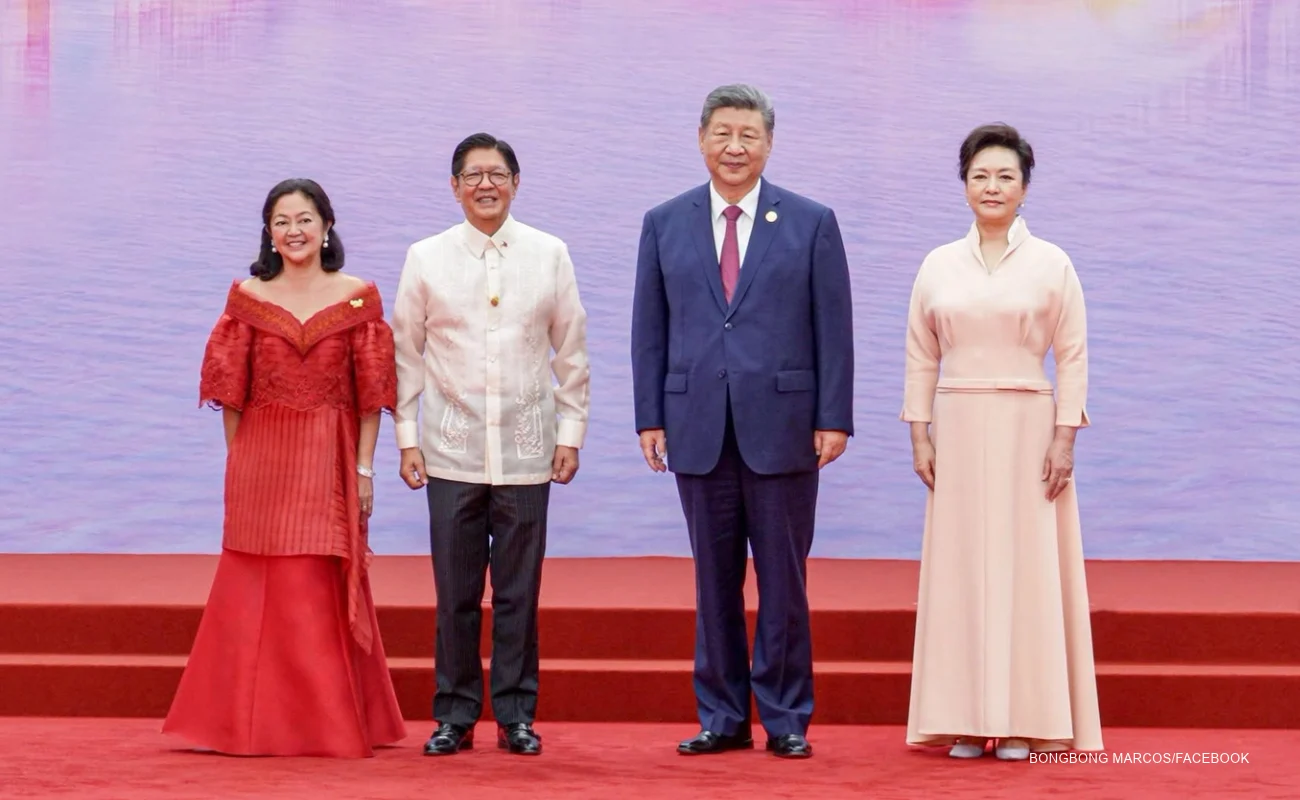


Metro Manila, Philippines – President Ferdinand Marcos Jr. and First Lady Liza Araneta-Marcos received an official welcome from Chinese President Xi Jinping and Madame Peng Liyuan in Shenzhen, China, as Asia-Pacific leaders gathered for the 33rd Asia-Pacific Economic Cooperation (APEC) Economic Leaders’ Meeting amid continuing tensions between Manila and Beijing over the South China Sea.
The meeting follows the conclusion of the Philippines’ 2026 chairship of the Association of Southeast Asian Nations (ASEAN), which ended without a finalized South China Sea Code of Conduct despite Manila’s efforts to complete negotiations with Beijing and other ASEAN-member states.
The Philippines and China have remained at odds over competing maritime claims, with repeated confrontations involving their vessels in disputed waters.
Manila has consistently invoked the 2016 arbitral ruling that invalidated the legal basis of China’s expansive claims to historic rights in the South China Sea. Beijing rejects the ruling.
Despite the tensions, Marcos said the Philippines would continue engaging China on economic opportunities while protecting its national interests.
“We will engage China constructively on expanding trade, investment, and people-to-people exchanges that benefit our peoples, even as we remain steadfast in upholding our national interest,” Marcos said in his departure statement.
The president said China’s theme for this year’s APEC gathering, “Building an Asia-Pacific Community to Prosper Together,” aligns with the Philippines’ priorities of expanding markets, accelerating digital transformation and attracting investments.
As outgoing ASEAN chair, Marcos said he would bring the regional bloc’s economic achievements to APEC.
“As chair of ASEAN this year, I will also bring to APEC the gains of our chairship, including the ASEAN Digital Economy Framework Agreement, the world’s first region-wide digital economy agreement which ASEAN concluded in Manila,” Marcos said.
The framework aims to strengthen cross-border digital trade, improve interoperability and expand opportunities for businesses across Southeast Asia.
However, the Philippines’ ASEAN chairship also ended with a major diplomatic objective unfinished.
Marcos earlier acknowledged that ASEAN and China had failed to finalize the long-awaited South China Sea COC, although he estimated that 85% to 90% of negotiations had been completed.
The remaining issues will be taken up under Singapore’s ASEAN chairship in 2027.
At APEC, Marcos is expected to focus on strengthening trade relationships and attracting investments amid growing economic uncertainty and geopolitical competition.
The president highlighted the economic importance of the Asia-Pacific region, which accounts for 37 percent of the world’s population, 61 percent of global gross domestic product and 46% of international trade in goods and commercial services.
He also cited projections that APEC economies would grow by 3.4 percent in 2026, supported by investments in digital technology and artificial intelligence.
Marcos said the Philippines would seek to capitalize on these opportunities by expanding export markets and encouraging foreign investment.
He cited the country’s record $84.5 billion in exports in 2025 and its reclassification as an upper-middle-income economy in July 2026 as indicators of economic progress.
“Our message is clear: the Philippines is open for business. Invest in the Filipino,” Marcos said.