
Metro Manila, Philippines – Filipino students posted higher scores in mathematics, science and reading in the 2025 Programme for International Student Assessment (PISA), showing improvement from the previous cycle even as the country remained well below international averages.
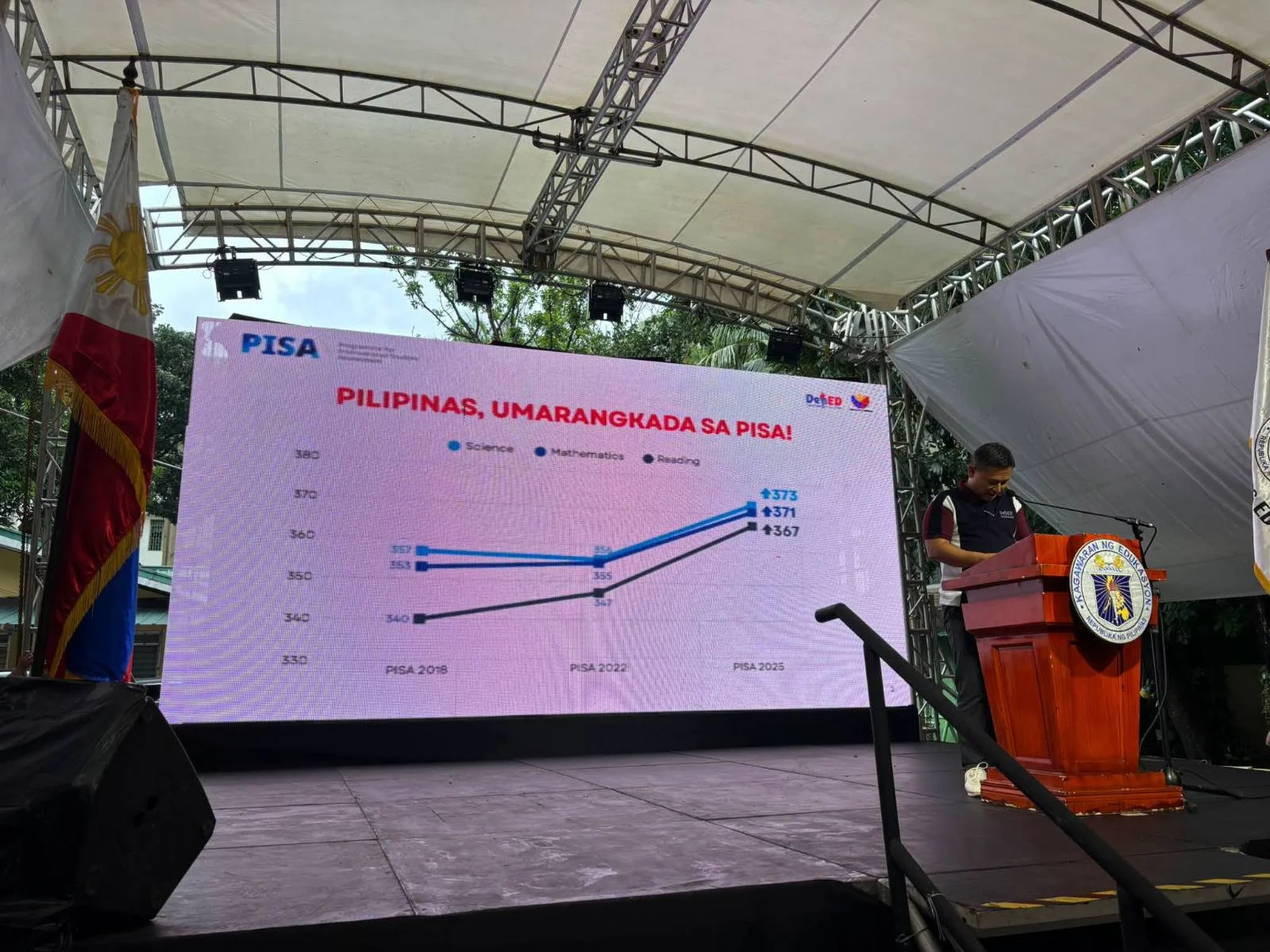
The Philippines scored 371 in mathematics, 373 in science and 367 in reading, according to the latest results released Tuesday, Sept. 8, by the Organisation for Economic Co-operation and Development (OECD).
Compared with the 2022 assessment, the country’s score increased by 16 points in mathematics, 17 points in science and 20 points in reading. The improvement in reading was the strongest among participating education systems, according to the OECD.
The gains stand out against a broader decline in student performance internationally. Across OECD countries, average scores in reading and mathematics fell to their lowest levels recorded by PISA, while science performance was largely stable.
But the Philippines still faces a wide learning gap.
The OECD average was 463 in mathematics, 482 in science and 461 in reading, leaving Filipino students more than 90 points behind the average in each of the three subjects.
The Second Congressional Commission on Education (EDCOM 2) welcomed the results but said the country should look beyond rankings and examine which groups of students are improving and which continue to fall behind.
“The PISA is an important international measure of learning outcomes, and this cycle’s data — together with our own national and classroom-based assessments — gives us a clearer, evidence-based basis for assessing progress towards the goals set out in EDCOM 2’s Final Report and the National Education and Workforce Development Plan (NatPlan) 2026–2035,” the commission said in a statement.
EDCOM 2 said the results should also be examined alongside factors affecting students’ ability to learn, including school safety, teacher support, access to resources and students’ sense of belonging.
The commission called for continuity in education reforms, warning against policies being repeatedly reset with changes in leadership.
“Education reform cannot begin again with every change in leadership; it requires consistency of purpose, continuity in implementation, and the commitment of the entire country,” EDCOM 2 said.
PISA measures how well 15-year-old students can apply their knowledge and skills in reading, mathematics and science to real-life challenges. More than 760,000 students from 91 countries and economies participated in the 2025 assessment.
Marcos welcomes PISA score improvement
President Ferdinand Marcos Jr. welcomed the results, saying the Philippines was among the education systems that improved across all three PISA domains.
“Napakagandang balita mula sa Programme for International Student Assessment! Tumaas ang marka ng ating mga mag-aaral sa reading, mathematics at science. Kabilang ang Pilipinas sa iilang sistema ng edukasyon na umangat sa lahat ng larangan,” he said.
[Translation: This is very good news from the Programme for International Student Assessment. Our students’ scores in reading, mathematics and science have improved. The Philippines is among the few education systems that made gains across all areas.]
Marcos said the government would continue and intensify its education programs.
“Ipagpapatuloy at lalo pa nating paiigtingin ang ating mga programa upang mas mapaganda ang edukasyon at kinabukasan ng bawat batang Pilipino,” he said.
[Translation: We will continue and further strengthen our programs to improve education and build a better future for every Filipino child.]
The Philippines first joined PISA in 2018, when it ranked at or near the bottom in all three core subjects.