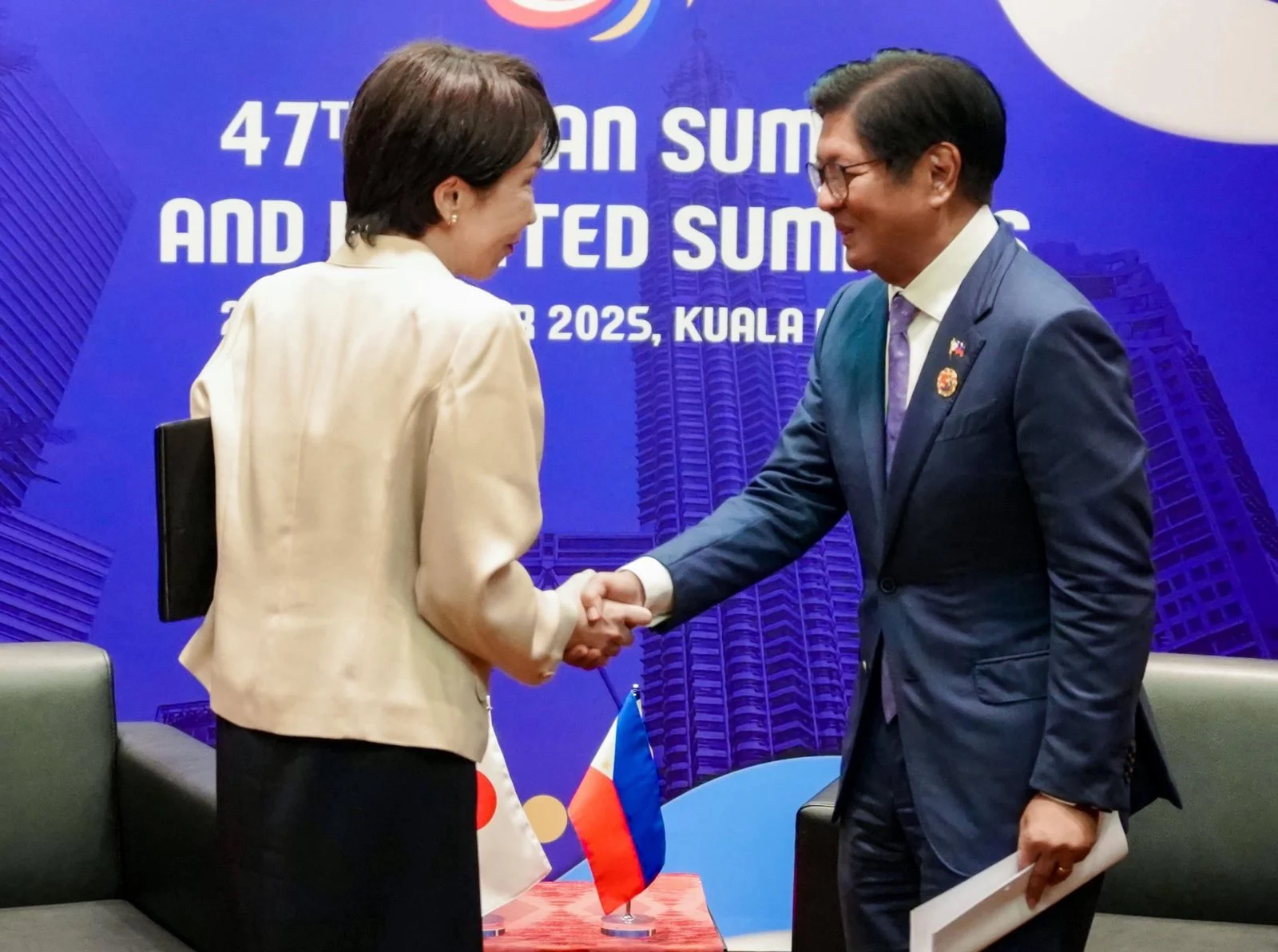


Metro Manila, Philippines – President Ferdinand Marcos Jr. said the Philippines and Japan are expected to discuss the full implementation of key defense agreements during his upcoming state visit later this month.
In an interview with Japanese media organizations, Marcos said security and defense cooperation would be among the major agenda items in his meeting with Japanese Prime Minister Sanae Takaichi.
“Security cooperation would be a very important part of that discussion,” Marcos said.
The president specifically cited the Reciprocal Access Agreement (RAA) and the Acquisition and Cross-Servicing Agreement (ACSA) signed between the two countries.
“We have agreed upon the reciprocal access agreement, for example, and the acquisition and cross-servicing agreement that was signed last January,” Marcos said.
“We want, and I assume we are going to discuss those, fully implement those agreements,” he added.
The RAA allows Filipino and Japanese troops to enter each other’s territories for joint military exercises and operations, while the ACSA facilitates logistics and military support cooperation between both armed forces.
Marcos said the Philippines is also seeking further clarity on Japan’s evolving security posture in the region and how it could expand cooperation both bilaterally and within the broader Indo-Pacific.
“This is all in the context of Japan’s new posture in terms of defense and security,” Marcos said.
“We have to define it now in terms of how it’s going to work for Japan and the Philippines bilaterally, and together, multilaterally, together with our other friends and allies in the region,” he added.
The president also pointed to Japan’s increased participation in this year’s Balikatan military exercises as a major development.
“For the first time in our Balikatan exercises, Japan has taken an active role,” Marcos said.
“Japan moved this year from being an observer to a participant, and that is a significant development,” he added.
Marcos said both countries have experienced similar security challenges in the region, particularly involving “coercive acts” and “gray zone tactics” in the South China Sea.
“And as Japan and the Philippines have experienced the same difficulties in terms of coercive acts, in terms of different gray zone tactics that are being exercised in the South China Sea,” he said.
The president also said discussions could include Japan’s continued assistance to the Armed Forces of the Philippines modernization program.
“Will that be expanded? So there are very, very many areas that we need to continue to explore,” he added.