

Metro Manila, Philippines — It has been almost a year since a massive fire ravaged the historical Manila Central Post Office for more than 30 hours. Now, the heritage site, which was filled with several mails, is empty as the restoration stands still.
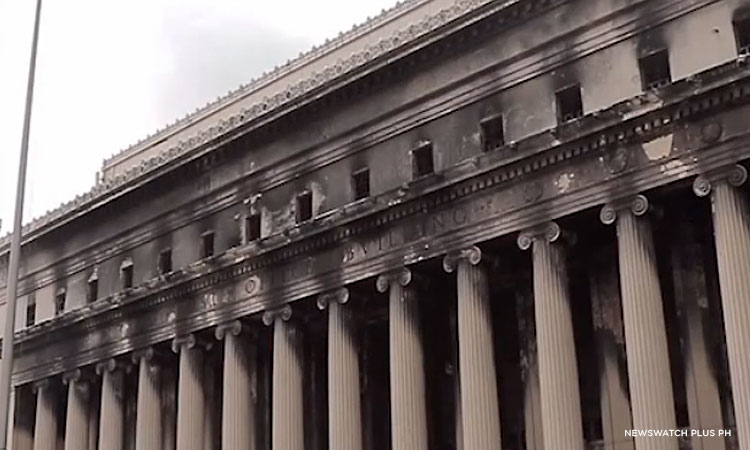
Presently, the iconic building’s facade is covered by black marks or what seems to be smoke stains. The inside of the post office, meanwhile, is gutted and only the pillars remain.
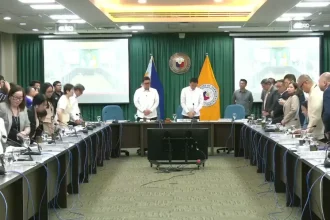
An inter-agency task force – composed of the Philippine Postal Corporation (PHLPost), National Commission for Culture and the Arts (NCCA), the Department of Tourism (DOT), the National Historical Commission of the Philippines, the National Museum of the Philippines, and the local government of Manila – is responsible for the restoration of the Manila Central Post Office.
PHLPost Postmaster General Luis Carlos told NewsWatch Plus the process that will be undertaken to bring back the post office’s full glory.
First, a Detailed Architectural and Engineering Study (DAES) will be conducted to assess the building’s condition and the interventions that will be done. After the study has been completed, there will be a bidding for a Detailed Architectural and Engineering Design or the building’s layout. Once a bidder has been chosen, the rehabilitation and restoration will start.
“Mostly the inside, it will be restored also… The third floor of this, basically, will be ‘yun pa rin ‘yung pinaka-structure. The corporate office will still be there and the Manila Central Post Office. We have to bring back the Central Post Office. Nandiyan siya dapat,” Carlos said.
Carlos said the DAES is already ongoing, and they are still waiting for the results of the study as of posting time.
The DOT has allocated ₱15 million for the DAES – ₱6 million for the designs of the shoring, construction scaffoldings, and temporary roof and the methodology; another ₱6 million for the condition assessment plans and building of diagnostic results; and ₱3 million for the process of cost analysis of the post office’s state of damage.
Even though the government has not reached the rehabilitation and restoration stage yet, Carlos said that the post office may be ready by 2026.
“Personally, there’s a target of 2026 [for] this building, the end of 2026. November of 2026 will be the anniversary of the Post Office for being a hundred years old building. Susubukan naming isabay du’n. Technically, that’s a moving target,” he said.
The restored Manila Central Post Office will be included in Manila’ s tourism circuit alongside Intramuros and the Metropolitan Theater.
“Historically, it’s for the next generation to see what this building is all about, its grandeur and its being an iconic building. So, the next generations after us hopefully can see how beautiful this building is,” Carlos said. “It’s beyond the commerce of men. It’s for the Filipino people to see the grandeur of this iconic building.”
National Historical Landmark
The Manila Central Post Office is a neoclassical building designed by Filipino architects Juan Arellano and Tomas Mapua. It was built in 1926.
During World War II, particularly the Battle of Manila, the post office sustained damage. It was then restored after the war in 1946.
The National Museum declared the post office as an Important Cultural Property in 2018. It has also been recognized as a national historical landmark.
On the night of May 21, 2023, a fire hit the Manila Central Post Office, burning around 90 percent of the items inside.
The Bureau of Fire Protection said that the blaze sparked from the basement when a car battery exploded.
‘Championing Heritage’
The anniversary of the Manila Central Post Office fire coincides with the National Heritage Month.
This year’s theme, Championing Heritage: Capacity Building to Transform Communities, honors the country’s cultural workers and advocates who reach out to indigenous peoples and “help them boost their ingenuity and creativity to the mainstream media.”
The NCCA aims to provide cultural mapping, maintenance of the Philippine Registry of Heritage, and other capacity-building activities.
The commission also seeks to “enhance and improve the Filipinos’ love and awareness of the preservation and conservation of our cultural heritage.”