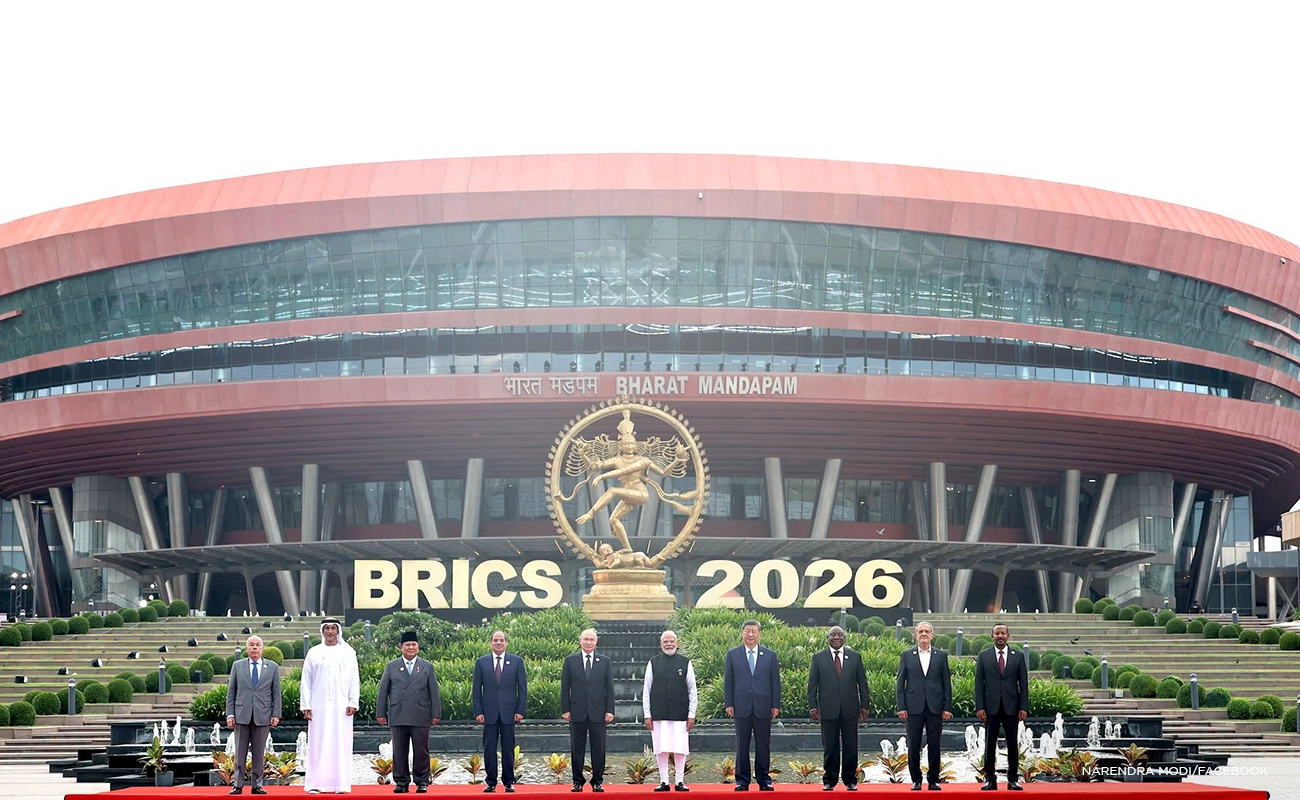


Dubai, United Arab Emirates – Leaders of BRICS, a grouping of major emerging economies led by Brazil, Russia, India, China and South Africa, called for maximum restraint amid escalating tensions in the Middle East, warning of risks to global energy flows, trade and supply chains.
In the New Delhi Declaration adopted at the 18th BRICS Summit on Sunday, Sept. 13, the leaders expressed “deep concern” over the continued escalation in the Middle East, which the group also refers to as West Asia, and urged countries to avoid actions that could further aggravate the situation.
“We encourage increasing efforts, through dialogue and diplomacy, towards a long-term understanding that will contribute to lasting peace, security and stability in the region,” the declaration said.
“We stress the need to work together to maintain smooth flow of global trade, supply chains and energy, in accordance with applicable international law,” it said.
The declaration did not single out a country in its broader call for restraint, saying civilians and civilian infrastructure must be protected while the sovereignty and territorial integrity of states must be respected.
The leaders separately expressed “serious concern” over deliberate attacks on civilian infrastructure and peaceful nuclear facilities under full safeguards of the International Atomic Energy Agency.
“Nuclear safeguards, safety, and security must always be upheld, including in armed conflicts, to protect people and the environment from harm,” the declaration said.
Gaza, Palestinian state
BRICS also took a firm position on Gaza, calling for the maintenance of the ceasefire and “full and unhindered humanitarian access” amid continued violence.
The group called for an end to policies aimed at the forced displacement of Palestinians from Gaza and expressed concern over arrangements that could undermine Palestinian rights or prolong occupation.
BRICS went further by declaring its “firm opposition” to the temporary or permanent forced displacement of Palestinians from the occupied Palestinian territory under any pretext, as well as attempts to change the geography or demographics of Gaza.
The leaders reaffirmed support for a two-state solution and a sovereign, independent and viable Palestinian state based on the internationally recognized 1967 borders, including Gaza and the West Bank, with East Jerusalem as its capital.
They also backed full Palestinian membership in the United Nations.
The declaration also addressed the situation in Lebanon, calling on all parties to adhere to the ceasefire and fully implement UN Security Council Resolution 1701.
BRICS condemned continuing violations of the ceasefire and Lebanon’s sovereignty and territorial integrity.
“We call on Israel to respect the terms agreed with the Lebanese government and to withdraw its occupying forces from all of the Lebanese territories, in which they remain,” the declaration said.
The group also condemned attacks against the United Nations Interim Force in Lebanon, or UNIFIL, and called for accountability for attacks on peacekeepers.
President Ferdinand Marcos Jr. was in New Delhi to represent the Association of Southeast Asian Nations, which the Philippines chairs this year, at the Outreach/BRICS Plus Dialogue. The Philippines is not a BRICS member and not a signatory to the leaders’ declaration.
BRICS said the outreach dialogue hosted by India was intended to strengthen international cooperation and solidarity.