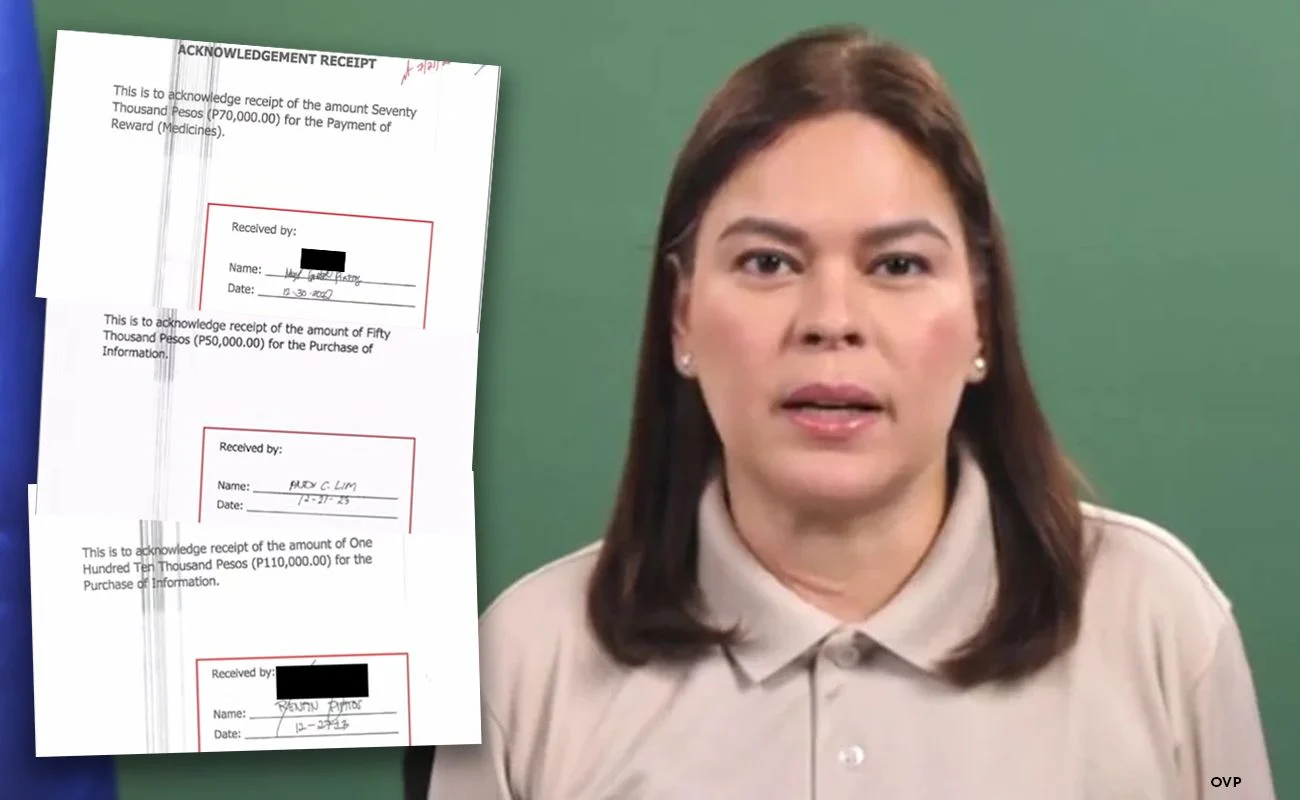


Metro Manila, Philippines – For the first time, Vice President Sara Duterte’s legal team admitted that the names of signatories listed in acknowledgment receipts for confidential funds were mere aliases.
Defense lawyer Justin Gular confirmed this during Day 22 of the impeachment trial on Monday, Sept. 7, settling a long-running question surrounding unusual names such as the controversial “Mary Grace Piattos.”
“Given that it has become a material matter, we have to couch this answer that this is classified information but these are in fact aliases, your honor,” Gular said.
He was responding to Senator-judge Risa Hontiveros, who said she was confused by the questions Gular raised during his cross-examination of Philippine Statistics Authority Assistant National Statistician Marizza Grande.
“Nung una pinapakita na posibleng totoong tao ang nakapangalan sa acknowledgement receipts hindi lang nahagip ng mga records ng PSA. Pagkatapos, pinapakita naman na kung alias eh wala naman talagang records sa PSA,” Hontiveros said.
“So for the record at malinaw na po once and for all. Ano po ba ang sinasabi ng respondent sa mga pangalan sa acknowledgement receipts? Mga totoong pangalan po ba ang mga iyon o mga aliases po ba iyon,” she added.
[Translation: At first, it was shown that the people named in the acknowledgement receipts could possibly be real people whose records simply did not appear in the PSA database. Then, it was shown that if they were aliases, they would not have records in the PSA in the first place. So, for the record and to make this clear once and for all: What exactly is the respondent saying about the names in the acknowledgment receipts? Are those real names, or are they aliases?]
While Gular confirmed that the names were aliases, he refused to provide further details, saying the defense would explain its position at the proper time.
‘A tad too late’
Prosecution counsel Mae Divinagracia, however, lamented that it was “a tad too late” for the defense to adopt such a position, saying it should have been disclosed during pre-trial proceedings when both sides were laying out their respective cases.
“Even the prosecution is entitled to due process,” she said.
Lead defense counsel Sheila Sison, however, stressed that the burden of proof lies with the prosecution, and that the defense should only be required to present its case afterward.
“I will not dignify these complaints,” Sison said.
Presiding Officer Francis “Chiz” Escudero noted that even the Impeachment Court could not force the defense to lay out its evidence or theories, adding that Duterte’s camp could even opt not to present any evidence if it believes the prosecution has a weak case.
Non-existent, dead, child recipients
During her direct examination, Grande confirmed that of the 2,669 names listed as recipients of confidential funds, more than half—or 1,685—had no birth, marriage, or death records with the PSA.
Grande said 37 of the names matched records of people who had died years before the supposed payment of the rewards charged to confidential funds.
These included a certain “Marlene Sunga,” who died in 1965 at two months old.
A total of 25 individuals listed as recipients were minors, including two children who were only one year old, Grande said.
Escudero pointed out that although these were single-match entries, the PSA could not definitively say whether the individuals in its records were the actual recipients named in the acknowledgment receipts.
Gular likewise pointed out that not all Filipinos are registered with the PSA, although Grande said the agency’s records cover more than 96% of the population.
Senator-judge Raffy Tulfo, meanwhile, suggested that the names could all have been aliases that happened to coincide with the names of real people in PSA records.