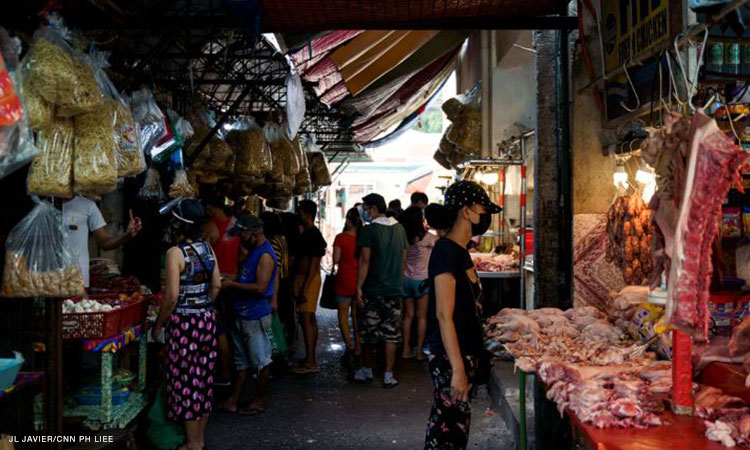


Metro Manila (CNN Philippines, December 26) — President Ferdinand Marcos Jr. has approved the recommendation to maintain lower tariff rates on rice, corn, and pork until end-2024 to help keep prices affordable amid the El Niño phenomenon and the prevalence of the African Swine Fever (ASF).
Marcos issued Executive Order No. 50 on Dec. 22 following the endorsement of the National Economic and Development Authority (NEDA) Board to extend the reduced “Most Favored Nation” rates of import duty on the said products until Dec. 31, 2024.
In the order made public on Tuesday, the president said present economic conditions warrant such a move “for the purpose of ensuring food security, managing inflationary pressures, help augment the supply of basic agricultural commodities in the country, and diversify the country’s market sources.”
El Niño, which is seen to last throughout the first half of 2024, is expected to negatively impact agricultural production and prices both locally and globally.
Apart from the dry spell and the ASF, Marcos also cited trade restrictions in some exporting countries as a cause of uncertainty in the country’s steady supply of rice, corn, and pork.
Under the Customs Modernization and Tariff Act, the president is given the power to increase, reduce or remove existing rates of import duty in the interest of general welfare and national security, and upon the recommendation of the NEDA.
Meanwhile, Marcos ordered the NEDA Committee on Tariff and Related Matters to submit its findings and recommendations on the semestral and annual review of tariff rates, including analysis and monitoring of the subject commodities.
Treated as scapegoats?
For the Samahang Industriya ng Agrikultura (SINAG), the extension of the tariff cuts will only benefit importers and hurt local farmers and producers.
“It is unfortunate that NEDA and the economic team are just looking at the retail prices, they are not looking at the farmgate prices and cost of local production,” SINAG executive director Jayson Cainglet told CNN Philippines’ The Final Word on Tuesday.
He also claimed that local producers are being treated as \”scapegoats\” for soaring food prices due to inflation.
Cainglet stressed that prices of rice, corn, and pork in the country did not go down for the past three years despite the lower tariffs.
\”It never happened for the past three years and it will never happen again next year,\” he said, adding that the problem lies on the disparity between farmgate and retail prices, and not on local production.
\”From 2021 to 2024, binigay namin sa kanila ang data na nagpapakita na hindi nakinabang ang producer at consumer,\” he added.
[Translation: We gave them the data showing producers and consumers did not benefit from the tariff reduction from 2021 to 2024.]