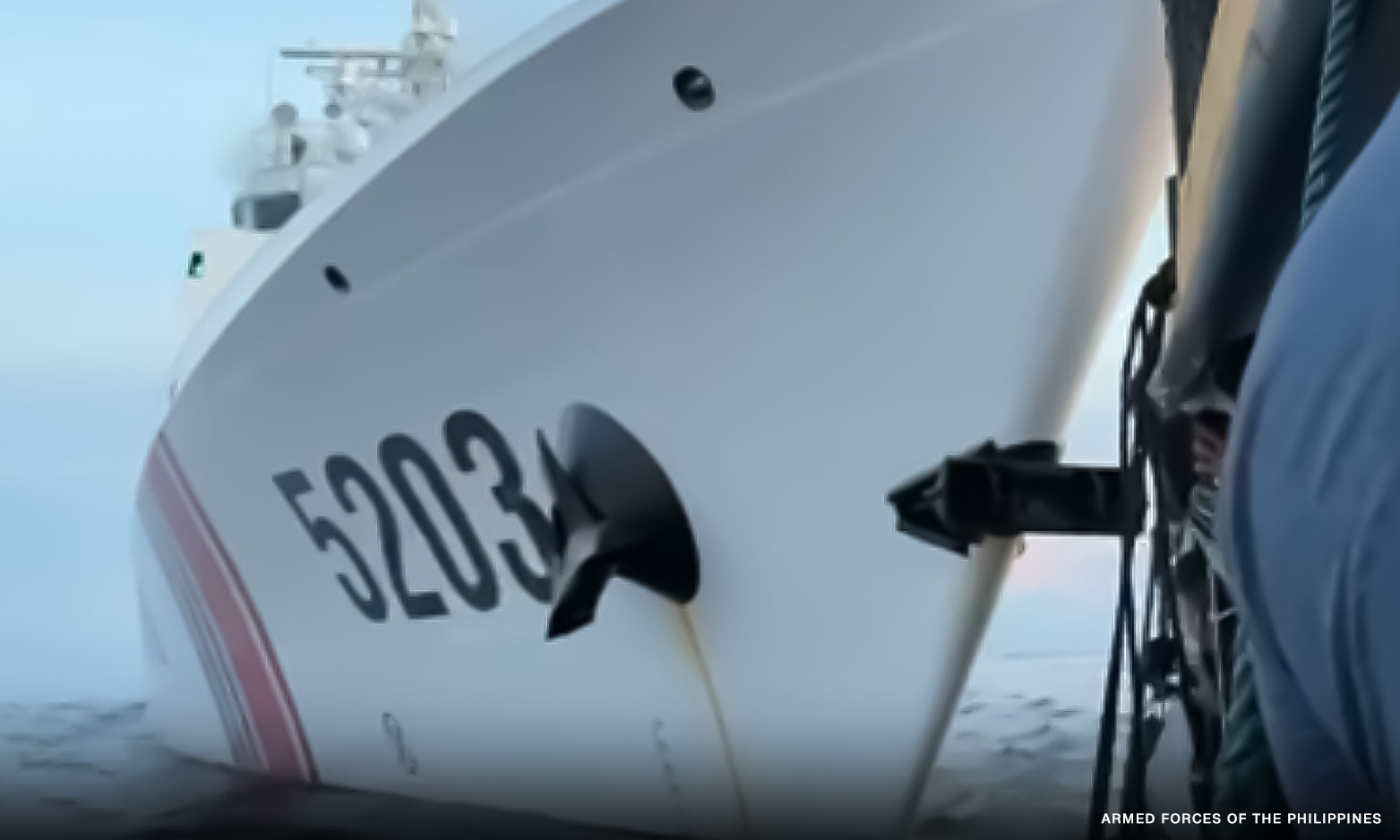


Metro Manila (CNN Philippines, October 23) – Thirteen Chinese vessels interfered with the Philippines’ latest resupply mission to the BRP Sierra Madre, when Beijing’s ships collided with Philippine military-contracted civilian boats, officials said on Monday
Commodore Jay Tarriela, Philippine Coast Guard (PCG) spokesperson for the West Philippine Sea, said five Chinese Coast Guard (CCG) ships “participated in the shadowing, dangerous maneuvers, and blocking” of the mission, while eight Chinese Maritime Militia Vessels (CMMVs) “actively participated in blocking the resupply contingent.”
READ: Chinese ships collide with PH vessels on resupply mission to Ayungin – NTF-WPS
The latest incident adds to the growing tension between the two countries as Beijing intensifies aggression in Manila’s exclusive economic zone. China claims nearly the entire South China Sea, including the portion Manila calls the West Philippine Sea, and continues to rejected a 2016 arbitral tribunal ruling that invalidated Beijing’s expansive claims in the area.
At 9 p.m. on Saturday, a day before the resupply mission, Tarriela said two CCG vessels were monitored tailing the PCG’s BRP Cabra even before Unaiza May (UM) 1 and 2 – two civilian vessels contracted to deliver supplies – made it to the area.
On Sunday morning, when the mission began, two CMMV vessels corralled the BRP Cabra in an attempt to separate it from the civilian boats. Once the two CMMVs trapped the PCG’s ship, the CCG converged on the lone UM2 and crossed into its path, resulting in the collision.
No one was hurt but the civilian boat sustained damage and the maneuver imperiled Filipino lives, officials of the National Task Force on the West Philippine Sea said.
At one point, seven Chinese ships – four CCG and three CMMV – surrounded the UM2 and the PCG’s vessels. Aside from crewmembers, Filipino journalists were also aboard the country’s boats to cover the mission.
‘ ’19’: ‘image’: ‘jcr:74b1ac00-e96f-4c99-b70d-dcc5de4b4e5c’ ‘imageCaption’: ‘The PCG’s presentation before the NTF-WPS depicts how a swarm

Because of China’s interference, only one of the civilian supply boats was able to successfully deliver essential supplies to Filipino troops stationed on the Ayungin outpost.
In the afternoon, as the resupply contingent was returning to its station, Tarriela said two Chinese People’s Liberation Army Navy vessels escorted the Filipino ships out of the area.
Two hours later, two more CCG vessels continued to tail the Filipino ships away from the contested waters.
“It is also worth noting that the CMMVs now are also doing such dangerous maneuvers that even collided with our Philippine vessel. Before, they were just taking orders from the CCG vessels, supporting the coast guard in blocking the PCG and separating the indigenous boats,” Tarriela pointed out.
The PCG accused the CCG and CMMV vessels of breaking three rules under the 1972 Collision Regulations (COLREG) set by the International Maritime Organization, of which China is a signatory. These are:
Rule 2, pertaining to the responsibility of vessels to avoid a collision.
Rule 7, stating that all vessels must use all available means appropriate to prevailing circumstances and conditions to determine if a risk of collision exists.
Rule 18, dictating that a vessel shall keep out of the way of another if the latter has right of way.
Meanwhile, the Department of Foreign Affairs revealed that the hotline connecting the Philippines and China remained silent as the incident took place. A fresh diplomatic protest has been filed against Beijing for its latest harassment.