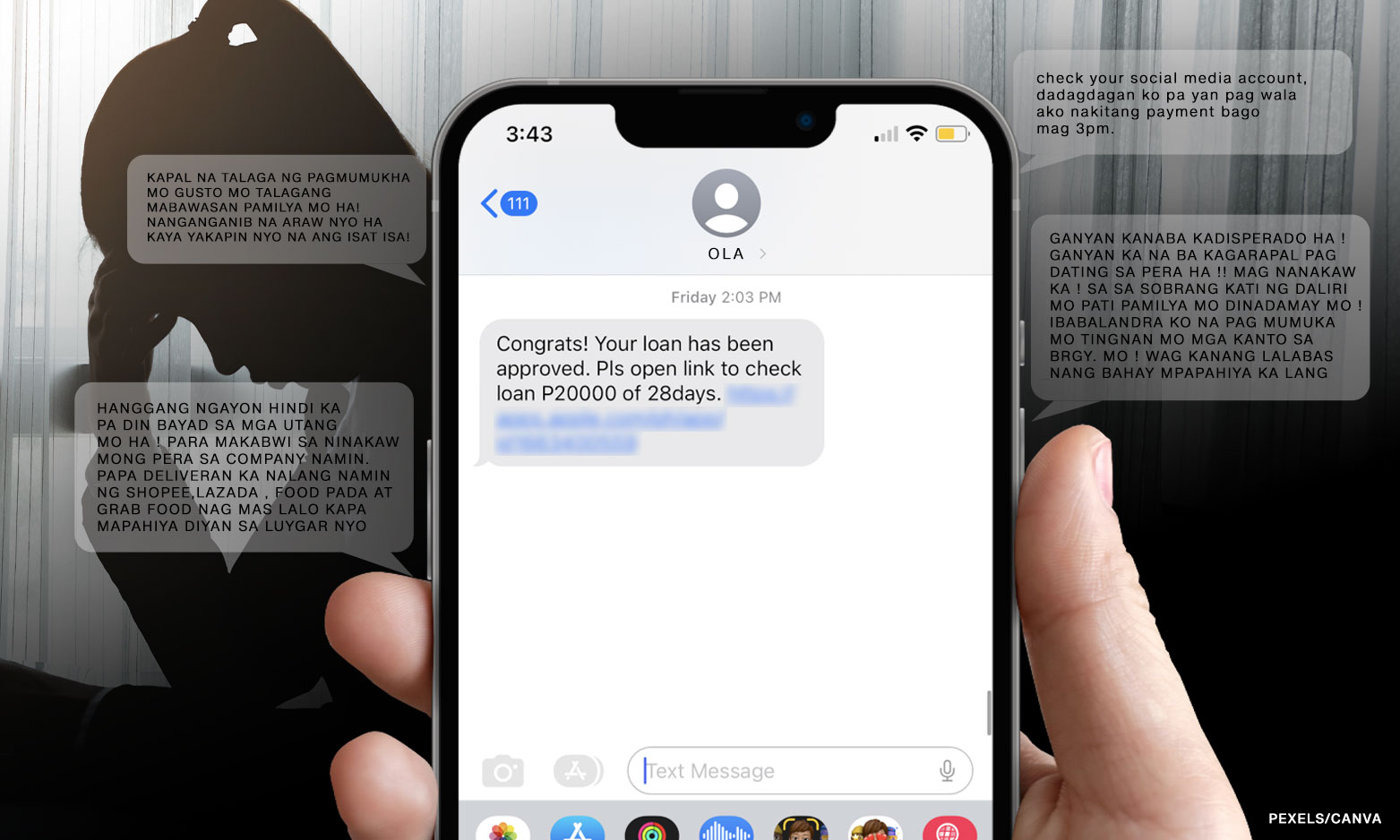


CNN Philippines — It all starts innocently enough — an advertisement on your newsfeed or a text message from an unknown number informing you that you have been approved for a loan. For those in dire financial straits, they’re heaven sent.
‘ ’60’:

Online lending apps (OLAs) promise instant cash loans with very minimal requirements and are processed entirely on a smartphone, typically within a few minutes.
Applying for a loan is as simple as filling out a personal information form with a working cell phone number, submitting a valid ID, and taking a selfie. The final step is to agree to all of their terms and conditions, which often include access to one’s contacts.With the accessibility of OLAs, some desperate people would be willing to take a chance, oblivious to the nightmare that is about to unfold, as told by hundreds of loan takers.
“I didn’t know the gravity of what’s going to happen,” said Ace, a technical support expert for a BPO company, who experienced monetary stress and resorted to OLAs. He recalled feeling embarrassed and hesitant to borrow money from relatives and friends when he saw an OLA advertisement on Facebook in December 2021.
“Nakita ko yung ads. Nag-o-offer daw sila ng loan… I tried kasi nga ang nakalagay sa advertisement nila is you can get this [amount of] money, 10% interest, and you pay it for 180 days. Siyempre kailangan ko ng pera, kailangan ko mag-pay ng bills,” he said.
[Translation: I saw the ads. They said they were offering a loan…I tried because what was written in their advertisement is, you can get this [amount of] money, 10% interest, and you pay it for 180 days. I absolutely needed money, I needed to pay bills.]
Ace breezed through the process without a hitch and accepted all conditions “out of requirement” so that the online lender could deposit the money into his bank account. He was approved for a principal amount of ₱2,500 and received around ₱1,200, nearly 50% was deducted for the processing fees and other charges.Contrary to the advertised maximum loan term of 180 days, Ace claims the OLA only gave him seven days to refund a total of ₱2,800. He pressed on out of desperation.
“Mas malaki pa yung interes mong babayaran kaysa sa nahiram mo. At first I was hesitant, kasi wala na eh, na-click ko na eh, and I was not looking at the rules kasi yun nga, dun sa advertisement, nakita ko 180 days. Suddenly, seven days lang pala,” he said.
[Translation: The interest you will pay is more than what you have borrowed. At first I was hesitant, but I’ve already clicked it, and I wasn’t looking at the rules because, in the advertisement, I saw 180 days (loan term). Suddenly, it’s only seven days.]
The Securities and Exchange Commission (SEC) in March 2022 complied with the Bangko Sentral ng Pilipinas’ (BSP) directive and placed a cap on interest rates on loans made by lending and financing companies, as well as their OLAs. For loans of ₱10,000 and below with a duration of up to four months, it set the maximum nominal interest rate at 6%, or around 0.2% per day, and the effective interest rate at 15%, or roughly 0.5% per day.
When she found her grandchildren were without milk or diapers, Rachel, a mother and a city hall employee, realized she was in a monetary bind and had no one to turn to for help.
Like Ace, she found an OLA advertisement on social media and took the risk despite the exorbitant interest rate. “Unang try ko, malaki pala yung tubo nila pero hindi ko na ininda kasi kailangan, eh,” she said.
Both Ace and Rachel were able to make payments for the first few weeks. They said their worst nightmare started when they couldn’t pay anymore due to the mounting interest.Persistent calls and text messages bombarded them from morning to night. They remembered that most contained threats, curses, and accusations intended to force them to pay.
At this point, Ace recalled receiving a message, from another OLA informing him that he has an approved loan. The same thing happened to Rachel.
“I was panicking. ‘Di ko na alam gagawin ko…May nag-text sa ‘king OLA, ang sabi, ‘Kapos ka ba sa budget?’ So kinuha ko. Hanggang sa nagpatong-patong na siya,” said Ace.
“‘Yung isang OLA, para mabayaran ko, kailangan ko humiram sa tatlo [To pay my loan in one OLA, I had to borrow from three],” Rachel said, recalling how her list of OLAs racked up to 50 after settling her loan one app at a time. Rachel’s loans from all the lenders swelled to around ₱200,000.
‘ ’62’:
The threatening messages, according to Ace and Rachel, kept them from showing up for work and took a toll on their mental health. They said most, if not all, collectors took it a step further and text-blasted the rude messages to their contacts to further humiliate them.
“I tried to explain…but they did not listen. They blocked me, they stopped talking to me. ‘Yung effect niya talaga, it’s very big in terms of how I was treated after,” Ace said.
The collectors’ atrocious tactics went beyond just leaving messages. Rachel remembered waking up and seeing her photo posted on her hometown’s online buy-and-sell groups under a slew of incriminating titles, such as “scammer” and “magnanakaw.” The photo, posted through a fake social media account, was the selfie that she submitted as part of most OLAs’ verification process.
Ace claimed some collectors would go as far as to create group chats with the borrower’s Facebook friends to embarrass them, which he said he had endured. Rachel said she knew of a friend who received a coffin-like box to humiliate and harass her. ‘ ’63’:
The SEC earlier said it was aware of the practice of lending companies in engaging the services of third-party service providers in “their effort to avoid liability for client harassment, by invoking the latter’s separate juridical personality,” after it received complaints against lending companies allegedly “harass[ing] borrowers and employ[ing] abusive, unethical, and unfair means to collect debts.”
With that, it prohibited unfair debt collection practices, such as the use of threat of use of violence or other criminal means; the use of obscenities, insults, or profane language; disclosure of a borrower’s personal information; and contacting the persons in the borrower’s contact list.
In August 2021, the National Privacy Commission (NPC) ordered the immediate takedown of four OLAs over “various complaints of unauthorized personal data that resulted in harassment and shaming of borrowers.” The commission noted that the apps were engaged in “irrelevant, unnecessary, and excessive harvesting of personal and sensitive information without borrowers’ free and informed consent.” As a result, technology giant Google removed the apps from the Google Play Store.
In February 2022, the SEC cracked down further on illegal online lending by tightening its measures and creating a task force to handle OLA-related complaints after it discovered that some online lending corporations operated unregistered OLAs, violating the Lending Company Regulation Act. Google then required developers offering personal loans to submit a Personal Loan App Declaration, stating that they are registered with and duly licensed by the SEC to operate an OLA.
In January 2023, the SEC, together with Google, removed 33 unregistered OLAs from the Google Play Store. To date, the commission said it has revoked the certificates of registration of 2,084 lending and financing companies and canceled the certificates of authority or licenses of 39 financing and lending companies due to various violations.
Relief
Like many online users, Ace and Rachel combed social media to seek solutions to their life-wrecking problem. A single search led to hundreds of Facebook groups with the number of members reaching thousands. They learned that they were not alone and that was consoling enough for them.
“Nung nalaman ko na hindi lang pala ako yung may ganoong experience — I don’t know if millions, probably hundreds, thousands na victims — medyo nabuhayan ako,” Ace said. “The fact na alam mo sa sarili mo na you were not the only one, doon pa lang malaking bagay na ‘yun.”
[Translation: When I found out that I was not the only one who had such an experience — I don’t know if millions, perhaps hundreds, thousands of victims — I felt a little bit relieved…The fact that you know that you were not the only one, that’s a big thing.]Ace recalled how he first began sharing his knowledge and what he had done to make his life a little bit easier, like telling his relatives and friends of his situation beforehand, setting his social media accounts to private, and changing his phone number. Before he realized it, he was getting multiple messages a day from people asking him for advice after his comments gained traction.He created a group chat, which initially had a handful of people who were supportive of one another and shared common experiences. The group grew and would soon have hundreds of members. They would help each other in reporting malicious posts from fake accounts containing their photos.
“Every day, nagru-run kami ng search [ng pangalan] sa Facebook… Iniisa-isa namin kung meron nang lumabas. ‘Pag may nakita kami, siguro mga five a day, sine-send namin sa group chat, ‘Oh, paki-report itong post na ‘to, pati yung account para matanggal.’ Lahat tayo may ginagawang trabaho every day. You will not have the time to check it every now and then,” he said.
[Translation: Every day, we run a search of every member’s name on Facebook… We do it one by one. Once we see a post about them, maybe five a day, we send it to the group chat, ‘Please report this post, as well as the account so it can be deleted.’ We all have work to do every day. You will not have time to check it every now and then.] Rachel, who also asked help from Ace, was astounded when she joined the group chat. She discovered that online lending apps prey on anyone, regardless of social class or profession.
“May mga teachers, may pulis, may mga propesyon… Kung nagawa nilang manghiram sa OLA, so makatwiran rin kung bakit ko nagawa. Dumarating talaga sa point na talagang kailangan,” she stressed.
[Translation: There were teachers, there were policemen, there were professionals… If they all needed to borrow from OLA, then what I did was also reasonable. It’s really just being in dire need.]