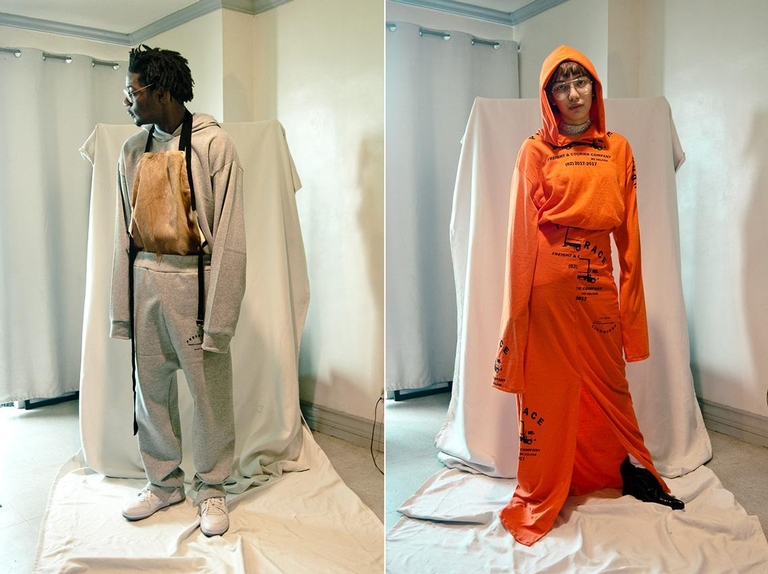


Manila (CNN Philippines Life) — This is part of a series of articles profiling designers who are presenting at Fashion Exchange International.
Proudrace has been in the fashion industry for almost a decade, but the brand is still a constant learning process for its owners, Rik Rasos and Pat Bondoc. The duo explain that the brand has always been experimental, having started with T-shirts they had made for themselves and their friends while Bondoc studied and Rasos took on gigs as a stylist and a DJ.
The collections that succeeded Proudrace’s beginnings as a simple T-shirt brand were still based off of that idea, with the addition of cardigans and dresses. Each of its collections has built on the last. Rasos is quick to note how everything they produce involves reinterpretation and addition. “You look back on the stuff that you’ve worn before,” he says. “Like, ‘Oh, I can reinterpret this now differently.’”
Bondoc adds that they still keep things fun by making sure that they can relate to it and that they don’t take everything too seriously. “It’s always something that we know; it’s always something that we can relate to,” he says. “I think it’s part of the DNA of the brand that everything that we do is based on things that we’ve experienced growing up and things that we are actually interested in.”
This month, the brand is going back to Rasos and Bondoc’s roots with a new collection that’s heavily inspired by 70s silhouettes and triple XL outerwear — basically things that one digs up in an ukay-ukay. The collection includes leather and fur aprons to accessorize, Philippine-made maong jackets — a first for Proudrace — with intentionally unfinished stitching for the buttonholes, dresses with a “reconstructed” feel to them, and shirts that reimagine Proudrace as a freight courier service printed over with the logo of the band Misfits using vinyl so it feels “lived in.”
The brand’s office space isn’t where the clothes are made, but it is home to the team pets (Lisbon the dog and Brutus the cat), a number of magazines and books, and Bondoc’s cacti collection.
Rasos and Bondoc graciously opened their studio recently to talk to CNN Philippines Life about how they evolved as a brand, what it’s like to be in the international market, and Proudrace’s new collection, Unisex No. 2. Below are edited excerpts from the interview.

What were you producing when you were starting out as a T-shirt brand?
RR: Yeah, T-shirts talaga. But it was like, for fun. Nothing serious. We were doing other stuff also at the time. After T-shirts, that’s when we started with the clothes, but everything was still based on T-shirts. So it was deconstructed into a dress, into a cardigan.
PB: It’s all very experimental.
RR: Very experimental. So whatever we know, yun lang yung ginawa namin for the first few years when we were starting. Kasi it wasn’t really serious, it’s not like we were looking for international stockists. It was for fun lang talaga.
You started Proudrace mostly because you wanted to make clothes for yourselves. How have your goals evolved?
RR: Well, we still want to make clothes for ourselves. Pero right now, we don’t have time for that.
PB: It’s really more of making the clothes that we’d want to wear given the right client.
RR: Also I think now, siyempre your ultimate goal is to actually be profitable, have a sustainable brand. Not like before when our goal was just to have fun.
PB: But still at the same time, we’re not gunning for it to be a big brand. We want to keep it a small independent label.
RR: Parang how it is is that we’re independently produced. Not exactly looking at it na maging SM or something.

How would you describe your evolution as a brand? Because you still produce a lot of black clothes and the silhouettes are all relatively similar.
PB: I think the evolution was organic. There wasn’t really a big push to try and come up with different things every season. Because it’s really based on our personalities.
RR: It’s not really a conscious effort na, “Oh, this collection’s supposed to look like this. Next collection dapat totally different from what we made before.” It’s more of, you have this archive of silhouettes and you work on it, you add something, you rework, you interpret something else. It’s more of doing what we do and creating something different out of it. Everything is based on something that we already did before.
Why did you decide to put in color?
RR: For the past few seasons, it’s a conscious effort. This is the first time that I’m doing creatives by myself. This is all my creative direction, itong collection natin. So I just wanted to do something different from what we used to do. I’m looking at all our collections. Actually, siya rin naman ang nakakapansin. Like, Pat would tell me, we need to do something different.
PB: At the end of the day, we wanna produce something that’s fun. We don’t take it too seriously.
RR: Yeah, not so seriously. The business is serious, so might as well have fun being creative.
With that, can you talk about your latest collection?
RR: It’s called Unisex No. 2. This collection is inspired by thrift-store finds. Basically, I wanted it to feel like it’s hand-me-downs and we just injected it into the DNA of the label. It’s very dark, very scheme-y. Elevated basics. Really inspired by mga thrift-store finds. Like what you do with your thrift-store clothes — you DIY it, turn it into something else. So reconstruction, deconstruction of pieces. Most of the pieces are based on triple XL sportswear, and then it was reduced and reconstructed into something else. You can see it in the prints, parang weird na yung prints nila because we had to cut them and turn them into something else. That’s the main inspiration of the collection. Also, we kind of looked a little bit into the 70s. The material, the color.

Do you think you can connect your new collection back to your origins? The DIY aspect of it helps, presumably.
RR: Yeah, I think so. Growing up, you have no choice, eh. You buy from ukay, and you don’t exactly get the size that you want. You don’t get the stuff that you want. So you kind of alter it into the kind of stuff that you want. So it was greatly inspired by our youth.
How has it been running the brand and the business? What have you learned through the years?
PB: I’m still learning. It’s an ongoing process.
RR: It’s really difficult especially if you try to make it outside of your country.
PB: It’s a different business model. It’s something that we’re really learning as we go along.
RR: We don’t concentrate on made-to-order. We don’t do bespoke. It’s really ready-to-wear. Different, eh. Our country is not ready for that.
PB: We also do a lot of research. We look at companies that we admire and we look at their business models, and we try to explore how we can get little bits and pieces from the brands that we like, from the businesses that we admire, and we apply it to our own business.

Did you ever have trouble keeping your identity in the collection?
RR: Yes! I think there was a time, maybe two years that it was difficult. I had mental block, or designer’s block.
PB: It was so hard to keep on churning out new stuff.
RR: You can’t really tell. Every season is different, so every season the buyers from overseas, iba yung gusto nila, iba yung trends.
PB: I think it’s more of the compromise between what the buyers want and what the buyers buy versus what we actually want to do.
RR: It’s super difficult. You really can’t tell. It’s a shaky business to be in.
PB: You really have to get the perfect balance with stuff that you like and what will sell.
RR: Because we’re not made-to-order, we’re ready to wear. So there were two years where we couldn’t process the right balance. Pero now, we said that we’d just do whatever we want. We know we’re gonna get a buyer even if we’re producing just pieces that we want. Definitely there’s gonna be a buyer for it.

When we interviewed Maco Custodio, he talked about how Filipinos aren’t really the market for designers here. Like, it’s better to go international.
RR: It’s kind of true, but to be honest, the international market is a big scene, a huge scene. It’s hard to compete.
PB: Outside it’s different. I mean, we’re a very, very small player. I can’t even call us a player. The thing is, with the Filipino market, the culture here of designing is really more of made-to-order, very glamourous.
RR: Ganun talaga. That’s the culture here. Client-designer relationship. That’s what they want. You need to be a VIP, parang ganun. People feel like you’re a VIP all the time. Unlike if you go overseas, they won’t care. They will like you, they will befriend you, but it’s not like we need to go one-on-one.
PB: But for us it’s different, ‘cause we’re just an RTW brand. There’s no client-designer relationship.
RR: You become friends with loyal customers.
PB: But sometimes we get buyers from one of our stockists, and they would message us.
RR: And we eventually become friends with them, our loyal customers. It’s not exactly how client-designer relationship works, na there’s fitting …
PB: I guess it boils down to the price. You know that the market here is very young and the buying power is quite low compared to other countries wherein a person who works in a fast-food can buy a luxury item. Here, that’s unheard of.
RR: Overseas, even if you’re a sales agent or if you’re from McDonald’s, you can actually buy our stuff.
PB: You can just save up. But here, it’s really different. So I guess that’s why with a lot of the brands wherein the price points are quite high compared to the prices you get at the mall, I guess that explains the reason why a lot of people would rather buy from a local brand, a fast-fashion brand, rather than a designer.

So do you get responses from customers who say, “Oh, I really saved up for this”?
RR: Yes. All the time. Actually I’m so happy when they say that, “We saved up for your T-shirt.” It’s so cute. It’s so nice that they actually really want to buy it. It’s really flattering.
Do you know what’s in store in the future?
RR: Very unpredictable. Fashion is super unpredictable. Especially now, everything’s changing. Nobody’s following the seasons anymore. The market slowed down also. Retail is so different now. For us I guess, create more clothes and just continue what we’re doing.
So just create more clothes?
PB: Just keep doing what we’re doing.
***
Fashion Exchange International will hold its premiere collection showcase on July 7 and 8 at the Marriott Grand Ballroom in Manila Marriott Hotel, Pasay City. There will be a showroom and presentations featuring the works of participating designers, including Aranaz, Ann Ong, Jail Jeans, JR by Jeffrey Rogador, John Herrera, Ken Samudio, Maco Custodio, Proudrace, Rosenthal Tee, and Tex Saverio.