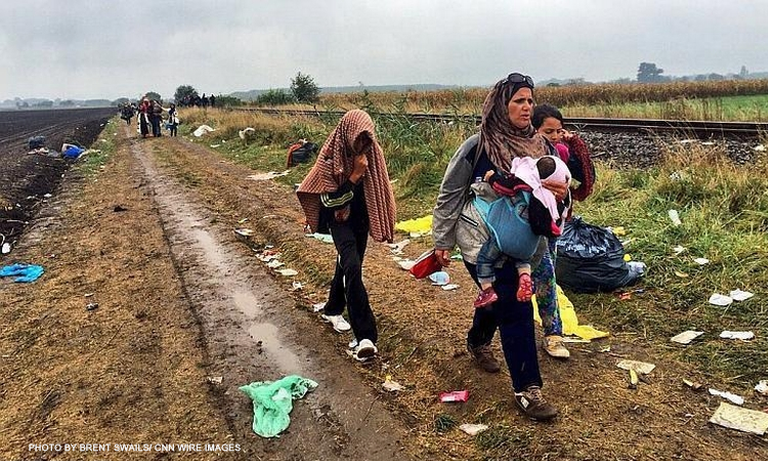


Munich, Germany (CNN) — It’s not just migrants fleeing war and chaos in Syria, Iraq and elsewhere who want to put the world’s growing refugee crisis behind them. European nations bearing the brunt of the influx are desperate for it to end as well.
As Germany, Austria, and Hungary clamped down on border crossings, European Union interior and justice ministers met Monday in emergency session in Brussels, Belgium, to discuss the crisis, EU plans for refugee quotas and how to stem the tide of migrants striving for European destinations.
European Commission President Jean-Claude Juncker has proposed that EU countries should be required to take in 120,000 refugees who were already in Italy, Greece and Hungary — on top of plans made in May to relocate 40,000 from Italy and Greece.
While some leaders expressed concern about that proposal, officials said they are ready to move forward with earlier plans to allow naval forces in international waters to board, search and divert ships suspected of involvement in human trafficking. Despite the assessment, more planning still has to be done, the EU said, and when such interdictions might begin remained unclear.
Here’s the latest on the emergency spreading across Europe:
Germany
Germany — which had committed to taking in 800,000 migrants this year — might have to take in a million, German Vice Chancellor Sigmar Gabriel said Monday. Some 10,000 are pouring in each day, Interior Ministry spokesman Tobias Plate. Some 16,000 have flooded Munich alone in two days, according to German officials.
With the relentless stream of migrants, Germany is now implementing temporary border controls for “security reasons urgently necessary,” the country’s interior minister said.
Officials suspended the region’s normal open borders policy, checking identifications of cars coming across the border and making decisions about whether to allow in those with Syrian or Iraqi identifications. Officials also stopped train traffic from Austria for a time as well.
“The goal of this measure is to restrict the present inflow of migrants into Germany and return again to an orderly process upon entry,” Interior Minister Thomas de Maiziere said Sunday.
Such actions are allowed on a temporary basis under EU law based on “serious threat to public policy or internal security.”
Austria
In Austria, an Interior Ministry spokesman told CNN that the country would introduce reinforced border as a consequence of Germany tightening its border enforcement. Many refugees bound for Germany pass through Austria.
Officials also deployed 2,200 soldiers to help beleaguered police, a spokesman for the Interior Ministry said. The troops will work on humanitarian aid, security and border protection, according to the spokesman.
German Chancellor Angela Merkel and her Austrian counterpart, Chancellor Werner Faymann, are scheduled to meet Tuesday in Berlin to discuss the crisis, the German government said.
Hungary
Tough new border laws were set to go into effect Tuesday along its border with Serbia, which is not part of the European open-borders agreement. The laws call for three years in prison for climbing the country’s newly built razor-wire fence along the border. They also create new border transit ones to hold asylum-seekers while their applications are processed.
Migrants in the transit centers won’t be considered to have officially entered Hungary, according to a government statement.
The changes will “result in asylum procedures which are swifter and more effective,” the statement said.
Hungary has been the site of some of the most dramatic scenes of the crisis, with refugees setting out on foot from train stations and holding sites despite police efforts to contain them. Some migrants have complained about their treatment by Hungarian officials.
Macedonia
A record number of migrants crossed into Macedonia over the weekend, said Alexandra Krause of the UNHCR — the U.N. refugee agency.
About 8,600 people crossed from Greece to Macedonia from Saturday until Sunday, Krause said from the border Monday.
Many migrants are trying to make the arduous journey from Syria, Iraq and Afghanistan to Germany. To do so, they travel through Greece, Macedonia, Serbia, Hungary, Austria and then Germany.
Defense Minister Zoran Jolevski visited a Macedonia army post along the country’s southern border with Greece as well as a transit city where migrants are registered, calling for greater international support for European nations dealing with the crisis.
Britain announces more help
The British government announced Monday it has appointed a minister to oversee the resettling 20,000 Syrian refugees.
“Richard Harrington will be responsible for coordinating and delivering work across Government to resettle up to 20,000 Syrian refugees in the UK, along with coordinating the provision of Government support to Syrian refugees in the region,” the government said.
The UK also announced it is increasing its aid for refugees in Syria, Lebanon, Jordan and Turkey to £1 billion ($1.5 million).
The £40 million will be allocated to the United Nations and nongovernmental organization partners working in Lebanon, Jordan and Turkey, including British aid agencies such as Save the Children, providing shelter, food, relief packages, health and protection services as well as cash assistance — giving individuals the freedom to decide how best to cover their needs.
Death toll rises
A day after a migrant boat capsized off the Greek island of Farmakonisi, officials are finding more bodies.
The death toll rose to 34, including 10 children, duty officer Vasiliki Patsioura of the Hellenic Coast Guard said.
The coast guard said it rescued 99 people from the vessel that capsized in the Aegean Sea.
At least 2,800 migrants have died or disappeared this year trying to cross the Mediterranean to Europe.
‘Open your heart and help someone’
Some EU ministers questioned whether the quota system makes sense.
“Quotas cannot be imposed on countries,” Slovakian Interior Minister Robert Kalinak told CNN’s Hala Gorani in Brussels. “Migrants want to move from one country to another. We should concentrate on camps instead and differentiate between illegal migrants and asylum-seekers.”
On Monday, the aunt of Aylan Kurdi, the toddler whose drowning death forced the world to take notice of the refugee crisis, spoke to a rally in Brussels urging action.
Aylan’s brother and mother also died trying to escape Syria.
“It is too late for my family, for Aylan, but they need all your help,” Fatima Kurdi said at a rally in Brussels, shortly before the EU interior ministers were due to meet on the crisis.
“We need action — a plan to make it happen urgently. And I hope you all understand it could happen to anyone’s family. Open your heart and help someone.”
CNN’s Atika Shubert reported from Munich and Holly Yan reported and wrote from Atlanta. CNN’s Stephanie Halasz, Ivan Watson, Bharati Naik, Alex Felton and Brian Walker also contributed to this report.