Metro Manila (CNN Philippines) — Daang Matuwid — the good governance platform that has driven the administration of President Benigno Aquino III for the last five years — has been “a resounding success.”
House Speaker Feliciano Belmonte Jr. made this assessment in his remarks at the opening of the third session of the 16th Congress on Monday (July 27), just hours before the president was set to deliver his last State of the Nation Address (SONA).
Belmonte, who belongs to the ruling Liberal Party, recalled how the commitment to achieve good governance began when the president delivered his first SONA, calling for all officials to observe a “no wang-wang” policy.
The wang-wang — a vehicle siren that’s only legally allowed for use by law enforcers — has become a familiar sign of abuse of power and privilege in the Philippines.
Anyone in a vehicle using that siren expects other motorists to give way — regardless of his actual authority or urgency of his trip.
Transportation officials tightened the ban on the unauthorized use of such sirens. And President Aquino himself has refrained from using such a siren, and most of the time, his convoy would stop at a red light.
“This was not only meant to be a symbolic gesture, as it actually highlighted the government’s commitment of doing away with the pomp and privilege of power, and high position,” Belmonte said. “It became our collective mission as well, to restore decency to public service, ending long-standing practices of preferences, exemptions, and abuse, profoundly guided by the sense of fairness and decency of the Filipino.”
And because Congress acted in this spirit as it passed several significant measures, it gained “credibility,” Belmonte said.
Echoing a point that President Aquino had often made, Belmonte explained what the enhanced credibility meant for the Philippines,
“And it is this credibility, earned at home and around the world, which has generated tremendous growth potential for our country,” he said.
“Good governance and credible laws are the key to continuing and expanding this growth. Through these economic measures we intend to make unstoppable the full economic resurgence of the Philippines. By placing our economic policies in line with the best practices of the world we will make inevitable the achievement of full social inclusiveness, and no dream will be unreachable.”
‘Landmark legislation’
Belmonte called the measures “landmark legislation” that “languished for decades for lack of political will.”
It hasn’t always been smooth sailing for some of these measures.
Some of them fueled so many long and heated debates, both in and out of Congress — notably, the Sin Tax Reform Law, the Reproductive Health Law, and the K-to-12 educational system.
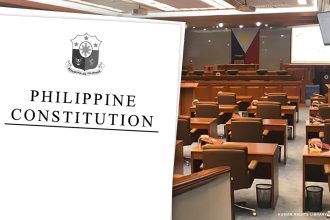
Several others that Belmonte said would be tackled next as priority measures have also been controversial — notably, the proposed Bangsamoro Basic Law, and the resolutions that would amend what Belmonte called “restrictive provisions” of the Constitution to attract more foreign investments.
With Congress reconvened, Belmonte said lawmakers were determined to see these measures passed.
In urging his colleagues to pass the economic measures, he said: “By amending the restrictive economic provisions of our Constitution, we empower Congress to enact laws that will attract the kind of investments that will reverse the de-industrialization and de-agriculturalization of our economy. Only then can we encourage locators and investors to expand our manufacturing sector, the area where the better paying decent jobs can be created. This is the best strategy to ensure that no Filipino will be left behind.”
As to the Bangsamoro Basic Law, he said: “For far too long, the conflicts in the Bangsamoro have taken on different forms, rooted in passions that feed on discrimination and deprivations that are fueled by poverty,” Belmonte said. “We must address the longstanding grievances of the Bangsamoro people by empowering them to fully provide for their self-expression and development.”
He was careful to point out, however, that non-Muslims in the Bangsamoro should get equal treatment: “But this has to be complemented by clear and decisive legislative language to accommodate and empower not just the new majority of the Muslims in the Bangsamoro, but also for all other groups whose lives, family, and work are located in these regionally autonomous areas of the Bangsamoro.”
Another thorny issue, with international repercussions, is the Philippines’ territorial dispute with China and several other neighboring countries over the West Philippine Sea.
Without actually naming China, Belmonte also urged Senate to pass measures related to the Philippines’ territorial dispute — the Archipelagic Sea Lanes Act and the Maritime Zones Act.
These laws, he said, would protect the territorial integrity of the Philippines — “even as this Congress, continues to fully, and unequivocally support, the country’s claims over our Exclusive Economic Zones in the West Philippine Sea, at the Arbitral Tribunal of the Permanent Court of Arbitration at the Hague.
Apparently aware that some lawmakers might be distracted by preparations for the 2016 elections, Belmonte said towards the end of his remarks: “Next year we will see a transfer of power. But today, we must recognize that there remains a last window of opportunity, to make a greater difference in the lives of our people.”
Passed and prioritized measures
Here are some of the other measures that Congress has already passed:
allowing compensation for the human rights victims of the martial law regime of President Ferdinand Marcos
the GOCC Governance Act, which reined in the abuse of some official using government-owned and controlled corporations as their milking cows
the amendment of the Sandiganbayan Law, which created two additional divisions and allowed the transfer of minor cases to the Regional Trial Courts
raising tax exemption for 13th month pay, from P30,000 since 1992 to P82,000, which increased their purchasing power
stopped practice of operating on a reenacted budget while ensuring that it is passed on time
the Philippine Competition Act, an anti-trust law that prohibits and penalized anti-competitive deals and abuse of dominant market positions
amended Cabotage Law, allowing foreign vessels to call on several local ports
Belmonte also enumerated several other priority measures, some of which had already passed on third reading:
the 2016 national budget
the creation of the Department of Information and Communications Technology
strengthening the Build-Operate-Transfer Law
the modernization of the Philippine Atmospheric, Geophysical and Astronomical Services Administration (PAGASA)
the Freedom of Information Act
the Tax Incentives Management and Transparency Bill
the Customs Modernization and Tariff Act
the National Identification System
the prepaid SIM card registration
the Barangay Officials Welfare and Incentives Act
the Philippine Immigration Act of 2015
the law adjusting the amount involved, value of property or damage on which a penalty is based and the fines under the Revised Penal Code
the Healthcare Services Price Disclosure Act