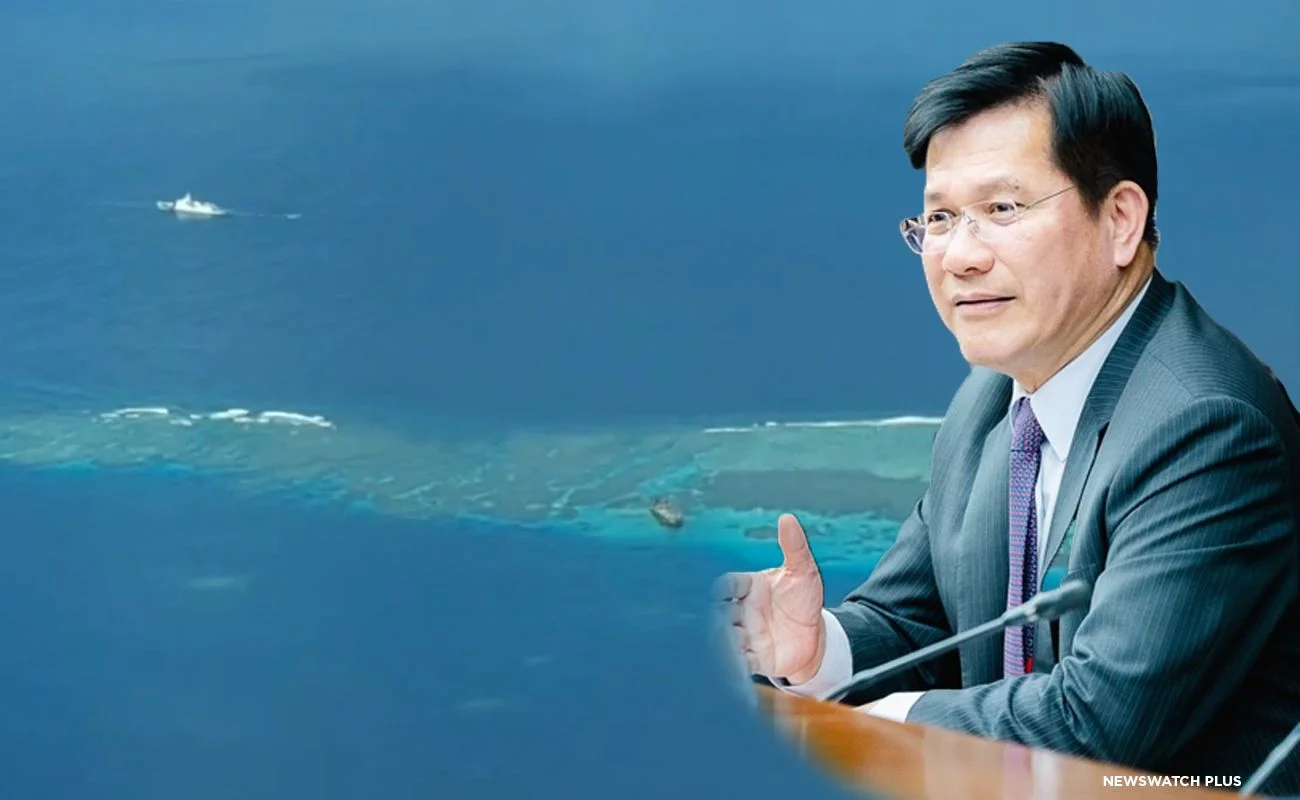


Taipei, Taiwan – Taiwan is calling for greater information sharing, joint training, and exercises with regional partners as it seeks a collective response to China’s expanding military and gray-zone activities across the Indo-Pacific.
Taiwan Foreign Minister Lin Chia-lung said security across the so-called first island chain—stretching through Japan, Taiwan, and the Philippines—has become increasingly interconnected as Beijing expands its military presence beyond the Taiwan Strait.
“We must further information sharing, joint training and exercises, [and] deterrence capability with regional partners to guard against authoritarian expansionism,” Lin told visiting journalists in Taipei on Wednesday, August 20.
Lin emphasized that China’s military activities in the Taiwan Strait, the East China Sea, and the South China Sea should no longer be viewed as isolated security issues.
“China’s military exercises in the Taiwan Strait and the East and South China Seas have become increasingly interconnected,” he said, pointing to Chinese military maneuvers extending into the Western and South Pacific as signs of Beijing’s growing power projection.
“These are not isolated maritime issues, but rather a large-scale strategic challenge to the entire Indo-Pacific,” Lin added.
Taiwan has been strengthening its military preparedness as China maintains near-daily military deployments around the self-governing island.
Earlier this month, Taiwan conducted its 10-day Han Kuang military exercises, which tested the readiness of its armed forces and civilian agencies against a potential Chinese invasion, naval blockade, or communication disruption. The Taiwanese navy and coast guard also completed their first joint anti-blockade drills.
Beijing dismissed the exercises, labeling them nothing more than a “charade.”
PH rules out joint maritime patrols
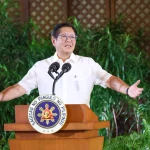
Meanwhile, President Ferdinand Marcos Jr. has drawn clear boundaries regarding direct security cooperation with Taiwan, emphasizing that existing engagements must remain strictly within the framework of Manila’s One-China policy.
“We have been doing business with Taiwan for a very long time since they are a very close neighbor. And those arrangements and partnerships that we have with them continue,” Marcos said.
“However, this is very much in the context of our One-China policy. We continue to respect and to behave with that policy as the dominant principle in the treatment of both the People’s Republic and our more local engagements with Taiwan.”
Marcos also ruled out allowing Philippine territory to serve as a staging ground or launching point for offensive operations in the event of a cross-strait conflict.
“No, there will be no attacks on anyone from the Philippines. The Philippines has no desire to be a belligerent nation in the region,” Marcos stated on August 14.
Teodoro advocates defense cooperation in non-taboo areas
Despite diplomatic constraints, Defense Secretary Gilberto “Gibo” Teodoro Jr. has publicly advocated for expanding non-military relations with Taiwan within the bounds of the One-China framework.
Speaking at the Shangri-La Dialogue in Singapore, Teodoro noted that while the Philippines is strengthening multilateral security alliances with partners like the United States, Japan, and Vietnam, Manila should also develop its relationship with Taipei in “non-taboo areas” that do not imply formal diplomatic recognition.
Teodoro also highlighted the grave humanitarian stakes of a potential regional crisis, stating there would be “no political objection” to establishing safe havens in northern Philippine provinces for fleeing civilians—noting that roughly 180,000 to 200,000 Filipinos currently live and work in Taiwan.