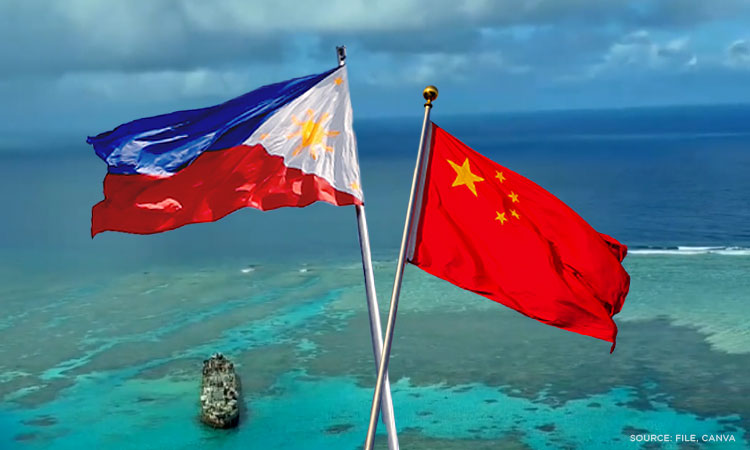


Metro Manila, Philippines — A decade after an international tribunal invalidated China’s expansive claims in the South China Sea, the Philippines asserted that the 2016 Arbitral Award remains final, legally binding, and beyond negotiation, as officials declared it the cornerstone of the maritime policy and rules-based approach to the West Philippine Sea.
Speaking at the commemoration of the ruling’s 10th anniversary in Pasay City on July 10, Foreign Affairs Secretary Ma. Theresa Lazaro said the award represents a lasting victory for international law and the peaceful settlement of disputes.
“This award is final. It is legally binding. It is not a mere statement of policy,” Lazaro said.
She said the ruling is “not subject to negotiation or compromise” and described it as “an unshakable, permanent anchor of our rules-based international order.”
The July 12, 2016 ruling by an arbitral tribunal constituted under the United Nations Convention on the Law of the Sea found that China’s sweeping “nine-dash line” claim had no legal basis and upheld several Philippine maritime entitlements in the West Philippine Sea.
‘A lighthouse’ for nations
Lazaro likened the arbitral award to a lighthouse guiding nations through an increasingly uncertain geopolitical environment.
“When the shadow of coercion looms, nations need something far more permanent than political dominance. They need a lighthouse,” she said.
“A lighthouse does not block the winds. It does not command the tides. It stands immovable upon bedrock, casting a steady, piercing beam to warn of hazards and guide all ships to safe harbor,” Lazaro added.
She said the Philippines initiated the arbitration to defend its rights and strengthen international law for all nations.
“We did not do so for ourselves alone. We acted to speak for every nation, especially those who find in international law a vital shield against geopolitical uncertainty and the stark asymmetries of power,” she said.
Lazaro said the award permanently clarified maritime rights by rejecting China’s historic claims under the so-called nine-dash line.
“By authoritatively ruling that historic claims within the fictional Nine-Dash Line have no basis in law, the 2016 Arbitral Award permanently illuminated the once murky waters.”
She added that the ruling has since been cited by international courts and states and now extends beyond maritime disputes, influencing issues involving marine environmental protection, biodiversity and ocean governance.
Looking ahead, Lazaro said Philippine maritime policy will continue to rest on four pillars: unwavering adherence to international law, maintaining dialogue, strengthening alliances and pursuing a principled foreign policy.
“We will use this award as our clear legal and policy baseline to engage partners and pursue an effective, legally binding Code of Conduct in the South China Sea,” she said.
Marcos calls issue ‘almost existential’
President Ferdinand Marcos Jr. also underscored the importance of preserving the country’s position on the arbitral award beyond his administration.
Speaking during a media interview in Vancouver, Canada earlier this month, Marcos described the West Philippine Sea issue as one of the country’s most critical national concerns.
“It’s almost an existential issue for us,” Marcos said. “We really have to be consistent in that.”
The president said growing international support for the arbitral ruling validates the Philippines’ foreign policy.
“The rightness in our positioning is validated by countries like Canada who support it and see it as simply an enforcement of international law and the defense of our territorial integrity and the exercise of our sovereign rights,” he said.
Marcos added that few issues facing any Philippine president carry greater significance.
As of June 18, the Marcos administration had filed more than 160 diplomatic protests against Beijing over incidents in the West Philippine Sea.
China rejects ruling
China continues to reject the 2016 decision.
Chinese Foreign Ministry spokesperson Mao Ning reiterated that Beijing neither accepted nor participated in the arbitration proceedings.
“China neither accepts nor participates in that arbitration, neither accepts nor recognizes the award, and will never accept any claim or action arising from the award,” Mao said.
She also argued that the ruling “does not constitute part of international law” and instead undermines the international legal order.
The Philippines has consistently rejected Beijing’s position.