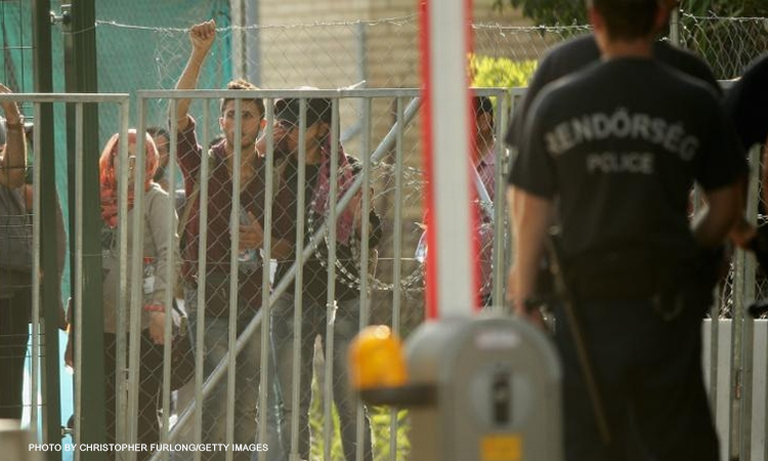


(CNN) — Hungary closed one of the main routes Tuesday (September 15) that migrants are using to reach the European Union – plugging the final hole in its border fence with Serbia, implementing harsh new rules for anyone attempting to enter illegally and leaving hundreds massed on its border.
A railway carriage fortified with razor-wire was wheeled in to block the remaining gap in the fence with neighboring Serbia, sealing shut a route that tens of thousands of refugees have used to escape bombings and terrorism in their homelands.
Hungary is a member of the EU; Serbia, to its south, is not but is in negotiations to join.
Under new laws that took effect Tuesday, anyone caught climbing the fence faces up to three years in jail. Hungarian authorities said arrests had already begun.
“We call this as a temporary fence. Obviously it is … a must decision (rather) than a nice decision,” Hungarian government spokesman Zoltan Kovacs said.
“We don’t like building fences, but up until we are able to reinstate border control on the natural border/green borders of the country, we have no other choice.”
Registration and entry to Hungary will now be possible only at two assigned entry points, he said.
Hungary also plans to expand the fence along its border with Romania to the east, Norbert Domotor, spokesman for the Hungarian Ministry of Foreign Affairs, told CNN on Tuesday, although he said construction had yet to begin.
In a statement, Amnesty International slammed Hungary’s actions as “ugly” and “draconian.”
“For refugees fleeing from terrifying conflict zones to be met by such an intimidating show of militarized force is shocking, and a woefully irresponsible response to people already traumatized by war and brutality,” said Gauri van Gulik, Amnesty International’s deputy director for Europe.
“This ‘raise the drawbridge’ mentality will simply redirect, but not put an end to, desperate and dangerous journeys.”
Unprecedented influx
Hungarian authorities took action following an unprecedented influx of migrants entering from Serbia.
A record 9,380 migrants made the crossing Monday (September 14), Hungarian police said, nearly double the previous record of 5,809 migrants set a day earlier.
The closing of the border left throngs of refugees, carrying everything they had on their backs, stranded on the Serbian side Tuesday.
At the main border crossing, a crowd of more 1,000 gathered as a Hungarian police helicopter circled overhead.
Migrants banged on the fence, chanting, “Open, open”; children peered at Hungary through the cracks and asked when the border would open again.
Some pitched tents, and aid workers brought them food and water.
U.N. workers and Serbian authorities encouraged people to relocate to a camp about 10 kilometers (6.2 miles) from the border, but few took them up on the offer in case they missed a temporary opening of the border.
Stephane Moissaing of Doctors Without Borders told CNN he had seen authorities open the border crossing twice Tuesday, with several hundred people rushing through each time.
Simka Somer, vice president of the Red Cross in Serbia, told CNN that refugee camps in Serbia had largely emptied out Tuesday as migrants made for the border.
The Kanjiza camp, the biggest in Serbia and closest to the Hungarian border, had about 30 migrants staying on Tuesday, according to Ivan Miskovic, spokesman for Serbia’s Commissariat for Refugees and Migration.
By contrast, Red Cross worker Monika Cesko told CNN she believed 6,000 to 7,000 people were at the camp over the weekend.
Serbian official: ‘We know how it feels’
Aleksandar Vulin, Serbia’s minister of labor, employment, veteran and social policy, told CNN that Hungarian authorities had not coordinated with his country on plans to close the border.
“We heard some rumors that they would close some border, but officially we received nothing,” he said.
“We want the migrants to be able to travel freely without criminals and smugglers,” he said, adding that “every migrant had an opportunity to apply for asylum and travel through Serbia.”
His government was taking care of about 5,000 migrants at present, providing food water and medical supplies, and busing those who accepted a ride to the camps.
“We know how it feels; we are Serbs,” he said, referring to his country’s war-torn recent past. “We are always sympathetic to people who suffer.”
Call for emergency summit
At a press conference Tuesday in Berlin, German Chancellor Angela Merkel and her Austrian counterpart, Werner Faymann, announced they had called for an emergency EU summit next week to address the escalating migrant crisis.
“We cannot wait until the middle of October,” said Merkel, calling on European countries urgently to formulate a response.
The German leader said that only three European countries were “actively trying to do something” to resolve the crisis.
“Germany, Austria, and Sweden cannot solve the problem on their own,” she said.
Faymann echoed Merkel’s call for cooperation, adding that European countries need to face the crisis as one and cannot simply “pretend to be ostriches.”
Germany is the most welcoming European country for migrants, having pledged 6 billion euros ($6.8 billion) to take in 800,000 migrants. By the end of the year, it might take in 1 million migrants, its vice chancellor said.
Migrant boat sinks
Many migrants don’t even make it onto European soil. More than 2,800 have died or disappeared trying to get to Europe this year.
On Tuesday, a migrant boat headed to Greece sank off the coast of Turkey, killing at least 22 people, the Turkish coast guard said.
So far, 249 people have been rescued. The coast guard deployed five ships to try and find more survivors.
The sunken boat was found off the Turkish island of Kara Ada, in Bodrum Bay. The boat was headed to the nearby Greek island of Kos, the semi-official Anadolu News Agency reported.
At least 72 migrants have died since the weekend trying to make the same crossing from Turkey to Greece, the International Organization for Migration said Tuesday.
Many have described the conditions on such boats as abhorrent.
Migrants arriving in Turkey often speak of cruel smugglers who ignore worsening weather conditions and force people on overcrowded rubber boats to squeeze a bigger profit, said EU Frontex, the joint European Union border patrol.
More than 430,000 migrants have fled to Europe so far this year, the International Organization for Migration said.
The domino effect
Many refugees are trying to escape the carnage and devastation in Syria, Iraq, and Afghanistan. Their ultimate destination: Germany.
But to get there, migrants typically cross the Mediterranean Sea and go through Greece, Macedonia, Serbia, Hungary, and Austria before finally reaching Germany.
And when Germany announced tougher border controls this week, countries down the chain followed suit – likely fearing an intense backlog.
On Sunday (September 13), Germany increased ID checks at the border and temporarily stopped rail service coming from Austria.
On Monday, Austria sent 2,200 soldiers to its border to help overwhelmed police.
And on Tuesday, Hungary enacted its new border laws. It’s also creating new border transit zones to hold asylum-seekers while their applications are processed. These will result in asylum procedures that are “swifter and more effective,” the government said.
Migrants in the transit centers won’t be considered to have officially entered Hungary, the government said.
Absorbing the flood
The European Union is still trying to figure out how to distribute 160,000 migrants – and whether to set quotas for member countries to absorb them.
That number includes 40,000 from Italy and Greece that the EU had already agreed to relocate. Another 120,000 need placement.
EU officials met Monday in an emergency session in Belgium but didn’t finalize a plan.
“It was too early for a decision to be taken today,” Jean Asselborn, Luxembourg’s minister of foreign affairs and immigration, said Monday. “Nonetheless, a large majority of member states have committed to this principle of the additional relocation of a further 120,000 people who deserve international protection as part of these massive migratory flows.”
CNN’s Ben Wedeman and Ivan Watson contributed to this report from the Hungarian-Serbian border. CNN’s Gul Tuysuz, Khushbu Shah, Stephanie Halasz, Atika Shubert, Archith Seshadri, Milena Veselinovic, Claudia Rebaza, and Bharati Naik also contributed to this report.