

Metro Manila (CNN Philippines) – The P500 million assistance fund for teachers projected to be displaced by the implementation of the K-to-12 program of the Department of Education (DepEd) should be raised.
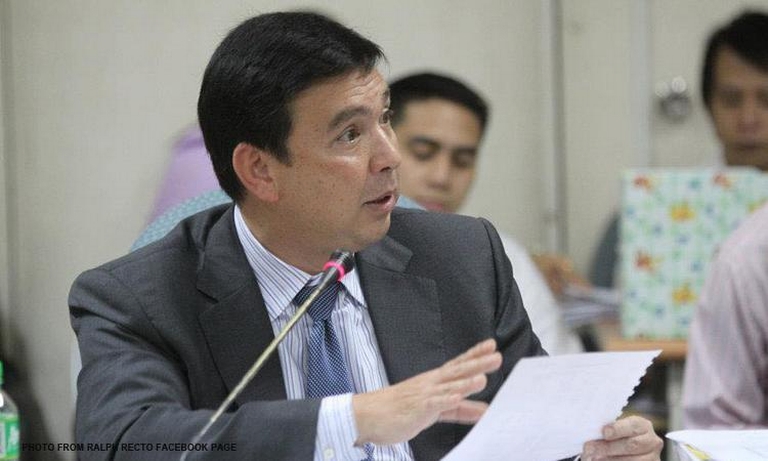
“This should be augmented because if there will be 50,000 employees affected, it translates into about P840 in monthly aid per individual,” Senate President Pro Tempore Ralph Recto said in a statement issued on Sunday, August 9.
The P500 million fund is part of P6.5 billion “obligation budget” proposed for 2016 by the Department of Labor and Employment (DOLE).
The fund is tagged under “Augmentation Measures for Displaced Workers Under the K-12 Program.”
But where would the the extra money come from?
Recto pointed out that funds earmarked for “non-urgent and postponable activities” in other sections of the P3 trillion national budget could be “rechanneled” to boost the proposed P500 million assistance package.
One package for all
In the same statement, Recto also urged the Department of Budget and Management (DBM) to “list in one package” all programs that will aid college faculty and workers who will be temporarily displaced by the new system.
“By consolidating all programs, we will be able to know and correct the deficiencies,” he explained.
Under the K-to-12 system, DepEd projects that as many 1.21 million students who finish Grade 10 will stay in high school for two more years of senior high school beginning 2016.
This will cut the number of college-bound graduates next year, leaving some college teachers and employees temporarily without work.
DepEd has projected that up to 1.21 million students who will graduate from high school in 2016 will stay in school for two more years.
The P500 million assistance fund added four other similar packages totals P25.4 billion, a hefty amount that needs to “unbundled,” Recto said.
“Assistance to individuals should be unbundled from the assistance to be given to institutions,” he said. “I think there should be sharper and clearer budget language which assigns what will be given to HEI [higher education institution] workers.”
Doing this, he said, would help the government find out if the guidelines on the implementation of the Enhanced Basic Education Act of 2013 are fully funded.
The guidelines spell out assistance to be extended to higher education institutions and their affected academic, academic support and non-academic personnel.
The document was signed in May 2014 by representatives from DOLE, DepEd, CHED, and the Technical Education and Skill Development Authority (TESDA).
Assistance to displaced personnel would could come in various forms:
employment in public schools through “green lanes” dedicated to them
assignment to senior high school class if the college offers it
moratorium on the payment of loans from the Social Security System and Pag-IBIG
training, livelihood packages, and other forms of bridge financing
Other programs
In his statement, Recto outlined four other aid packages.
In the proposed 2016 budget of the DepEd, he pointed out, P12.2 billion will be set aside for a “voucher program.”
Under this program, senior high school students will be enrolled in accredited private schools, including colleges with a high school department.
DepEd also has a proposed P9 billion funding for the Government Assistance to Students and Teachers in Private Education GASTPE) program.
Under this program, the government will “buy seats” in all grade levels of private schools to take up “the spillover in public school enrolment.”
The proposed budget of the Commission on Higher Eduction (CHED), Recto added, will also have an allocation of P1.4 billion to fund scholarships to faculty members and administrators of higher education institutions (HEIs).
The CHED is also authorized to tap up to P 2.3 billion from the Higher Education Development Fund (HEDF) to assist HEIs transition to the K-to-12 program.
HEDF is an off-budget item funded, in part, by earnings of the government from casinos.
‘Moratorium in high school graduation’
According to Recto, the K-to-12 system would cause a “moratorium in high school graduation.”
“[This] means that the conveyor belt which deposits graduates to colleges won’t be working for two years,” he said.
Up to 33,000 college instructors may temporarily lose their jobs until the first Grade 12 graduates in 2018, Recto said, citing a forecast made by the Philippine Institute for Development Studies, a government think tank.
In a briefing paper to Congress, DepEd had a lower estimates, Recto said: 13,634 teachers, or 12% of all college teachers, and 11,456 nonteaching staff, or 20% of the total.