Metro Manila (CNN Philippines) — The national government registered a budget surplus for a second straight month in May, according to figures from the Department of Finance (DoF).
The agency revealed on Monday (July 20) that May’s surplus reached P67.3 billion — nearly five times larger compared to the same month last year. The figure subsequently brings the budget balance for the first five months of the year to P86.4 billion, or about nine times larger than last year’s comparable surplus.
Government revenues alone posted a year-on-year 41% spike, reaching P242.5 billion. Revenues for January to May totaled at P922.2 billion — 16% higher than the same period last year.
The Bureau of Internal Revenue (BIR) was the government’s largest source of income, raking in P128.5 billion for the month. The funds subsequently bring the agency’s year-to-date revenue collections to a total of P596.3 billion, 9% higher than last year’s comparable figures.
The Bureau of Customs (BOC) raised P26.7 billion, which subsequently brings its year-to-date revenue total to P147.1 billion.
“[D]espite the 49% decrease in weighted average values of imported oil given the price declines in the world market, total customs collections for January to May 2015 still grew by 1% year-on-year, pulled up by the 15% improvement in collections from non-oil commodities,” the DoF said.
Income from the Bureau of the Treasury reached P11 billion in May, up P6.8 billion year-on-year. Year-to-date collections for the agency reached P60.4 billion — 8% higher than a year ago.
On the other hand, government expenditures totaled P175.2 billion for the month, 9% higher than the same period in 2014. January to May disbursements have reached P835.7 billion, a 6% increase from a year ago.
The government’s interest payments in May totaled P20.6 billion, bringing the year-to-date figure to P136.9 billion, 2% lower compared to the first five months last year.
Interest payments for January to May 2015 accounted for 16% of expenditures, improving on the 18% share recorded last year.
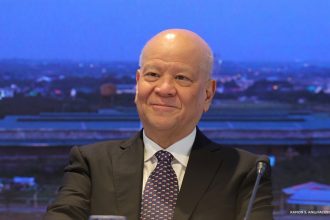
“Various volatile events in the global landscape serve as stark reminders of the importance of the hard work of reform carefully sustained by prudent fiscal management,” DoF chief Cesar Purisima said in a statement.
“We continue to build ample safeguards protecting the country from shocks that pose risks to our upward trajectory. Protecting our fiscal health over time enables everyday Filipinos to reap the dividends of higher and more durable growth.”
Lower government spending has been blamed as a major cause of 2014’s missed gross domestic product (GDP) target. Last year’s GDP posted a full-year growth of 6.1%, about a notch below the government’s target range of 6.5% to 7.5%.
“Lower government spending, investment delays and slowdown, and weaker exports are likely to limit economic growth to… 6.5 percent in 2015,” the World Bank said in highlights of its Philippine Economic Update for January 2015.