

Beijing, China (Reuters) — China’s Foreign Ministry accused the Philippines on Friday (May 15) of working together with the United States to “exaggerate the China threat” over a disputed shoal in the South China Sea.
Beijing stepped up its criticism of Manila a day before U.S. Secretary of State John Kerry is due to visit China, where he is expected to raise Washington’s commitment to ensuring freedom of navigation and flight in the South China Sea.
Security concerns have deepened internationally about Beijing’s maritime ambitions in the South China Sea.
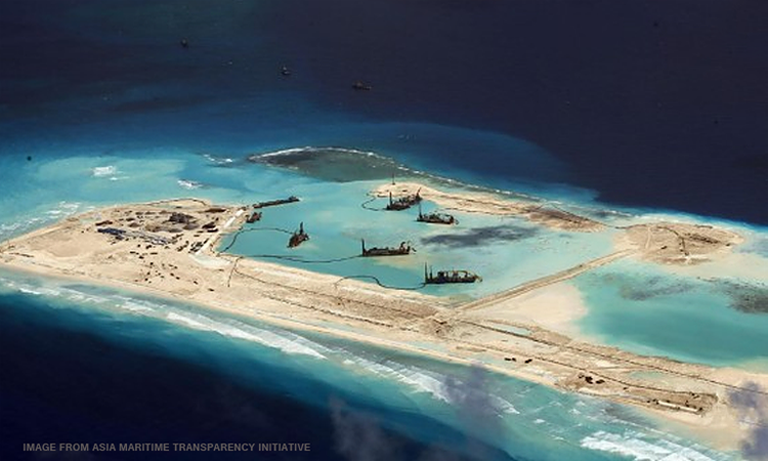
Recent satellite images have shown that since about March 2014, China has conducted reclamation work at seven sites in the Spratlys and is constructing a military-sized air strip on Fiery Cross Reef and possibly a second on another reef.
The Philippines, a U.S. treaty ally, has called for urgent action to be taken.
“I feel that in recent days, some people in the Philippines are jumping very high and are echoing some people in some countries to actively exaggerate the China threat, manufacturing tensions in the region. This theatrical double act has grabbed many eyeballs, but as everyone can see, the current situation in the South China Sea is stable,” the ministry’s spokeswoman Hua Chunying told a daily briefing in Beijing.
“The Philippine side is ignoring the common interests of countries in the region and continuing to take provocative measures that complicate and expand the dispute, which just fully exposes the fact that the Philippines is hiding behind (other countries). I want to stress again that China’s determination of protecting country’s sovereign right and legitimate interests is resolute. We will respond firmly to any acts of provocation against China,” Hua added.
On Wednesday (May 13), China’s Foreign Ministry said that Beijing was “extremely concerned” about a possible plan by the Pentagon to send military aircraft and ships to assert freedom of navigation in the South China Sea.
China has always rejected U.S. involvement in the dispute and has dismissed Washington’s proposal for a freeze on provocative acts in the area. It has reiterated that the only way to address the issue is through bilateral talks.
Beijing claims sovereignty over most of the South China Sea, through which $5 trillion in ship-borne trade passes every year.