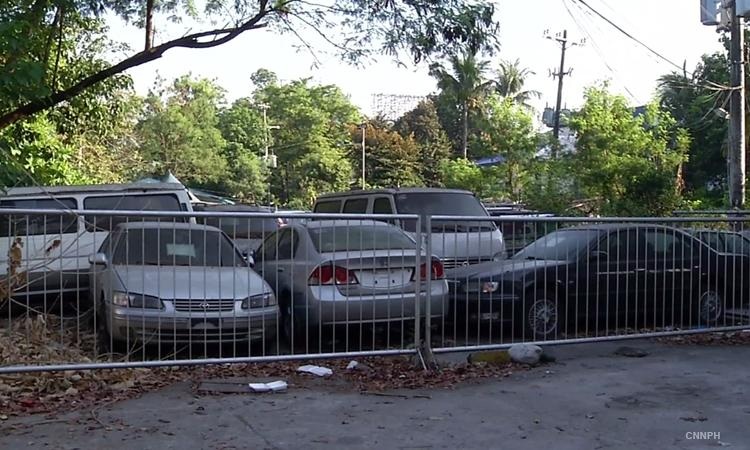


(CNN Philippines) — Hundreds of impounded cars are rotting in police compounds across the country.
But some are not unused assets.
In fact, some police officers are allegedly making money from them.
Paul, not his real name, works as a claims processor for an insurance company.
On the condition of anonymity, he tells CNN Philippines how, allegedly, some members of the Highway Patrol Group would hold the release of recovered stolen vehicles in exchange for bribes of up to hundreds of thousands of pesos.
“Ang nangyayari parang bibilhin din namin sa kanila yung kotse na na-recover para lang ma-release sa amin,” he says.
[Translation: “What happens is that it’s like we’re buying the car that was recovered just so they would release it to us.”]
A company that has paid insurance claims for a stolen vehicle should take possession of the vehicle once it is recovered.
It shouldn’t take too long for insurance companies to reclaim cars from impounding areas.
“Iba-ibang rason yung pwede nila ibigay sa inyo para tumagal. Pero alam niyo naman na rason lang yun,” Paul says. “Madalas ho nangyayari, nagpapadala sila sa amin ng middle man, tawag nila bounty hunter.”
[Translation: “They could give so many reasons to prolong the release. But you know they’re just making excuses. Usually they would send us a middle man, whom they call a bounty hunter.”]
Paul says corruption is rampant.
Bribes to police officers range from 10% to 20% of the car’s resale value.
Take, for instance, a Toyota Vios worth P700,000.
That means a kickback ranging from P70,000 to P140,000 — no receipts, no paper trail.
Otherwise, the vehicle is left to rot in the impounding area.
“Kalat ito. Kahit saang insurance company alam yan. Tawag nga diyan SOP eh,” Paul says.
[Translation: “This is rampant. Every insurance company knows that. That’s why they call SOP (standard operating procedure).”]
Sen. Panfilo Lacson, a former chief of the Philippine National Police, knows the standard operating procedure.
“Magka-carnap ang pulis. Itatago, kunwari recover, and then intay sila reward sa insurance companies. Napakaraming pwede pagkakitaan diyan, kaya lalong lumalala ang carnapping,” Lacson says.
[Translation: “The police wil have a car stolen. They would hide and then pretend to recover it and they they will wait for a reward from insurance companies.”]
We asked the PNP Highway Patrol Group to answer Paul’s accusations.
Its spokesman, Supt. Elizabeth Velasquez only says they follow rules on releasing recovered vehicles.
The PNP appears to have turned a blind eye to problems surrounding vehicle impounding — with cars neglected, at times used to make money from, and to serve personal interests.
“Malaking problema, malaking suliranin. Nagiging eyesore. Hindi naman ito basta basta lang i-dispose o itapon,” Chief Supt. Generoso Cerbo, former PNP spokesman, says.
[Translation: “This is a big problem. They’ve become an eyesore. And we can’t just dispose of them or throw them away.”]
In 2012, then Interior Secretary Jesse Robredo ordered an online posting of all recovered vehicles. The Highway Patrol Group complied — but only for that year.
A former police official is looking into preventing the breakdown of impounded cars.
Rep. Samuel Pagdilao, a former police officer, wants a law that would require building a secure, enclosed facility for vehicles.
Like any other bill, though, this will need time to pass and money to enforce.
His quick fix?
Turn recovered unclaimed vehicles into police mobile patrols once these are cleared by the courts.
“Its use will follow the official use of any vehicle owned by government,” he says.