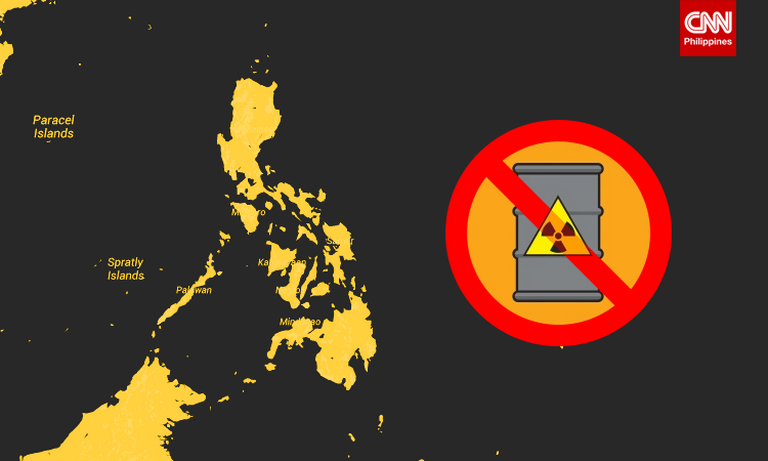


(CNN Philippines) – Members of the House belonging to the Makabayan bloc want stricter toxic and hazardous wastes law in the country with this message in mind: The Philippines is not other countries’ garbage can.
“Our laws are good and well intentioned but we have problems in implementation,” Rep. Luz Ilagan of Gabriela Women’s Party (GWP) said Monday (April 13).
Ilagan along with fellow GWP Rep. Emmi De Jesus and Carlos Zarate of Bayan Muna — all from the progressive Makabayan bloc — filed House Bill 5578 which seeks to amend the Toxic Substances and Hazardous and Nuclear Wastes Control Act of 1990 (RA 6969).
The amendments include the shipping of toxic military wastes out of the country and higher penalties, a media release posted on the House of Representatives’ site said Sunday (April 12).
“As provided under the bill, any nuclear or military waste produced while based in the country shall be shipped out to the homeland of the foreign military force,” it explained.
Violations on Section 13 of the RA 6969 which deals with prohibited acts will also be raised from the previous range of P600 to P4,000 to P5,000 to P15,000.
The administrative fine that the Department of Environment and Natural Resources (DENR) can impose will also be increased to a fine of not less than P15,000 but not more than P75,000.
Ilagan argued that the amendments seek to improve an “antiquated law.”
He called P4,000 as “a measly sum” that could encourage a “culture of impunity.”
“They can go on and continue the violation,” she said.
Importation of garbage
Imported cargoes from Canada got attention in 2014 after a Change.org petition brought up how 50 40-foot container vans left at the Manila Port since 2013 has “garbage juice” already leaking and posing a health hazard.
DENR, however, later declared the household garbage inside the cargoes as nontoxic.
Declaring it as not hazardous was the decision of the interagency committee created to deal with the issue, engineer Gerry Sañez, head of the Hazardous Waste Management Section of the DENR-Environmental Management Bureau, said.
The interagency committee is composed of the DENR, Department of Foreign Affairs, and the Bureau of Customs.
Sañez added that even though not hazardous, the importation of the cargoes is against Annex II of the Basel Convention which deals with household wastes.
It was a case of misinformation on the part of the importer, he explained.
“[The importer] declared it as plastic for recycling,” Sañez said. But upon inspection the DENR found that the cargoes contained household waste.
Right now, he said that resolving the issue involves diplomatic talks. But if the cargo could not be shipped back to Canada, DENR is looking at disposing the garbage in the country as another option.
‘Other cases’
This is not the first case of misdeclaring imported cargoes that contain garbage from other countries, according to Sañez.
Ilagan pointed that other countries get away with sending waste-containing cargoes to the Philippines by taking advantage of the corruption in the country.
Related: Survey: Customs tops list of most corrupt Philippine agencies