Visual artist Jao San Pedro seems so fascinated with the sun lately, so much so that the titles of her most recent works both allude to it.
“Longing for the Sun to Set Upwards” is a film she made late last year using a filter that reads bodies in contrast to space, giving off an infrared-like look. Screened at the Queer East Festival in London last April, the film is described as “an ode to the multiplicity, mutability, and expansion of what constitutes a body, a self, through imaging and technological mediations.”
Then, there’s her current solo exhibition at Tarzeer Pictures: “Willing the Sun to Rise Twice.” Similar to “Longing for the Sun to Set Upwards” and her solo exhibition last year titled “Misnomer,” San Pedro uses artificial intelligence to generate sound and images based on her first love’s last voice message.
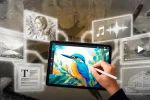
San Pedro’s process for this exhibit is best represented by a diagram because of its causal nature. “Each of the work here won’t exist without the previous one. It’s a line, it’s a map, it’s a diagram because I want him to be abstracted or dissolved as it courses through the diagram while my control over the processes also dissipates,” San Pedro says.
The artist first feeds the raw voice message to the machine to create the voice clone. Its transcript is then extracted to generate the semantic fingerprint for the installation “Dial.” This is then used to generate 100 portraits. These images then become the basis for both “Portal 1: Lover” through frame interpolation and “Portal 2: Machine” through image sonification.
‘111’: ‘image’: ‘jcr:a7fd1b8c-7d18-41af-b19c-ae1f37bd15a1’ ‘imageCaption’: ‘An installation view of “Willing the Sun to Rise Twice.” Photo

Aside from the semantic fingerprint installation called “Dial,” there is nothing visually sunny about “Willing the Sun to Rise Twice.” With the amount of alterations, translations, and generations the material — a human remnant — went through, it is expected to see works that almost feel devoid of humanness. Something is lost on each stage both from the source material and from the artist herself until what is left are pixels infinitely rearranging themselves into abstractions. And yet, there is inexplicable warmth.
In “Portrait of a Lover,” the portraits all look human with seemingly Caucasian descent, but are somehow not human enough. Some of the faces seem ghostly. Some are blurred. Some are melting. Some are even absent. But the longer I stare, I see a glimmer of nuanced expression. The pensive boy on the column, in all his pixels, may be capable of affection.
“Portal 2: Machine” presents forms and fragments morphing from one abstraction to another. Then, in a split second, what I see feels like a vague memory of a room on a Sunday afternoon.
The voice clone sounds mechanical and cold. But as I listen closely to the words it recites, I hear forlorn expressions. “There was something real and beautiful. It’s time to let it go,” the voice says. A machine laments the loss San Pedro experienced and at the same time its inability to generate feelings. “I can never truly replicate love or desire,” it says.
Although mere fractions, it is in these moments that I find the warmth that illuminates the whole.
“Willing the Sun to Rise Twice” evokes a lot of contradictions that subvert the very notion of contradictions. Warm feelings emerging from cold tools. Human vulnerability spoken by a machine. Loss being transformative and generative.
In this interview, San Pedro details her process, materials, and hopes.
“Longing for the Sun to Set Upwards” and “Willing the Sun to Rise Twice” both have the word ‘sun’ in their titles. What is it with the sun?
When I proposed to Tarzeer, it was meant to be a film again. We were meant to make another film titled “Willing the Sun to Rise Twice.” The initial idea was to use the voice clone of an ex-lover to narrate instead of my voice clone. They were meant to be in conversation with each other. Nearing the exhibition, like two to three months before, I felt like I could do much more.
What made me think of this were clementines or kiat-kiat. There’s a work by Felix Gonzalez-Torres called “candy works” where he creates a mound of candies in the weight equal to his lover. People are meant to take from the pile until it disappears.
‘ ‘112’: ‘contentWidth’: ‘100%’ ’embedCode’: ‘
When my partner and I split up, every time I peel[ed] a clementine, I felt like I was summoning him. I was toying with the idea of anything orange or anything citrus-smelling or anything remotely resembling a piece of kiat-kiat could summon him in. I’m staying at La Union and [the] sunsets are orange. And I was like, what if I could reconstitute him through visions?
In a lot of ways, “Willing the Sun to Rise Twice” is like peeling something over and over until I summon something. Initially, the idea was to summon him but as I course through actually peeling metaphorically, I actually summoned myself.
That was what the film was going to be — me just peeling clementines in reference to Felix Gonzalez-Torres work. But it changed a lot.
A lot of my recent spiritual [practice] has a lot to do with the sun too, so it’s been a constant imagery in my life. I pulled cards the other day and it’s the sun again. It always circles back to the sun. I used to hate it until I lived here in La Union.
You moved to La Union because of Emerging Islands, right?
Partly. I technically never really moved. I just lived here for a long time.
My last show prior to \”Willing the Sun to Rise Twice\” was May of last year. I took a pause due to an amount of reasons, but I really needed to recuperate and reevaluate where I wanted to go with my practice. When I came here, I decided not to do anything. My motivation to be here was really to recenter.
\”Longing for the Sun to Set Upwards\” was actually an accident. It wasn’t meant to be a thing. I was just playing around with my phone. It was December of last year and it was my birthday. I just wanted to show it to my friends. We made a mini exhibit here and people came. For some reason, it reached someone from London. They offered a space at the Barbican to screen it. It was kind of a pull to make again.
A lot more residents came here. Kristone Capistrano and Aaron Kaiser Garcia were here with me at that time. Both of them got me running again. The project we made was called “Transmutation.” I wanted it to be a collage of moments that aren’t really visible but are represented through material.
I designed a score that only Aaron, a movement artist, will hear at that exact moment. I played it once and then he moved to the score. Kristone witnessed the moment and drew it as Aaron moved. Kristone was the only person who ever witnessed Aaron move. The drawings are artifacts of that moment. These are the datasets for other people to process.
When I came here, I really hibernated for a while before moving again. It kind of unleashed this whole thing.
How did living in La Union change your approach to art?
My approach shifted in a way that is no longer as controlled as before. Before, I would think it through. I would not start a work until it’s finished in my head. But now, I make as I go and I diagram as I go. Instead of it having a finished answer already as I’m making — which I think stunted a lot of the things I was making before — now I give myself some room to experiment or to fail and see how it all constellates in the end. Instead of moving through a line, I now kind of operate in a constellation, just letting things fall into place and make sense of itself rather than having a definitive answer.
When I first met you, you were making art out of tangible things like cutouts for collages and textile. But I noticed that you’ve grown out of that. For example, in Carlos Quijon Jr.’s “Synthetic Condition,” you worked with dancers and choreographers. Now, you’re working with technology. When did you realize that you can use technology for your art?
I built that work, “A Fold in the Horizon,” during my artistic residency for Art Fair Philippines. That work was seeing how different people process data. We kind of treated the bodies as machines, seeing where one could bring and transform that unit or dataset as well as finding the commonalities within that transformation as well. I worked with five different movement artists. I designed a text prompt and elements that they have to contend with while performing — music, atmosphere, costume. I treated it as a science experiment. All my collaborators had some sort of blinders on. They didn’t really know what was happening. That specific work was designed for people to not be able to prepare for the moment and seeing them process it for the first time and then recording it. That was my first foray into seeing the body as machine.
\”A Fold in the Horizon\” was built in 2021 but it was only shown last year. My second solo exhibition was in May of last year. I then wanted to flip the script. What will happen if I feed my body to machines? I think earlier on my work has always been about the body. My collages were. When I shifted to textile, I wanted to see how a material succumbs to form. I wanted the body to be a machine that processes the material. And then, the next step was the body as the data being processed by the machine. It’s all in conversation with each other. So I think it’s a natural course for me to explore technologies.
I like playing around and not being stuck with one medium. I like shifting gears whenever I feel like I’m stuck.
Moving forward, I’m transforming humans into tangible material. I’m working on paintings using hair for my next solo exhibition. It’s the process I’m doing now: taking from the body and then breaking it down until I can paint with it.
So, anything can be material in your practice?
What I’m exploring now is actually generating from nothing. For example, I generated a piece of a “mountain” for Columbia’s Institute of Ideas and Imagination. I took a photo of an excavation site in La Union. From that image, I extracted a pixel. And then, I upscaled that pixel and ran it through multiple generators until I was able to make a 3D render of an object.
I have so much fascination now with either breaking down to generate or generating from absolutely nothing. It speaks to my experiences as a trans woman having to work with crumbs basically. Ultimately, I can make up for the things or the spaces that I don’t have access to through creativity and imagination using those losses as a way to shape rather than a sign to give up.
‘113’: ‘image’: ‘jcr:4cd96a26-cd7c-4464-b391-7e3efd505f8b’ ‘imageCaption’: ‘In her latest exhibit, San Pedro uses artificial intelligence to generate sound and images based on her first love’s last voice message.
In “Willing the Sun to Rise Twice,” the voice of your ex-lover is your source material. How did the idea arrive to you?
I think my practice has been about using myself as material, and I feel like now I’m venturing off to human materialization as a practice. As mentioned earlier, I’m expanding to using other people as datasets.
The idea for this exhibition came about early last year while I was working on my second solo exhibition titled \”Misnomer.\” In that exhibition, I used myself as a dataset. That was the first time I used voice cloning as a tool to make art. At the time, I was thinking of cloning the voice of a lover. That was just the initial idea that I had. But also, I kept it in the back of my mind for a while.
The premise of the exhibition was to only use 25 seconds worth of voice messaging that amounts to four sentences. The voice cloning AI needs at least 30 minutes worth of training data for it to be able to recreate a voice. I didn’t have that much, so what I did was to loop the initial 25-second clip into 30 minutes and that’s what I fed to the AI to confuse it.
Initially, I wasn’t going to ask for permission. But it needed a verbal contract for him to say \”I am so and so, and I am giving the rights over my voice to Jao for cloning.\” If I feed the AI our conversation, for example, and I’m the only one who has the voice contract, it’s going to filter out your voice. It only reads based on the fingerprint that is fed into it. You can’t actually clone anyone else’s voice without their consent, which is fair. For me, what was interesting was having to communicate that with someone who does not fully grasp what I do and also the technology in which I’m using his voice.
I started talking to him and explained to him what I was doing. I even asked him if I could use his actual voice message in the exhibition, but that’s the only thing that he was kind of averse to. I ended up not having his actual voice at the exhibition, which in hindsight also fulfills the exhibition even more because he is no longer within the scope of the show.
I’m curious. Did you prompt the machine to make faces?
The visual language of that generator used semantic fingerprints. The text that I fed it was basically “portrait of blank” — the name of my ex-lover. I ran it over and over until it generated faces.
In the beginning, I was actually failing to make a face. It only gave me a bunch of prints. I was also ready to exhibit that. But as I played with the generator, it started giving me faces. I really love how some faces fail, some faces warped, and some faces are more realistic than others.
‘114’: ‘image’: ‘jcr:db655554-6ed8-42ec-a8a6-551e0b01949f’ ‘imageCaption’: ‘”I think my practice has been about using myself as material, and I feel like now I’m venturing off to human materialization as a practice,
Did you have a look in mind of what the tool should come up with?
To me, I just wanted the grid to be ever present. A lot of the visual languages that I used were of a grid, so everything that came out were grids also. I think that’s where the control is, because I wanted it to allude to previous works. Within that regard, visually I had control because I used my own datasets for these things.
I trained these generators with datasets that come from me and then fed it back to itself. For the second stage onwards, I’m feeding the machine itself. From the initial input of the voice and then it becoming a clone and then it giving me a transcript and then feeding it to the text generators and then extracting from those text generators, I used the machine as a dataset for itself and then over and over until it’s confused. I think that’s why I also don’t contend with those fears because I’m kind of tricking the thing. I’m stretching the ways in which it is used or is supposed to be used. Most of the work relied on the machine’s failing to then generate actual work that speaks what I want to say. If anything, all the things that you see are technically errors. They’re not what is expected of artificial intelligence generation now. My generating is degenerating.
What was your goal when you embarked on the creation of this exhibition?
I intended to use technology as a language of loss, letting the technology [make him] disappear and then stretch him into many different forms. I was seeking a way to speak loss like no other. To me, artificial intelligence is the perfect language to speak loss. It’s devoid of feeling, yet it’s really entwined with our histories. I used it as a tool to speak what I feel. I don’t think I can recreate this exhibition with any other medium. I wanted it to feel cold but also warm at the same time. For me, it was a perfect tool.
To me, as I went on making this show, it felt more like I was trying to make an image of myself instead of his. Funnily enough, my previous exhibition was of self-portraiture, but I feel like this one is more me.
“I was kind of desperate to see the generative potentials of loss. As a woman of trans experience, the world was built with its back against me. I’m continually losing. Within that loss, I am holding on to hope that losing can mean something generative or transformative because I’m going to forever lose.”
I was kind of desperate to see the generative potentials of loss. As a woman of trans experience, the world was built with its back against me. I’m continually losing. Within that loss, I am holding on to hope that losing can mean something generative or transformative because I’m going to forever lose. And that’s not a sad thing to me. I know that it’s something that I will have to contend with and I’m not sad about it. It’s just a fact of my life that it’s something that I have to contend with, maybe not my whole life but, for a while. It’s less about him but more of how losing him or just losing anyone or losing opportunities or losing access to spaces, even with legislature built against women like me, I can make worlds, I can build portals, I can build work that mirrors not only my experience but everyone else’s. It’s what my body of work is about — stretching myself and now lending that language or that ability to anyone who is willing to do it with me.
What have you learned while tackling loss and negotiation in your work?
A recent realization of mine is that a lot has been taken away from me, but also, I’m a portal. I don’t actually lose anything. No one can touch me. I feel like that’s how I move in the world now. Pain is to be expected, violence is to be expected, trauma is to be expected. But for me, it’s like I worked my way into finding an immovable center — the center that is generative while also giving way to degeneration because I am constantly losing.
When I speak of losing, I am not a victim to anything. I’m never going to let myself be. If anything, my practice is my way to process my loss and turn it into something beautiful. I hope to still surface hope with all of it, because that’s what I’m going to need for me to live fully — hope and constant reassurance turning the bad into something beautiful that people can see themselves in too.
We all need hope.
It’s the only thing that I have.
And what are you hoping for?
As pointed as my works or as precise as they are, I still hope to create softer and softer works.
I wish to perpetually soften. I want to dissolve or dissipate but not disappear. I hope to course through my life and other people’s and be one with them. I hope to never box myself into anything. I just want to revel in the possibility of transformation and softening.
A friend spoke with me about this once and it stuck with me. I forgot the name of the person she was referencing but it was somewhere along the lines of becoming love itself. That no matter the heartbreak, you have to have an immovable center and become love itself. As cheesy as that sounds, I feel like the hope is that I just course through my life as soft and as loving and as hopeful as possible. I just want to soften.