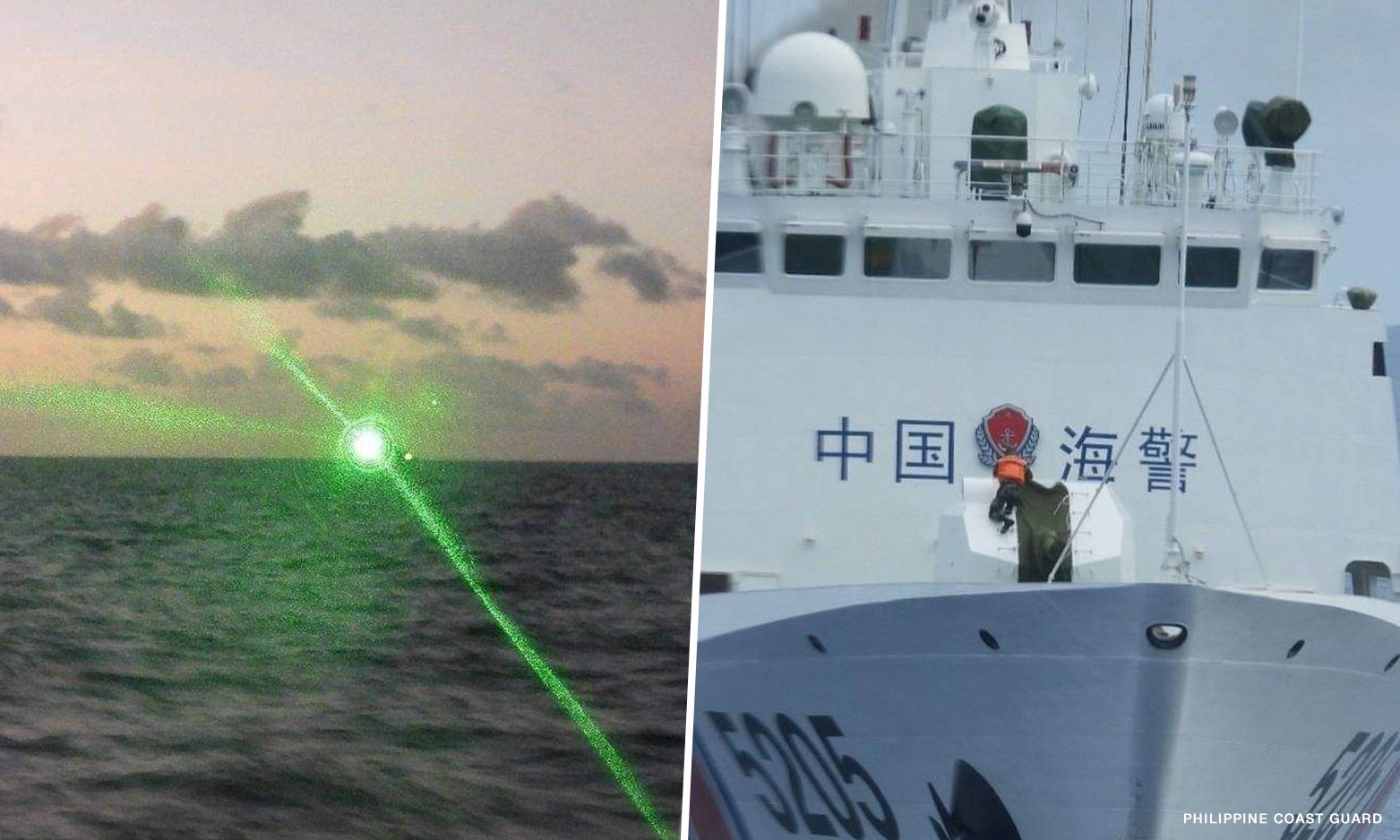


Metro Manila (CNN Philippines, February 15) — Experts on Wednesday suggested steps the government can take as China becomes more aggressive in asserting its claims in the West Philippine Sea, including lowering the level of diplomatic ties and conducting joint patrols with allies.
Last week, the Philippine Coast Guard (PCG) reported that its Chinese counterpart aimed military-grade lasers at Filipino crew members aboard BRP Malapascua. The incident disrupted the resupply mission to the BRP Sierra Madre in Ayungin Shoal and prompted the Department of Foreign Affairs to file another diplomatic protest.
But China’s Foreign Ministry spokesperson Wang Wenbin said it was the Philippines that was intruding in Chinese waters. The Chinese Coast Guard (CCG) only “upheld China’s sovereignty and maritime order,” Wenbin claimed, calling the act “professional and restrained.”
Beijing insisted that Ayungin Shoal in the West Philippine Sea is part of China’s Nansha Islands, refusing to acknowledge the 2016 arbitral ruling in The Hague, which concluded that China has no legal basis to claim historic rights to the bulk of the South China Sea. The tribunal also declared that Ayungin Shoal is part of the exclusive economic zone and continental shelf of the Philippines.
Following the Feb. 6 incident, former National Security adviser Clarita Carlos told CNN Philippines’ The Source that it was time for the Philippines “to shift gear,\” emphasizing that the country should stop being humble and to \”go on the offensive.\” [link story]
Prior to leaving her post, Carlos said she advised the PCG to make public the CCG’s aggressive actions. This includes an incident where a Chinese crew member removed the cover of their guns as a Philippine vessel was on a resupply mission in Ayungin.
Carlos said she also submitted a memo to President Ferdinand Marcos Jr. about options that the government can consider to address China’s actions, which includes lowering the level of diplomatic relations.
“We have done that before,\” she said. \”Remember our conflict with Malaysia on Sabah? We broke up diplomatic relations. We’ve done it before, we can do it again.”
The Philippines should also continue conducting joint maritime patrols with allies, she also said.
Carlos added that joint patrols with China in disputed waters can also be done for maritime piracy prevention as well as humanitarian assistance and disaster response.
Meanwhile, the seven artificial islands built by China in the South China Sea should be transformed into research stations.
“I want our marine scientists in UP [University of the Philippines] and elsewhere in the Philippines to be at the front line kasi ang mga (because our) marine scientists will treat the… contested East and South China Sea as one ecology,” she noted.
“I-declare nating (Let us declare this) heritage of mankind the whole contested sea,” she added.
For national security expert Rommel Banlaoi, the Philippines and China have two major issues — their differing national narratives and the sending of mixed signals — creating different behavior on the ground.
“We need to sustain dialogue and communications and consultations,” Banlaoi said, noting that there are already existing platforms, like the Bilateral Consultative Mechanism in the South China Sea, that both parties can utilize to find a common ground and identify where they can work together.