Editor’s note: Celeste Lapida (they/she) is a filmmaker and drag performer. They are a resident artist and community organizer of Elephant Party.
***
Most of my childhood summers were spent with my mom’s family in a small town in Nasugbu, Batangas. Barangay Calayo shares the same coast as premium resorts like Hamilo and Pico de Loro. For a time, I considered myself a local and indulged myself with gossip on which nearby islands belonged to rich legislators.
I would spend my afternoons playing with friends or walking around by myself. Once, I had wandered into an empty school, entranced by the sounds of women chanting from a house nearby. This was my first encounter with a pabasa. I caught a glimpse of women gathered in their yard, sitting on monobloc chairs. They sang a song about the life, death, and the resurrection of Christ. It was peaceful, maybe creepy to some, but the memory of their praises were as refreshing as the breeze that blew that afternoon.
On summer breaks I spent with my dad, we would stay with family friends in Pola, Mindoro or in Liliw, Laguna. In both towns, I witnessed the bloody penitensya performed by local men, where people would flood the streets during Holy Week to watch devotees reenact the Passion of Christ. I wasn’t afraid to look as chunks of flesh and blood fell from their backs to to the ground as they flayed themselves. I thought all of this was normal. We were taught of Christ’s suffering in school, as every pillar at your local church would depict this.
These groups of men were just one part of a long procession in which young men carry statues of Christ and Mary, women and children pray out loud, and groups of men wearing thorn crowns lag behind, whipping themselves. There were a number of instances, though, when I saw something peculiar: a man doing penance by himself in a much smaller, less relevant street.
‘ ’54’: ‘image’: ‘jcr:c6196a12-aafa-4f50-967d-527e5c981f3e’ ‘imageCaption’: ‘A devotee at Pampanga’s ‘Maleldo’ Lenten rites. File photo

Who is allowed to pray?
Penitensya occupies a large corner of our spiritual practice, not only as a form of praise but of spectacle (there are some reports of crucifixions taking place in cockfighting pits in Manila, a site of entertainment for many). Over the years, the practice had evolved to put a greater focus on the brutality of Christ’s suffering, especially in urban locales.
The penitents, usually able-bodied men, endure great physical pain in the hopes of spiritual and physical healing. In Barangay Kapitangan, Bulacan, even women volunteered to be crucified, like during the town’s very first Senakulo. According to residents, an 18-year-old woman saw the Santo Kristo in a vision and was compelled to volunteer. She was sick around that time, so the patron saint of healing offered a glimpse of hope.
Faith practices in the Philippines are described as “popular religiosity,” a combination of folk traditions mixed together with Catholicism. To Filipino Catholics, performance is part and parcel of our religion. We create these pockets of time. Holy Week, as much as it follows how we count our days (Maundy Thursday, Good Friday, Black Saturday, and so on), blurs the distinction of time for the rituals performed: a pabasa at dawn, a prusisyon at night. All of this seems otherworldly; definitely not part of the mundane. As a queer person, I’d like to think that I observed these rituals the same way any religious person would. That the depiction of Christ, both of Himself and His life, has always been performed with pain and fortitude. The act of suffering through time.
“Christ is depicted as someone patient in His suffering, while queer people, in moments of joy and community, desire to delay that moment’s end.”
There is a reason queer culture tends to gravitate to the nightlife scene. At odds with societal institutions such as the patriarchy, academe, and The Church, subculture revels in the fringes. We find ways to exist at night. In raves, gay clubs, establishments against the establishment. In this context, time, a measure of daily progress, is no longer valued this way. Time simply passes until the morning comes. Clubbing and drag performances — both culturally intertwined with the night — are situations where we realize safer spaces, or places of free SOGIE and coexistence. Here, out of movement and enjoyment, we tend to blur our own perception of quotidian measurement and desire to endure, to stick around a little longer. In that way, to also suspend time as we know it.
Christ is depicted as someone patient in His suffering, while queer people, in moments of joy and community, desire to delay that moment’s end. This fortitude, found in Christ and queer culture, is a time (minutes, hours, or any endured duration) of no anger. Christ knows no anger, and queerness desires for moments without such.
The persecution of Pura Luka Vega
On Saturday, June 24, 2023, Elephant Party held their annual Pride party not unlike any other night, except, well, it’s Pride! The most important Gay Event only closely followed by Halloween. There was a palpable feeling of excitement in the air. Strangers greeted each other at the door, which was brimming with folks from all walks of life. We danced the hours away. Just before the drag show at midnight, people stood up on the speaker stacks to get the best possible view.
Amadeus Fernando Pagente, or the drag queen known as Pura Luka Vega, didn’t need to do much to get the crowd going. A rock rendition of “Ama Namin” told one part of the story; the red and gold robes along with their signature beard told the rest. From the outside, it’s absurd: Jesus in the room with a community shunned by the religious sector. But that’s where the genius lies — if Jesus embraced those who were considered social outcasts, maybe it isn’t surprising at all. Phone flashlights flooded the room in admiration, the song drowned out by genuine cheers of joy.
READ: Drag queen: ‘Ama namin’ performance meant to challenge notions of praise and worship
Thousands of reposts later, and the now-infamous clip of Pura Luka Vega’s performance has left the masses divided on how we may, or may not, use religious iconography in art. The clip earned her a ‘persona non grata’ status in at least 17 different provinces, cities, and towns. The grounds? A violation of Article 201 of the Revised Penal Code for offensive acts “towards any race or religion.”
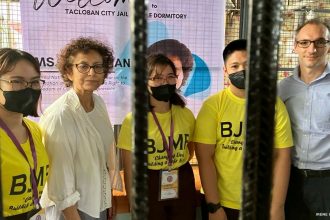
On Wednesday, Aug. 4, 2023, Pagente was arrested by Manila Police District operatives for failing to appear at their second court date for a complaint filed by the Hijos del Nazareno. According to Pagente, they didn’t receive a subpoena for the first date. The drag artist was detained for three nights and three days at the Santa Cruz Police Station. A number of their “Drag Den” co-contestants, production team, and fellow performers from the scene including “Drag Den” winner Naia Black and showrunner Rod Singh showed their support by visiting Pagente’s cell and crowdsourcing funds to cover the ₱72,000 required to post bail. Just a little over two days later, Singh announced that over ₱500,000 had been raised, and Pagente’s mother was able to fly to Manila from Dipolog.
On Sunday, Oct. 8, 2023, Black had put together a benefit drag show for Pura Luka Vega in Brooklyn Warehouse, Quiapo; fittingly titled “NKKLK.” The star-studded lineup including Precious Paula Nicole, Lady Gagita, and Maria Christina brought in hundreds of attendees showing their love and support for the artist, who had only been released from jail the night before. At the end of the night, Pura Luka Vega closed out the show with a surprise performance — a lip sync of Andrea Bocelli and Celine Dion’s “The Prayer.”
No longer sporting Nazarene maroon, Luka came to the stage as herself, swapping out her brown wig for a red bob more true to Pagente’s personality outside her drag persona. Two golden mirrors glimmered in the stage lights, mounted on both sides of her face. We got to see the real Luka, now reunited onstage with her mother.
Coming out spiritual
Most Filipinos are raised Catholic, and private schools are usually sectarian, teaching Jesuit or Dominican instruction, among others. Growing up, I could name parts of the Church or have segments of the mass and other prayers memorized.
How is religion different from spirituality? “Spirituality is not what we do to satisfy requirements of a religion,” writes Sister Joan Chittisier in the book “Called to Question: A Spiritual Memoir.” “…[I]t is the way we come into contact with the Holy. However we do it, whatever form or shape it takes — the mantra of devotions, the rhythms of nature, the faces of the other, the mysterious nothingness of deep meditation–spirituality makes real what religion talks about.”
Religion provided me structure: The Angelus at noon or three Hail Marys to wash away sins. From this rigor, I came out spiritual — still praying when I’m thankful or doubtful. I thanked God looking into the eyes of my partner. I stayed in silence when I lost my dad.
So, how would a queer person, given religious dogma, come into contact with the Holy?
In retrospect, Luka’s Elephant performance felt like a blur, but in my memory it remains as clear as day. I remember shaking out of excitement for what was happening before my eyes, as it went by so quickly. Her performance didn’t feel like any of the numbers that night: queer anthem lip syncs celebrating our identity or slow and sensual burlesque numbers. Something in the air felt different. To see Jesus Christ performed with joy is an embodiment of spirituality, and we were all reacting to a familiar figure who, for that moment, was no longer in anguish or pain, and there were clear reasons to celebrate that day. I wanted to stay longer where I felt safe.
‘ ’45’: ‘contentWidth’: ‘100%’ ’embedCode’: ‘
PURA LUKA VEGA WITH THEIR MOM PERFORMING THE PRAYER. #DragIsArt #DragIsNotACrime #AcquitPuraLukaVega pic.twitter.com/UIhFkr0FYF
— Noelle Capili-Ruiz (@MxNoelle) October 8, 2023