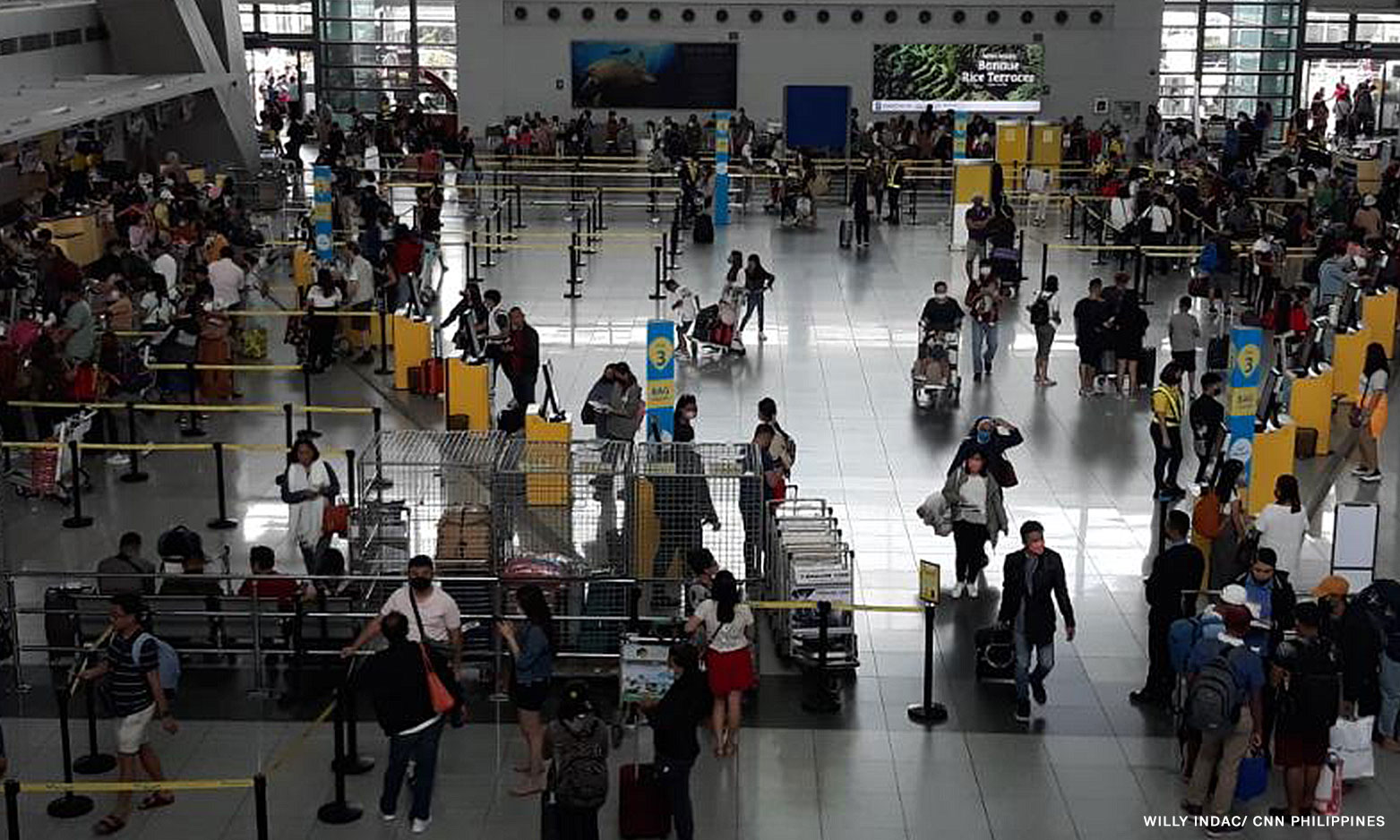


Metro Manila (CNN Philippines, January 3) — The Manila International Airport Authority (MIAA) said Tuesday it is expecting operations at the Ninoy Aquino International Airport (NAIA) to return to normal by Jan. 4 or 5 after the New Year’s Day technical glitch that canceled hundreds of flights and affected some 65,000 passengers.
“We expect actually to normalize already by tomorrow or by Thursday. So normalizing means we will be operating our regular schedule without these extra flights of the airlines,” MIAA Assistant General Manager Bryan Co told CNN Philippines’ The Source.
\n
Due to the technical issue with power supply that affected the airport’s communication, radio, radar, and internet, Co said 414 flights were canceled on Jan. 1, and 72 on Jan. 2.
\n
“We’re on our path towards recovery and we are glad to report that as of today the terminals are not as congested, the passenger flow is very manageable,” he said about the latest situation in NAIA terminals.
\n
While no more flight cancelations are expected, passengers should remain patient as delays may still occur due to aircraft rotation issues, the official said. Airlines are still fine tuning their schedules to normalize timings, he added.
\n
Meanwhile, MIAA General Manager Cesar Chiong said the radar and communications equipment at the airport are now fully functioning.
\n
“I was just at CAAP this afternoon with the secretary. And the information that we have is that it’s 100% functioning already,” Chiong said.
\n
He added that about 755 flights were recorded and 133,000 passengers were handled as of Monday.
\n
“It’s one of the highest we had on a daily basis already,” he added.
\n
Chiong also said no cancellations of flights related to the glitch were recorded on Tuesday. He added that the only flight called off was due to bad weather.
\n
On the recovery flights, Co explained that these are mounted based on the availability of fleets of airlines.
\n
Given this, affected passengers have different options like rebooking to other flights which could be an extra section flight or an additional flight going to the same destination, rebooking on another date, refunding, or converting the booking to a travel fund.
\n
Accommodating passengers who rebooked will also depend on available extra flights, Co said. This is because passengers who originally booked on a specific date will still be prioritized, he said.
\n
The MIAA official assured the public that air traffic service is already back to normal. He said the Transportation department is on top of the situation and is already investigating the issue.
\n
Meanwhile, the Civil Aviation Authority of the Philippines (CAAP) said in a separate statement that operations have returned to normal in provincial airports affected by the Air Traffic Management Center service interruption.
\n
The airports are Bicol International Airport, Tacloban Airport, Zamboanga Airport, Pagadian Airport, Dipolog Airport, Jolo Airport, Tawi-Tawi Airport, Laguindingan Airport, Camiguin Airport, Ozamiz Airport, Dumaguete Airport, Bohol-Panglao International Airport, Puerto Princesa International Airport, Tuguegarao Airport, Cauayan Airport, Basco Airport, Iloilo International Airport, Kalibo International Airport, Bacolod-Silay Airport, Roxas Airport, Antique Airport, Butuan Airport, Siargao Airport, Surigao Airport, San Jose Airport, Romblon Airport, General Santos Airport, Cotabato Airport, and Davao International Airport.
\n
The CAAP said these airports had flights that were either canceled, delayed, or diverted due to the incident.
\n
“Recovery flights from diverted and delayed flights in these airports have been successfully dispatched to their location and mounted by the airlines on case-to-case basis,” the CAAP said. “Meanwhile, other passengers have been re-booked to other scheduled flights with the assistance of their airlines.”
\n
The agency assured the public it is working on resuming normal operations and providing assistance to affected passengers.
‘
‘
‘
‘
‘
‘
‘
‘
‘
‘
‘
‘