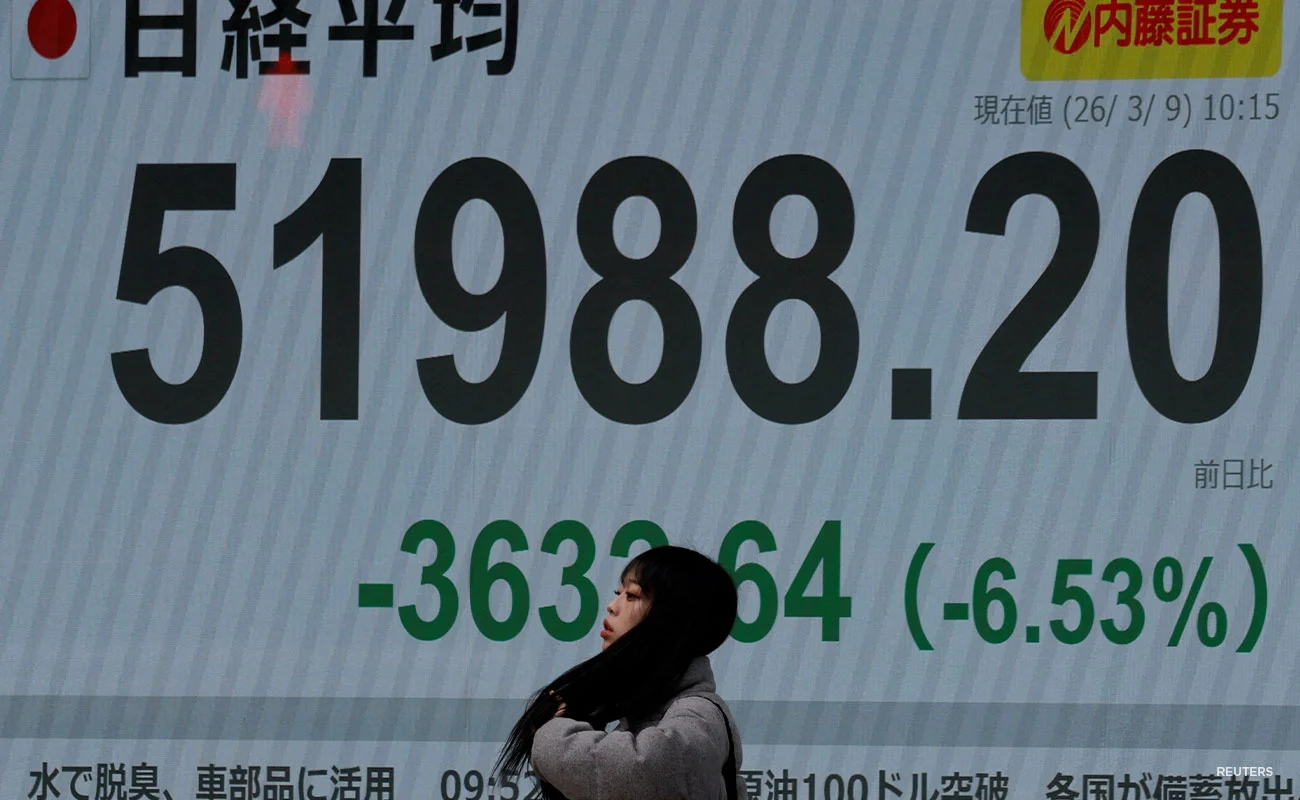


Sydney, Australia – Share markets nosedived in Asia on Monday, March 9, as the inflationary shock from surging oil prices threatened to raise living costs and perhaps interest rates across the globe, while an investor hunger for liquidity kept the US dollar in demand.
Brent soared 23% to $114.36 a barrel, the biggest daily gain since at least 1988, which came on top of a 28% rise last week. U.S. crude shot up a staggering 27% to $115.11, threatening to push petrol prices quickly skyward.
Iran named Mojtaba Khamenei to succeed his father Ali Khamenei as supreme leader, signalling that hardliners remained firmly in charge in Tehran a week into its conflict with the U.S. and Israel.
That was unlikely to be welcomed by U.S. President Donald Trump, who had declared the son “unacceptable.”
With no sign of an end to hostilities in the Middle East and tankers still not daring to cross the Strait of Hormuz, investors were bracing for a long stretch of higher energy costs.
“The global economy remains dependent on the concentrated flow of Mideast oil and natural gas through the Strait of Hormuz,” noted Bruce Kasman, chief economist at JPMorgan.
“The near-term scenario is a near-term spike towards $120 bbl followed by moderation as the conflict soon subsides,” he added. “But absent a clear and decisive political resolution, Brent crude oil prices are expected to settle at an elevated $80 bbl through mid-year.”
Such an outcome could cut global economic growth by an annualised 0.6% for the first half of this year and raise consumer prices by an annual rate of 1%, Kasman said.
He cautioned that a broader and sustained conflict could send oil well above $120 a barrel and risk a global recession.
All of this was sobering news for Japan, a major importer of oil and gas, knocking the Nikkei down 7.5% on top of a 5.5% drop last week.
South Korea’s high-flying market fell closer to earth with a drop of 8.1%, having already shed more than 10% last week.
China is another big oil importer, though it also has a huge stockpile of crude; its blue-chip index fell 2.3%.
China on Monday said inflation had already picked up in February ahead of the current oil spike, with consumer prices rising 1.3% on the year. This is not necessarily a negative development, given the country has long struggled with disinflation.
Central banks face inflation conundrum
The wave of market selling swept over Wall Street as S&P 500 futures shed 2.1%, while Nasdaq futures dived 2.5%. Over in Europe, EUROSTOXX 50 futures and DAX futures both slid 3.2%, while FTSE futures dropped 1.7%.
In bond markets, the risk of rising inflation outweighed safe-haven considerations to shove yields higher globally. Yields on 10-year Treasury notes rose 6 basis points to 4.204%, up from a trough of 3.926% just a week ago.
Interest rate futures slipped as investors feared the risk of higher inflation would make it harder for the Federal Reserve to ease policy, even though disappointing jobs numbers seemed to argue for stimulus.
Data on U.S. consumer prices due on Wednesday is forecast to show the annual pace holding at 2.4% in February.
The Fed’s preferred measure of core inflation is out on Friday and is forecast to hold at 3.0%, well above the central bank’s 2% target, and analysts see a risk of an even higher number.
The danger of energy-driven inflation has led markets to wager the next move in rates from the European Central Bank could be up, possibly as early as June.
For the Bank of England, markets have shifted to pricing just a 40% chance of one more easing, compared with two cuts or more before the Middle East conflict started.
Nervous investors sought the liquidity of dollars while shunning currencies from countries that are net energy importers, including Japan and much of Europe.
“Asia takes the brunt of the sharp escalation in oil prices and there are few places to run and hide,” said Vishnu Varathan, head of macro research for Asia ex-Japan at Mizuho.
“The dollar has to be the one outperforming, given Japan and Korea’s exposures here and the sharp pain that can be expected from Brent at $107.”
The dollar added 0.5% to 158.64 yen, while the euro slipped 0.9% to $1.1514. The Australian dollar, often sold as a hedge during periods of market volatility, skidded 0.9% to $0.6964.
Gold fell 1.8% to $5,075 an ounce, with dealers speculating that investors were having to book profits made on the metal’s long climb to cover losses elsewhere.