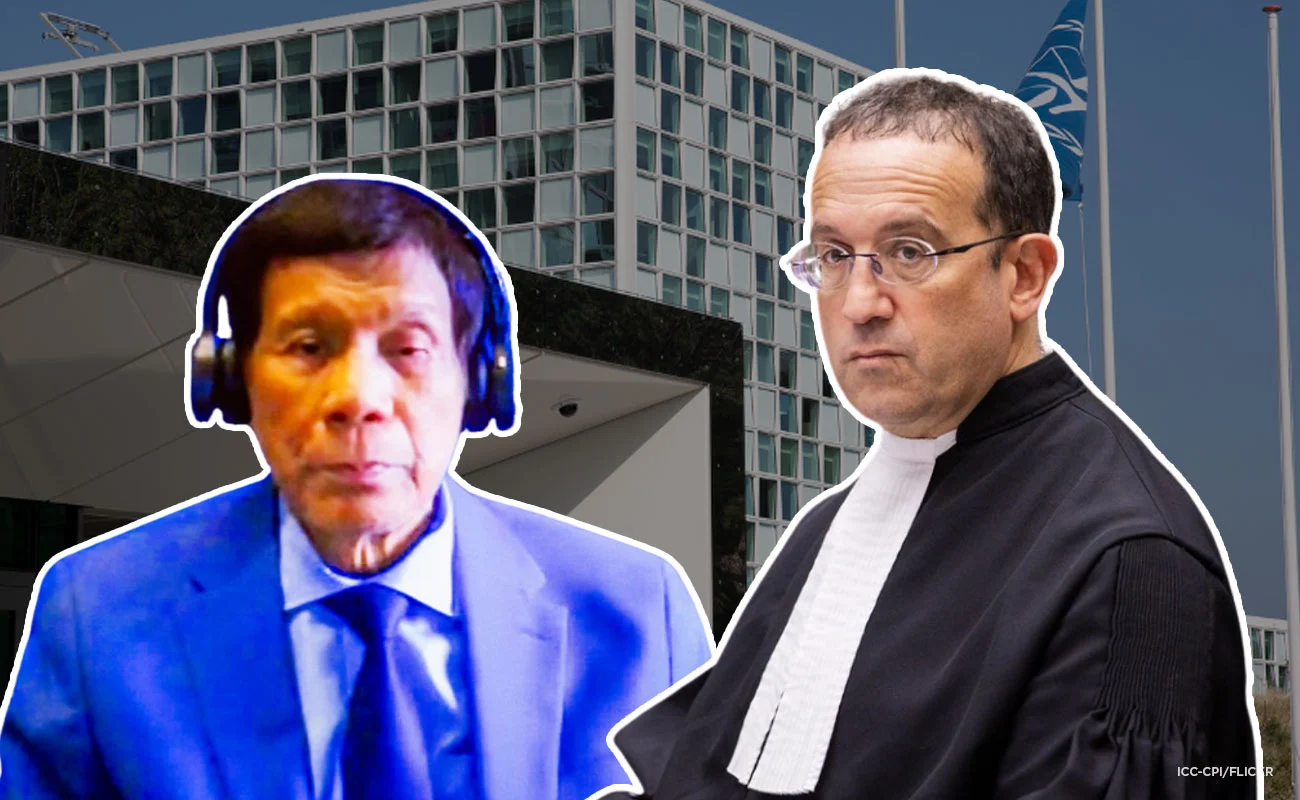


Metro Manila, Philippines – The defense team for Rodrigo Duterte said there was “no smoking gun” in drug war-related charges against the former president, telling the International Criminal Court (ICC) that the evidence was “totally inadequate” for a trial.
This was one of the major arguments in the third day of the confirmation of charges hearing on Thursday, Feb. 26, for Duterte’s crimes against humanity case.
“There is no smoking gun in this case,” British-Israeli lawyer Nicholas Kaufman said, alleging it is not written in the charges that Duterte gave a direct order to murder one of the 78 victims listed by the prosecution.
There were 49 incidents mentioned in the document containing the charges against Duterte, spanning from his mayoral period in Davao City to his presidential term.
“This, in and of itself, should be sufficient to convince any reasonable bystander observing the conduct of these proceedings that Rodrigo Duterte is innocent of these charges leveled at him,” the defense lawyer said.
The ICC prosecutors charged Duterte with three counts of murder and attempted murder in relation to the implementation of the war on drugs.
The ICC prosecution said Duterte’s individual criminal responsibility was indirect co-perpetration, ordering and/or inducing the so-called Davao Death Squad and the national network of law enforcement officers, non-police assets, and hitmen to commit the crimes, and aiding and abetting them.
“His contribution was essential as he was at the very heart of the common plan to neutralize alleged criminals in the Philippines, including through murders,” ICC deputy prosecutor Mame Mandiaye Niang said in his opening statement on Monday, Feb. 23.
But Kaufman on Thursday, Feb. 26, said that the prosecution could not show the “causal nexus” for Duterte’s criminal responsibility over the extrajudicial killings.
He also told the ICC pre-trial chamber that there is no direct evidence to indicate that even two of the alleged co-perpetrators actually met to agree to carry out the supposed killing scheme.
Kaufman said the prosecution must provide which one of Duterte’s statements, orders, or commands were given to a specific person who then went out and pulled the trigger, or communicated the command to someone else who also went out and pulled the trigger, killing one of the 78 identified victims.
“They’ve never been able to do that,” Kaufman told the ICC Pre-Trial Chamber I.
“What the learned prosecutors can’t show you is the connecting line between Duterte at the top and the next level down, comprising the so-called co-perpetrators,” he said.
Kaufman said the prosecution “resorted to papering over the cracks” of the case with human rights reports, press statements, hearsay, and Duterte’s “bluster and political hyperbole.”
Arguments on kill order, rhetoric
Kaufman also dismissed the prosecution’s argument that the word “neutralize” or “neutralization” was meant to kill under the 2016 command memorandum circular issued by then-Philippine National Police chief Ronald “Bato” dela Rosa to carry out “Project Double Barrel.”
He cited that the Supreme Court has not yet issued a ruling on the 2017 petition seeking to declare unconstitutional the circulars for the war on drugs. The high court only conducted oral arguments.
“The Supreme Court’s treatment of the issue is particularly instructive. The court observed that the wording was neither novel nor introduced during the Duterte administration,” he said.
The defense turned down the prosecution’s accusation that Duterte’s rhetoric resulted in the thousands of extrajudicial killings, as Kaufman said the speeches used by the prosecution had “exhortation to the use of lawful self-defense.”
Kaufman said the number of deaths in the course of the war on drugs was “minimal” against the number of arrests and operations conducted.
The government said around 6,000 people were killed during drug war operations but human rights groups claimed higher figures.
The defense lawyer also rejected that the alleged attack during the drug war was against the general Filipino population, saying it was only “a considerably smaller and nebulous margin of society, namely the alleged criminals themselves,” with no “clearly definable civilian population.”
Ahead of his arguments, Kaufman reminded the parties that the defense’s criticism was only confined to the prosecution’s charges.
“The defense does not disrespect the soul of any deceased person nor does it make light of the loss of life,” he said. “Any criticism made by us today will not be leveled at the loved ones of those.”
The ICC Pre-Trial Chamber I has 60 days to decide if the evidence is sufficient for the case to go to trial once the confirmation of charges hearing concludes on Friday, Feb. 27.