


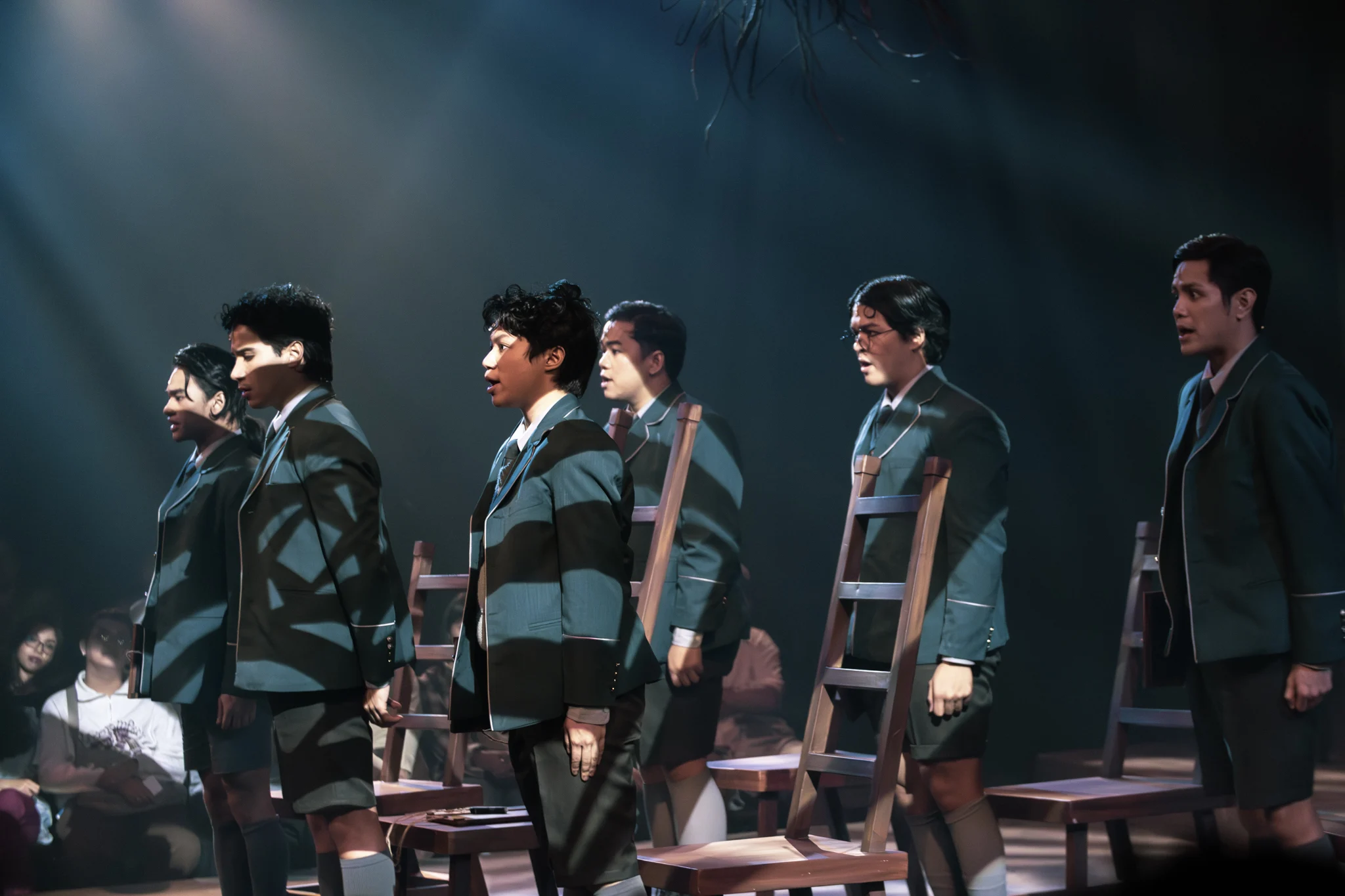
For adults, is there anything more terrifying than the mind of an adolescent? The Sandbox Collective’s Spring Awakening suggests there is: the certainty of grown-ups who think silence is protection, even when it’s clearly not.
The audience is greeted with a dark room. A cornflower blue dress hangs upon a tree, illuminated like a secret. Wendla Bergmann reaches to take her favorite dress, and her mother chastises her for choosing something “too small.” It’s a simple correction that quickly becomes a pattern. The show’s world is one where a girl can be on the edge of womanhood, and the one adult closest to her still refuses to acknowledge what’s happening, much less answer the questions underneath it.
This staging doesn’t treat the material casually. A trigger warning is necessary: the story deals directly with teen pregnancy, sexual and physical abuse, mental health issues, and self-harm. It also includes very intimate scenes, approached with clear care and control, in a way that feels intentional rather than sensational.
Director Andrei Nikolai Pamintuan keeps the tone disciplined. The staging leans into shadow, then sets it against choreography that can look almost buoyant at first glance, bright and youthful, but deliberately jarred in its rhythms and stops. That contrast creates an unsettling dichotomy: the stage feels dark and contained, while the movement suggests a kind of joy and urgency that keeps getting interrupted.
The adult world is sharply drawn, particularly through legends Audie Gemora and Ana Abad Santos. They give authority distinct personalities without turning it into caricature, which makes it feel more suffocating, not less. The adults don’t need to be villains in the theatrical sense to do damage. They simply need to be sure they’re right.
As Melchior Gabor, Nacho Tambunting plays the perfect dashing lead while still catching the nuances of a bright young man who believes knowledge can protect him. And as Wendla, Sheena Belarmino is almost unnervingly convincing in her innocence, not the cute kind, but the kind that comes from being denied language. There are moments when her voice is pitched so carefully small that you can feel the trap closing around her, and it makes what follows feel like a sick, slow inevitability.
Even with strong performances across the ensemble, two stand out a tiny bit more.
Nic Chien’s Moritz Stiefel is built scene by scene, oozing with anxiety that becomes more urgent as the pressure mounts. The line “’Cause, you know, I don’t do sadness / Not even a little bit” is haunting here, because it doesn’t read as confidence. It reads as a defense mechanism, said like it might keep him afloat if he repeats it enough.
Angelo Martinez, meanwhile, breathes life into Hänschen Rilow in a way that feels fuller than the role might be expected to be. Instead of functioning as a quick release valve between heavier beats, he gives the character a point of view and momentum, offering relief without flattening the story.
There are occasional technical hiccups, but they fade quickly because the ensemble holds the room steadily.
This production marks Sandbox’s next era, led by Sab Jose Gregorio after Toff de Venecia’s temporary step back.
And the timing is hard to ignore. When people in power describe today’s youth as “weak,” Spring Awakening doesn’t bother with a clapback. It answers by showing what adults too often mistake for weakness: kids struggling in the dark because the adults who should be guiding them keep withholding the tools they need.
So the question circles back. For adults, is there anything more terrifying than the mind of an adolescent? Maybe not. But this staging makes a strong case that what’s truly terrifying is the adult who refuses to see what is plain to see, and refuses to give young people what they deserve: knowledge, respect, and the freedom to speak clearly and be who they truly are.
Get your tickets while it’s running, and don’t treat it as “just” a night at the theater. If there’s a teen in your life, bring them (when appropriate), or at least bring the questions home. Watch it with someone you trust, talk about it after, and let the conversation be the thing the characters don’t get: honest, direct, and unafraid. The run is February 13 to March 22, 2026 at the Black Box in The Proscenium Theater.